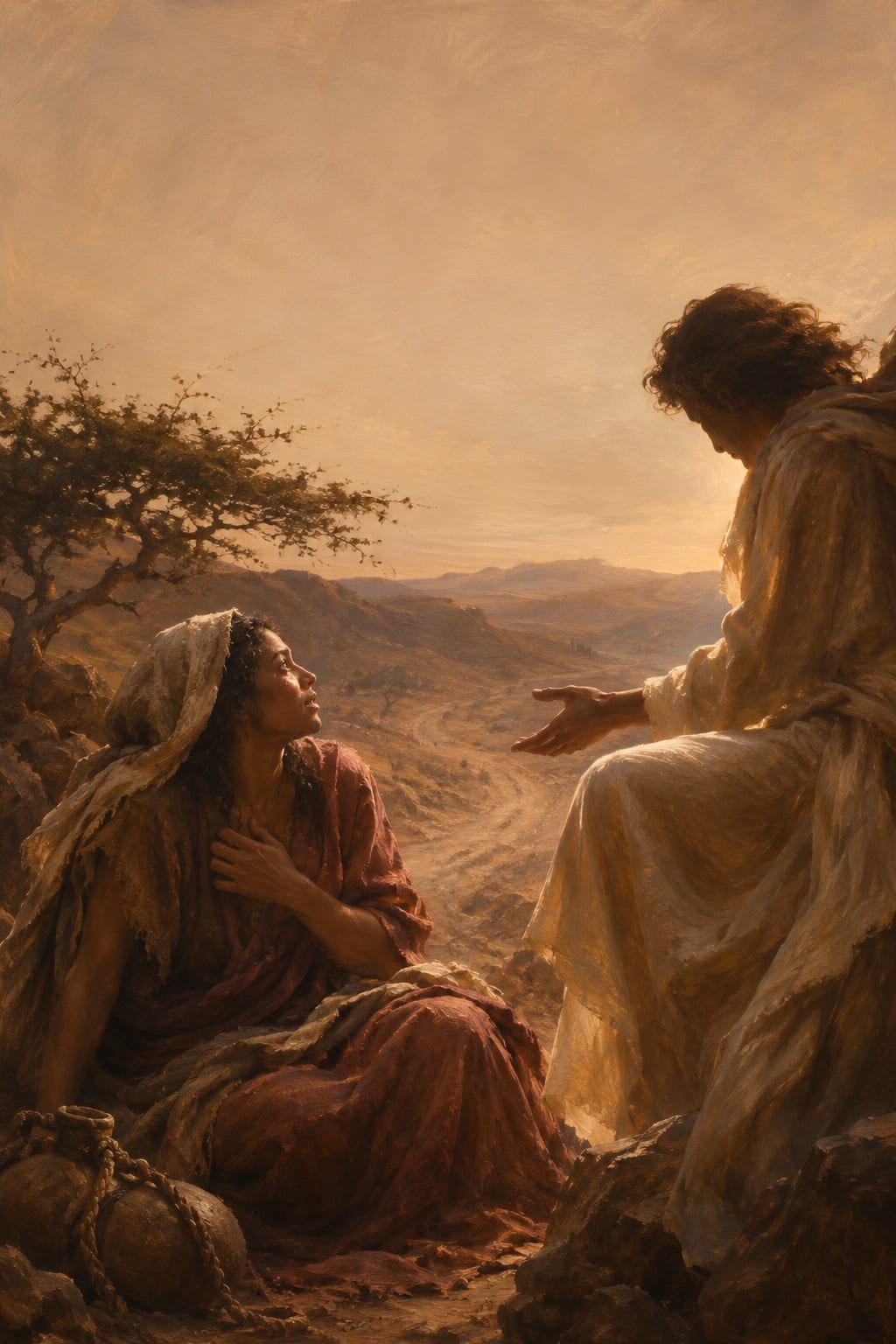
El Roi: The God Who Saw Her
Genesis 164 min
Hagar is met not at the tent, not after she has made things right, but on the road out. The God who finds her gives her a name for him no one else in scripture had given: the God who sees.
Scripture
Genesis 16
Key moment Genesis 16:13
Read
There is a wilderness in the book of Genesis with a spring in it.
Hagar is the second person in scripture to receive a promise from the Lord. The first was Abram, the patriarch. The second is a slave-girl with no power, no nation, no marriage of her own choosing. She is not Sarai's plan; she is Sarai's plan B. When she conceives, the household becomes unbearable. She runs.
The text says she sat down by a spring of water in the wilderness, the spring on the way to Shur. Shur is south, toward Egypt, the country she came from. She is running back. Whatever she had been promised in Abram's tent had broken; whatever she had hoped for had soured. She is alone with her body and a road.
The angel of the LORD found her by a spring of water in the wilderness.
-- Genesis 16:7
The verb is found. He came looking. He met her not at the tent, not after she had returned and made things right, but on the way out. The first word he says to her is her name: Hagar.
Notice what he does not do. He does not lecture her. He does not begin with you should not have run. He asks two honest questions. Where have you come from, and where are you going? He lets her say it.
Then he gives her three things. A promise about her son. A name for the boy: Ishmael, 'God hears.' And a sending back, harder than the running. The blessing is not a permission slip to keep going. It is a meeting that gives her a reason to turn around.
Hagar does something no one else in scripture does. She names God.
So she called the name of the LORD who spoke to her, 'You are a God of seeing.'
-- Genesis 16:13
The Hebrew is El Roi. The God who sees. The God who saw her, specifically, in the wilderness, on the way back to nothing, with no one else watching.
Today
Some of us have built a life around the conviction that no one is looking, or worse, that the looking would be unkind. We learned early that the things we feel are too much, too dark, too needy. We learned to run quietly. We learned to find ways to be alone with ourselves, usually with something to take the edge off.
Hagar's God did not wait for her to come home before he met her. He found her on the road out. He used her name. He listened to where she had been and where she was going.
Sometimes the moment grace finds you is not after the great repentance. It is in the middle of the next escape. You are by a spring you didn't choose. You are tired. You are not a hero. The God who finds you there is not surprised by the running. He is the one who saw what made you run.
If today's habit is I cannot face this, I will go elsewhere, let the elsewhere be a place where you let yourself be seen. Tell him where you have come from. Tell him where you are going. Let him use your name.
He has a name for you, too. It is not 'the one who failed again.' It is the one he saw.
Pause
Take a slow breath.
Sit with what you've read.
Ponder
When you run, where are you running to, and what are you running from?
Have you ever been met where you were not supposed to be? What did it feel like?
What name might God be calling you that is not the name you call yourself?
Pray
A prayer
God who sees, Hallowed is the name El Roi: the One who looks for the runaway and meets her by the spring. Let your kingdom come into the wildernesses of my life, the places I have been running to and the places I have been running from. Let your will be done on the road, not only at the tent. Give me today the bread of being seen. Forgive me for hiding from the only eyes that have always been kind. Free me from the lie that you do not know my name. Lead me back not by force but by meeting. Deliver me from the thought that I have to arrive somewhere before I am known. You are El Roi. I am Hagar at the spring. I am yours.
Amen.
Go in peace.You are seen.