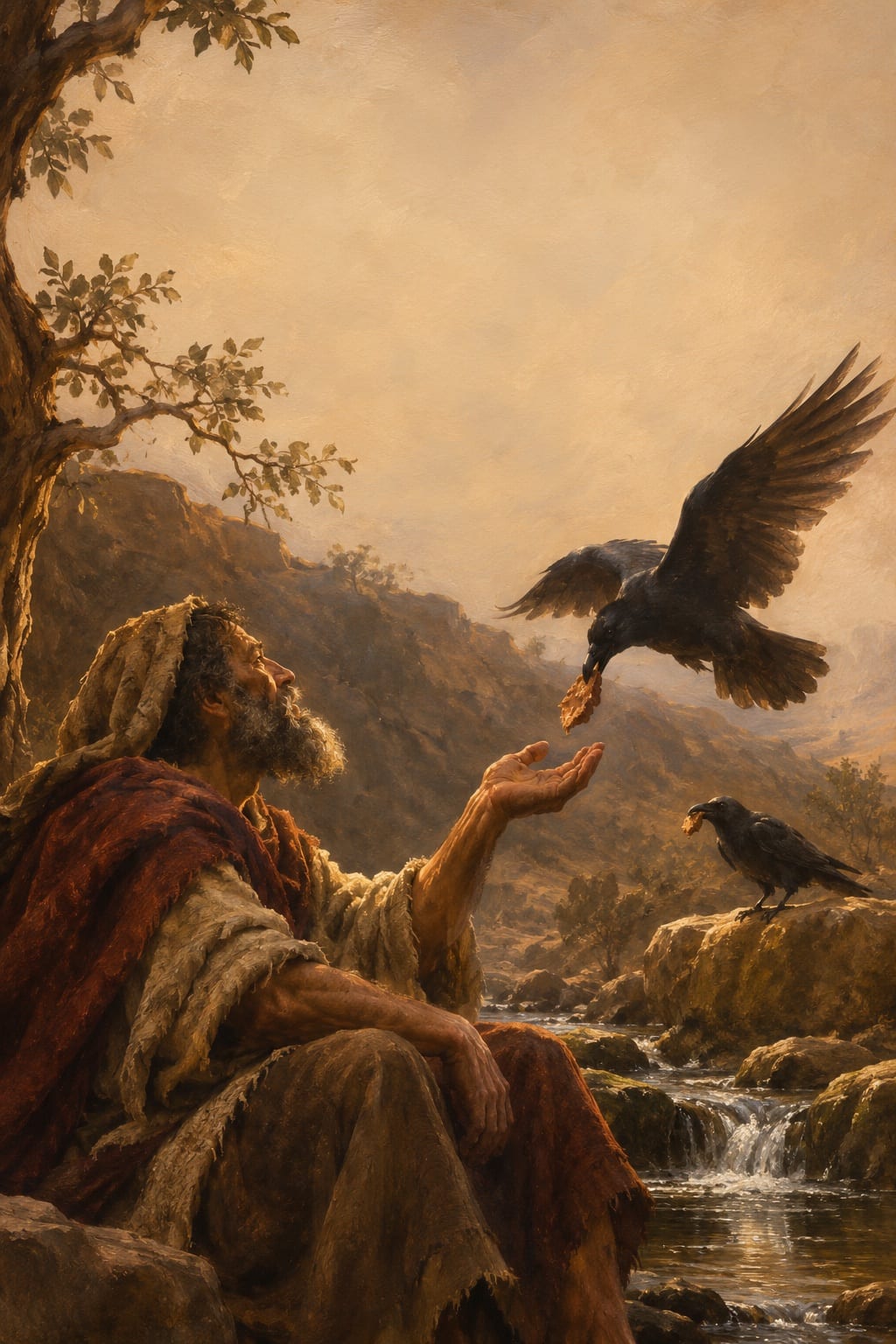
Fed by Ravens: When God Provides in the Strangest Ways
1 Kings 17:1-74 min
When God sent Elijah to hide by a brook and be fed by ravens — unclean birds no prophet would choose — He revealed that divine provision often arrives in forms we would never design for ourselves.
Scripture
1 Kings 17:1-7
Key moment 1 Kings 17:4-6
Read
Elijah had just spoken the most dangerous sentence in Israel. Standing before King Ahab, he declared that neither dew nor rain would fall except at his word. It was an act of breathtaking courage — and the very next thing God told him to do was disappear. Not advance, not build on the momentum, not rally the faithful remnant. Hide. Go east. Sit by a brook called Cherith, which itself means "cutting off."
The geography matters. God didn't send Elijah to a thriving oasis or a wealthy ally's estate. He sent him to a seasonal stream in a ravine, the kind of place that could dry up at any moment — and eventually did. The provision was equally strange: ravens brought bread and meat morning and evening. Under Levitical law, ravens were unclean birds, scavengers associated with death and desolation (Leviticus 11:15). No Israelite prophet would have drawn up this plan. God's supply arrived on dark wings, from a source that looked wrong by every religious category Elijah knew.
And yet Elijah drank from the brook. He ate what the ravens carried. Day after day, in silence, with no audience and no confirmation beyond the strange faithfulness of those birds and that water. The Hebrew word for the ravens' action, kul, means to sustain or nourish completely — the same word used for God sustaining all living things. The ravens weren't freelancing. They were instruments of a comprehensive care.
Then the brook dried up. Verse 7 is blunt about it: "After a while the brook dried up because there had been no rain in the land." God didn't prevent the loss. He let Elijah sit with an empty streambed before He spoke the next instruction. The provision had an expiration date — not because God's faithfulness did, but because that particular season of hiddenness had completed its work.
Today
Most of us resist the Cherith seasons. We want God to provide through recognizable channels: a promotion, a clear answer, a person who shows up at exactly the right time saying exactly the right thing. When instead He sends ravens — provision that looks odd, timing that feels off, help from sources we wouldn't have chosen — we question whether it's really Him at all.
But Cherith teaches us that God is not constrained by our categories of respectability. Sometimes the sustaining grace comes through the coworker you'd never befriend, the job that feels beneath you, the quiet discipline nobody notices. Sometimes it comes in solitude itself, in the stripping away of every external support until you discover that God alone is holding you together. That discovery doesn't happen on the conference stage. It happens by the brook, in the anonymous mornings, when the only evidence of God's care is that you're still here and still fed.
If you're in a Cherith season now — hidden, uncelebrated, watching resources thin — consider that God may not be punishing you or forgetting you. He may be doing the slow, interior work that only happens when the noise stops. The brook will eventually dry, and He will speak again. But what you learn about His character in the ravine will sustain you long after the next chapter begins.
Pause
Take a slow breath.
Sit with what you've read.
Ponder
What form of provision in your life right now looks nothing like what you would have chosen — and might that be God's design rather than His absence?
How has a season of solitude or hiddenness changed the way you relate to God, for better or worse?
Where are you waiting for a dried-up brook to flow again, when God might be redirecting you somewhere new?
Pray
A prayer
Father, Provider of every good thing, Your kingdom comes even to the ravines — the hidden places where no one watches and no one applauds. Your will is done even through ravens, through strange and unwelcome means I would never have requested. Forgive me for the times I've rejected Your provision because it didn't match my expectations. Forgive me for calling unclean what You have sent to sustain me. Give me today my daily bread, even if it arrives on dark wings. Teach me to receive it with open hands. And when the brook dries, give me ears to hear Your next word rather than clinging to the last one.
Amen.
He feeds you still.Even here, even now — the Provider has not looked away.