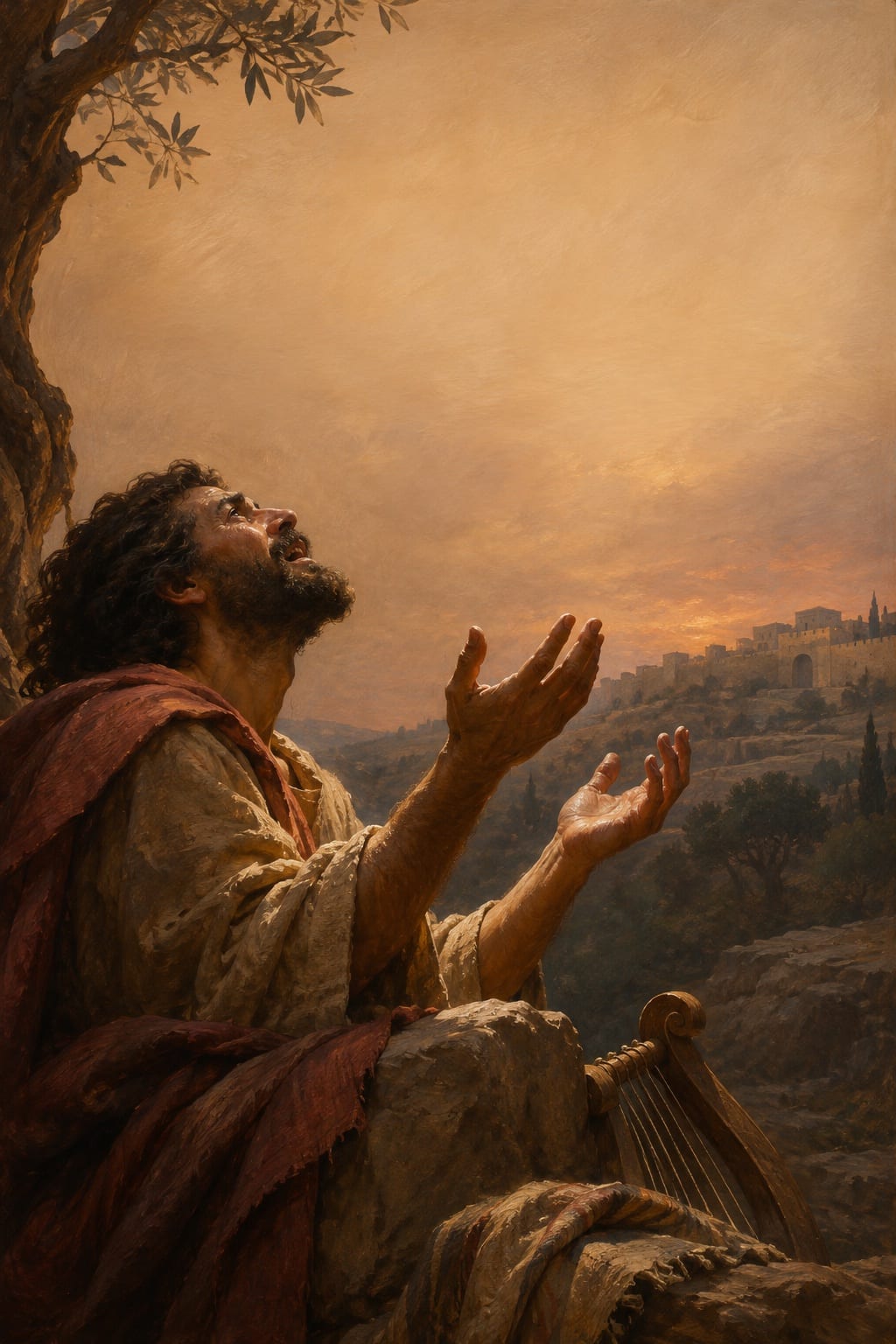
Out of the Depths
Psalms 1303 min
Psalm 130 begins not with a climb but with a cry from the bottom. The first move toward freedom is naming what we have been medicating, in plain words, before God.
Scripture
Psalms 130
Key moment Psalms 130:5-6
Read
Psalm 130 is short, only eight verses, and it does not wait. It begins underwater.
Out of the depths I cry to you, O LORD!
O Lord, hear my voice!
-- Psalms 130:1-2
The Hebrew is mimma'amaqim, 'from the deep places.' It is the same word used for the seabed, the abyss, the trench where light does not reach. The psalmist does not say from the shore. He does not say now that I am better. He sends his voice up while still under.
This was a song the pilgrims of Israel sang on their way up to Jerusalem. A song of ascents. Notice what it teaches them: you do not have to climb out before you sing.
The middle of the psalm makes a turn. The poet acknowledges the weight he is under: if you, O LORD, should mark iniquities, who could stand? But the next breath is not despair. But there is forgiveness with you, that you may be feared. He names what is wrong, then names where mercy is.
Then he waits.
I wait for the LORD, my soul waits, and in his word I hope; my soul waits for the Lord more than watchmen for the morning, more than watchmen for the morning.
-- Psalms 130:5-6
The repetition is not redundancy; it is the way watchmen actually waited. Slowly. With their eyes still on the dark. The morning had not come yet. They were still in the night when they hoped.
Today
Most of us have been taught to bring tidied-up versions of ourselves into the room where God is. A cleaned face. A solved feeling. A reasonable account of why we are upset.
The psalmist disagrees.
He sends his voice from the bottom while it is still the bottom. He names what hurts before it has resolved. His honesty is not the absence of faith; it is the shape of it.
If your habit is to numb the feeling before you have let yourself feel it, the first step out is small and surprisingly hard. Name it. Say it. I am sad. I am lonely. I am ashamed. I am exhausted. I am afraid. You do not have to know what to do about it yet. You do not have to fix it before God can hear it.
The naming is itself an act of faith. It says: I trust that you can hold what I have been carrying alone. I trust that you would rather have my honest cry than my tidied silence. I will not wait for the morning before I tell you I am still in the night.
That is how the psalm ends: O Israel, hope in the LORD! For with the LORD there is steadfast love, and with him is plentiful redemption. He does not say the morning has come. He says hope.
Today, before you reach for whatever you usually reach for, name what you would otherwise hide. Out loud, in writing, or under your breath. Let the ache have a word. Send it from the deep.
He has not asked you to climb out before you call.
Pause
Take a slow breath.
Sit with what you've read.
Ponder
What is the feeling you most often try to silence, and what would it sound like to name it instead?
What might change if you stopped waiting for morning before you cried for help?
Where in your day could a small, honest naming live before any habit answers it?
Pray
A prayer
God who hears voices from the deep, Hallowed is your name in places where light has not yet reached. Let your kingdom come into the bottom of me, where I have not let myself look. Let your will be done in the corner of my heart that has been silent for a long time. Give me today the courage to name what I have been numbing. Forgive me for the cleaning-up I do before I dare speak. Free me from the lie that you cannot bear my honesty. Lead me into the watchman's posture: eyes still on the dark, hoping for morning. Deliver me from the rush to be done with what only feeling will heal. I am still in the night. I trust you anyway.
Amen.
Go in peace.He hears the voice from the deep.