The Angel Came to Her First
Judges 13:1-255 min
Before Samson was a deliverer, he was a recipe whispered to his mother in an empty field. The angel of the LORD entrusted his formation to her quiet, unwitnessed days.
Scripture
Judges 13:1-25
Key moment Judges 13:2-7
Read
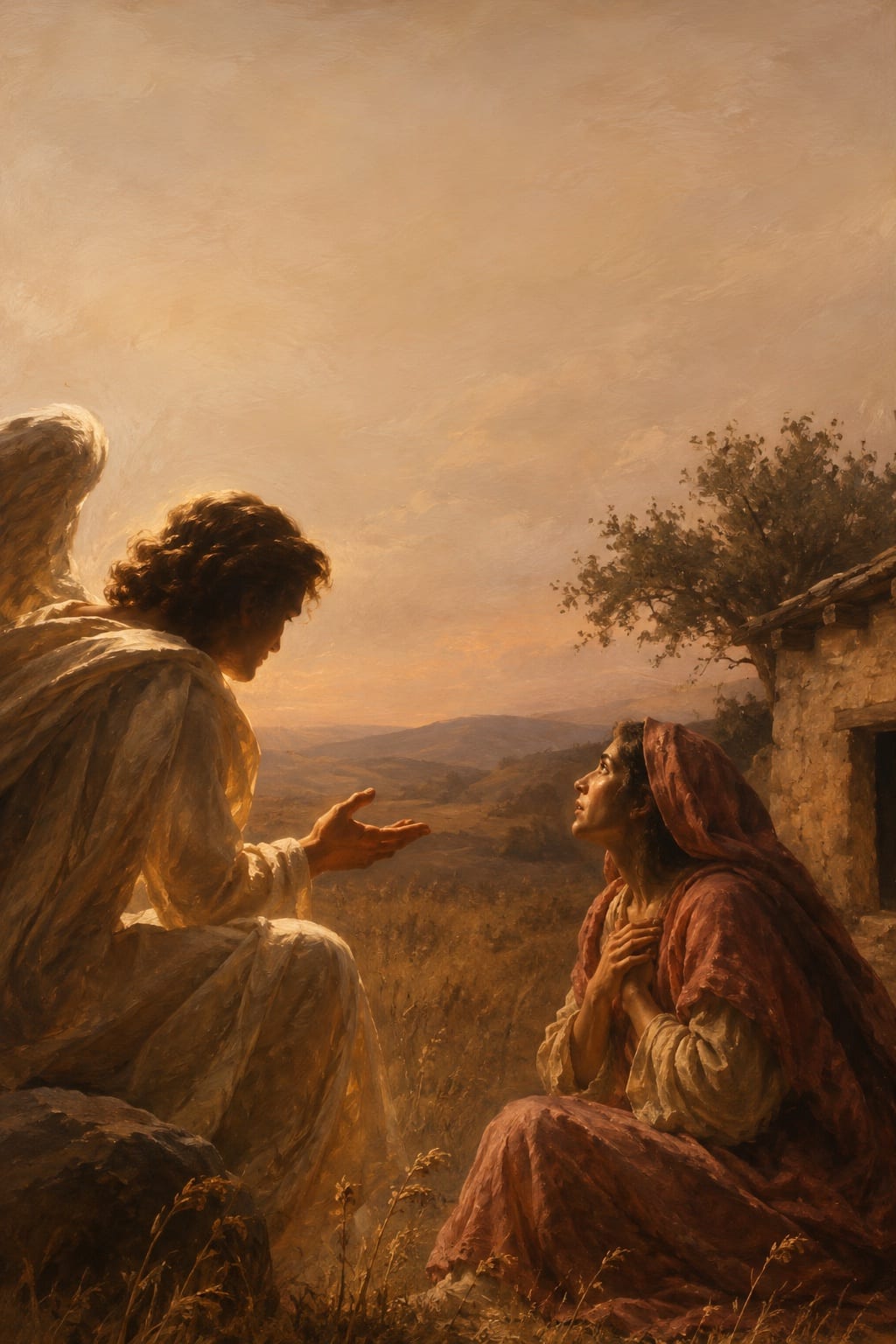
A woman is alone in a field. The text does not even bother to name her. She is called the wife of Manoah, and she is barren, which in her world meant her life had a missing center.
Then a man appears. The text quietly tells us what she does not yet know: this is the angel of the LORD. And the first thing worth noticing is who he chose to visit.
Not Manoah. Not the elders at the gate. Not a prophet, not a priest, not a king. Israel had been crushed under the Philistines for forty years, and heaven's response begins with a private conversation in a field, with a woman whose name the narrator never records.
"Behold now, you are barren and have not borne, but you shall conceive and bear a son."
-- Judges 13:3
What follows is striking. The angel does not just announce a baby. He gives her detailed, specific, weight-bearing instructions about how the child is to be formed. No wine. No strong drink. No unclean food. A razor must never touch his head. From the womb he will be a Nazirite to God, and he shall begin to deliver Israel from the hand of the Philistines.
The entire architecture of Samson's calling is handed to a woman in private, with no audience. No scribe. No witness. Just her, the wind in the field, and a stranger with terrifying eyes.
She runs and tells Manoah. Manoah, missing the point a little, prays for the angel to come back and teach him what to do with the boy. The angel returns, and the text is almost funny here, because the angel comes to her again. She has to go fetch her husband. When Manoah finally asks for the instructions, the angel essentially repeats what he already told her. She heard it first. She heard it correctly. Heaven did not need a second draft.
The Hebrew root behind "Nazirite" is nazar — to separate, to consecrate, to set apart. From the moment of conception, this child's body would be a living sign that Israel still belonged to God. And the womb that would consecrate him, the kitchen that would feed him, the home that would shape him — all of that was hers. The deliverer of Israel was being trained by a woman whose name we still do not know.
When Manoah panics and says, We shall surely die, for we have seen God, it is his unnamed wife who answers with the steadiest theology in the chapter. If the LORD had wanted to kill us, he wouldn't have shown us all this, or told us these things. She is the calm one. She is the one who can read God's intent. The text gives her the last word.
The chapter ends with a single sentence about the years that followed: And the woman bore a son and called his name Samson. And the young man grew, and the LORD blessed him. That is it. No fanfare. Years of nursing, washing, feeding, watching, correcting, praying — compressed into one verse. Years of hidden formation, behind a door, with no one applauding. And the LORD blessed him.
Today
You are three weeks in. Your world has shrunk to the size of a small body and the chair you feed it in. The work is constant and quiet. You wash the same things twice. You sing the same song until the words stop meaning anything. Nothing on your calendar moves. Nothing on the internet knows you exist this week. Some part of you wonders if you have been quietly demoted from your own life.
Manoah's wife was given the formation of a deliverer in a field, with no one watching. The angel did not gather a crowd. He did not put it in writing. He spoke into her ear, in her ordinary day, and trusted her with instructions that would shape Israel for a generation. Her hidden work was the work. It was not preparation for the real assignment. It was the assignment.
This is hard to feel when no metric moves. Babies do not give performance reviews. The internet does not notice if you held him through the witching hour. The dishes you washed at 2am do not stay washed. There is a particular grief to working hard at something the world does not log.
But God logged it. The text bothered to record her, even without her name, because heaven keeps different books than the internet does. The small indoor work of forming a person is not a lesser version of calling. It is what calling has always looked like when God is serious about a generation.
Your audience is small because your assignment is sacred. You have been entrusted with the cradle of someone's whole life. Nothing about that is secondary. Nothing about that is survival. The angel came to her first because the home was the first cathedral, and three weeks in, you are standing in the middle of yours, holding it up.
Pause
Take a slow breath.
Sit with what you've read.
Ponder
What part of your day feels most invisible right now, and what would change if you believed God was watching it most closely?
If the angel of the LORD walked into your living room this week, what instructions about your child do you think he would already trust you to carry?
Where have you been treating your hidden work as preparation for your real life, when it might already be your real life?
Pray
A prayer
God who sees in secret, Father of the unseen, hallowed be your name in this small room. Your kingdom come into the rocking chair, into the night feedings, into the laundry I will fold again tomorrow. Your will be done in the formation of this child, as it is done in heaven. Give me today the bread of believing. Forgive me for measuring my days by what the world can see, and help me forgive the part of me that keeps asking my work to prove itself. Deliver me from the lie that hidden means wasted. Open my eyes to see this season the way you saw a woman in a field — chosen, trusted, addressed by name even when no one else used it. You are the audience. That is enough.
Amen.
Go gently into the next feeding.Heaven knows your name.