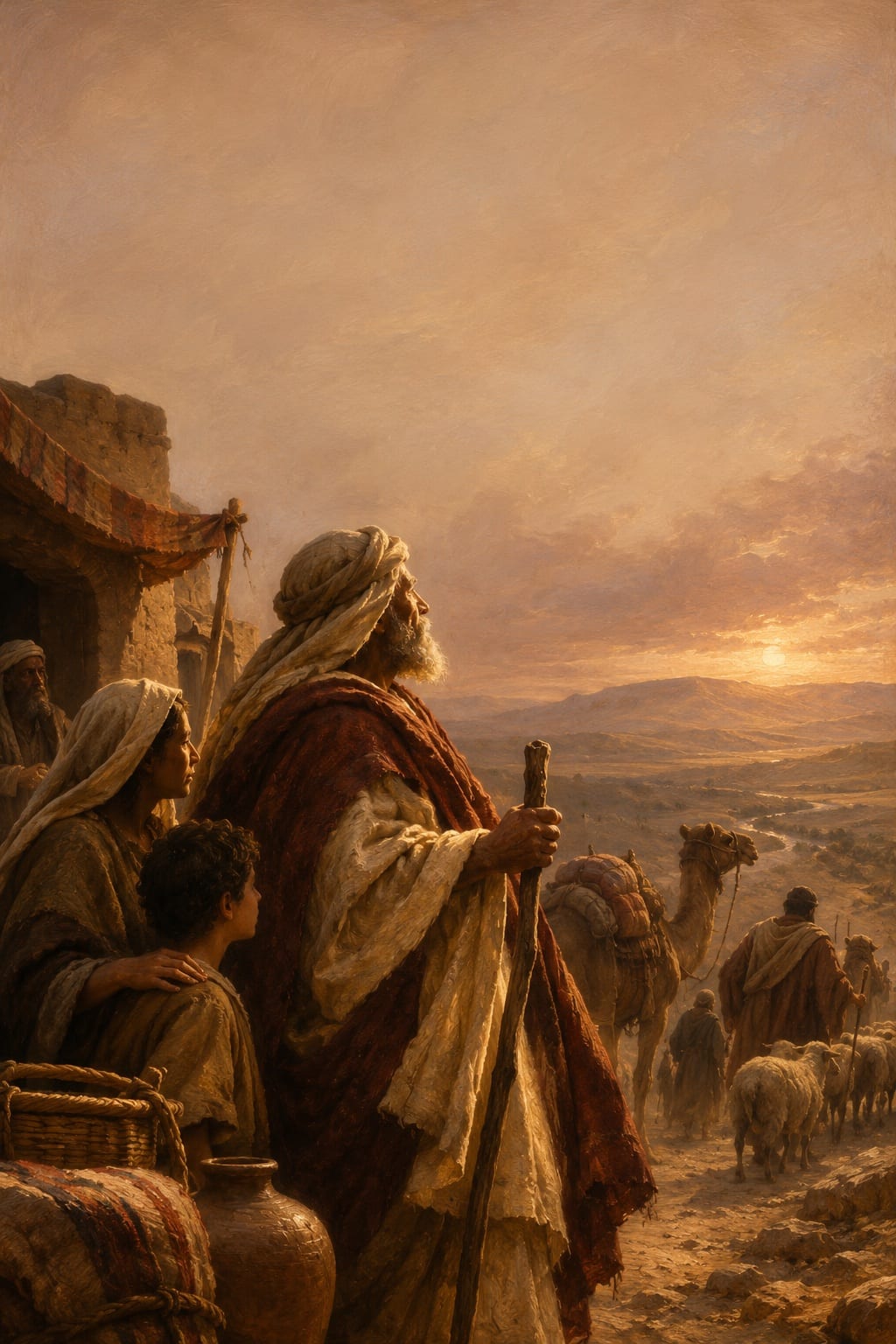
The Day Abram Packed Without a Map
Genesis 11:27-12:97 min
When God called Abram to leave everything familiar for a land he had never seen, Abram's obedience required him to honor what he was leaving while trusting the voice that was calling him forward. His departure teaches us that leaving well is one of the purest expressions of faith.
Scripture
Genesis 11:27-12:9
Key moment Genesis 12:1-4
Read
Ur of the Chaldeans was not a backwater. It was a sophisticated city, a center of commerce and culture in ancient Mesopotamia, with towering ziggurats, established trade routes, and a social order that gave its citizens a clear sense of place. Abram had roots there. He had family, livelihood, a network of relationships built over decades. He belonged.
This matters because the text is careful to tell us what Abram was asked to leave: your country, your people, your father's household. Three concentric circles of identity, peeled away one by one. The Hebrew word for country here — 'erets — doesn't just mean land. It carries the weight of homeland, the soil you know by smell, the place that shaped your instincts. Then moladah, your kindred, the people whose faces mirror your own. And finally, beit 'av, your father's house — the innermost ring, the structure that formed you before you had any say in who you were becoming.
God was not asking Abram to escape something broken. There is no indication that Ur was a place of suffering for him, no oppression to flee from. This is not a rescue story. It is a calling story. And that distinction changes everything, because it means the tension Abram felt was not between misery and freedom but between goodness and obedience.
"Go from your country, your people and your father's household to the land I will show you."
-- Genesis 12:1 (NIV)
Notice what God did not say. He did not name the destination. He did not lay out a timeline. He did not explain how the journey would unfold or what Abram would find when he arrived. The call was structured around a single verb — lekh-lekha, "go" — and a single promise: "I will show you." The destination was real, but it was held in God's knowledge, not Abram's. The only thing Abram could carry with certainty was the voice of the One who spoke.
And then verse 4, plain and staggering in its simplicity:
"So Abram went, as the LORD had told him."
-- Genesis 12:4 (NIV)
No recorded argument. No bargaining. No request for more detail. Abram gathered his wife Sarai, his nephew Lot, all their possessions and the people they had acquired in Harran, and they set out. The text gives us the logistics of departure — the packing, the people, the accumulated wealth — and in doing so it reminds us that obedience is not ethereal. It has a physical cost. Someone had to load the donkeys. Someone had to say goodbye to neighbors. Someone had to walk past familiar landmarks for the last time, knowing they would not return.
Abram was seventy-five years old. He had spent a lifetime building something in Harran, where his family had settled after leaving Ur. Seventy-five years of relationships, reputation, routine. And he left. Not because those things had failed him, but because the God who had blessed him through them was now calling him beyond them.
The journey itself continued this pattern of trust. When Abram arrived in Canaan, God appeared to him at Shechem and said, "To your offspring I will give this land." Abram built an altar there. Then he moved on to the hill country east of Bethel and built another altar. He kept moving, kept building altars, kept worshiping — marking each place not as a permanent home but as a site of encounter with the God who was still unfolding the promise.
What Abram modeled was not reckless abandonment. It was reverent departure. He did not burn Harran to the ground on his way out. He did not speak ill of the life he was leaving or diminish its significance to make the leaving easier. He took with him what God had built through that season — the wealth, the people, the faith that had grown in the soil of that place — and he carried it forward into the unknown. The old season was not wasted. It was preparation.
Today
Many of us will face a moment when the call to move forward does not come packaged with a crisis. There is no catastrophe forcing our hand, no obvious sign that something is broken. The job is good. The community is meaningful. The relationships are real. And still, somewhere beneath the surface, there is a stirring — a sense that God is initiating something new, that the season which has been so formative is drawing to a close.
This is where the tension lives, and it can be excruciating. Because we've been taught, rightly, to be grateful. We know that faithfulness means stewarding what we've been given. So when the impulse to leave surfaces, it can feel like ingratitude or even betrayal. We wonder if we're being selfish, restless, ungrateful for what God has provided.
Abram's story reframes this entirely. His departure was not a rejection of Harran; it was a response to God. Leaving did not mean the previous season had been meaningless. It meant the previous season had done its work, and clinging to it past its appointed time would have been its own form of disobedience.
Leaving well requires a specific kind of honesty. It means naming what a season gave you without pretending it was perfect. It means expressing gratitude to the people who shaped you without letting that gratitude become a chain that holds you in place. It means being clear about your reasons — not defensive, not apologetic, simply truthful — and trusting that clarity is a gift, even when it creates discomfort.
There is a difference between abandoning something and being called away from it. Abandonment is careless. Calling is costly. Abram took seventy-five years of life with him when he left. He honored the weight of what he was leaving by carrying its fruit into the next chapter.
If you are in this tension right now — grateful for where you are and simultaneously aware that God is stirring something new — you do not have to resolve the tension before you obey. Abram did not have a detailed itinerary. He had a voice he recognized and a promise he trusted. Sometimes faith looks less like a confident leap and more like a loaded donkey walking west, one step at a time, with an altar built at every stop along the way.
You can leave with honor. You can go with tears in your eyes and worship on your lips. You can hold deep gratitude for the ground that grew you and still put one foot on the road God is opening. These are not contradictions. They are the marks of someone who has learned to hold a season with open hands — receiving it fully, releasing it faithfully.
Pause
Take a slow breath.
Sit with what you've read.
Ponder
What has this current season built in you that you would want to carry forward, and what has it taught you that might be preparing you for what's next?
Is there a place where gratitude for what God has done has quietly become resistance to what God is doing? How can you tell the difference?
What would it look like, practically, for you to leave your current season with honor and clarity — not burning bridges, not clinging, but going with integrity?
Pray
A prayer
Father of Abram, God who calls people out of the familiar and into the uncharted, I bring before You the tension I carry — this ache of loving where I am and sensing that You are calling me somewhere I cannot yet see. I confess that I have sometimes confused comfort with faithfulness, and I have let the fear of the unknown keep me anchored to what I can control. Your kingdom come in the transition I am facing. Your will be done in the leaving and in the arriving, in the goodbyes and in the first uncertain steps. Give me today the grace to honor what this season has built without idolizing it. Give me the courage to trust Your voice more than my need for a detailed plan. Forgive me for the moments I have resisted Your stirring because I was afraid of what others would think, or because I could not imagine anything better than what I already held. Teach me to hold every good gift with open hands, knowing that You are the Giver and that Your generosity does not end when a season does. Lead me forward, as You led Abram — with promise ahead and provision for each day. And where the road is unclear, let me build altars of worship, marking each place of encounter with You as evidence that I am not walking alone
Amen.
Go with gratitude. Go with courage.The God who calls you forward is the same God who sustained you here.