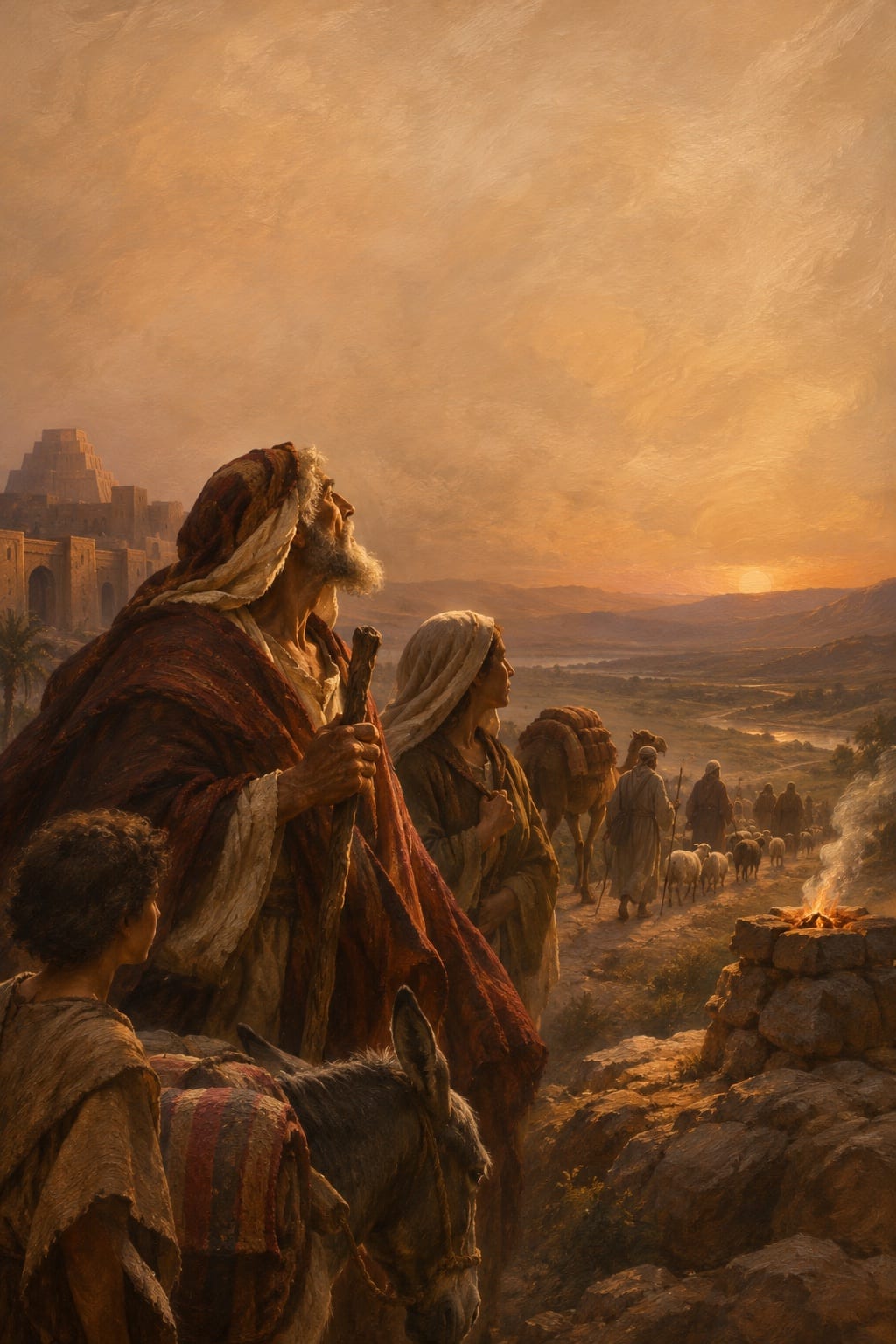
The First Man on the Road
Genesis 12:1-96 min
Abraham leaves Ur with no scripture, no prophet ahead of him, no faith community — only a voice, a promise, and the altars he builds along the way to mark where the Voice met him.
Scripture
Genesis 12:1-9
Key moment Genesis 12:1-4
Read
Before there is a Bible, there is a man on a road.
Abram has no scriptures. He has no prophet who has gone before him to map the country he is being asked to enter. He has no synagogue, no church, no spiritual director, no peer he can sit with at the end of a hard day and say did you hear it too, am I making this up? He has a father with idols and a brother who is dead and a wife who has buried her own dreams of a child. And he has, somewhere in the inner ear, a voice.
Go from your country and your kindred and your father's house to the land that I will show you.
The Hebrew is sharper than English usually carries. Lek-leka. Go, for yourself. Go, to yourself. Go, by yourself. The destination is not given. The land that I will show you — future tense, contingent on continued listening, withheld until he is already moving.
The text does what we want it not to do. It hands him a promise of land, of nation, of blessing on all the families of the earth, and then it does not hand him a map. So Abram went, as the Lord had told him.
This is the line that Hebrews 11 will spend a chapter exclaiming over. By faith Abraham obeyed when he was called to go out to a place that he was to receive as an inheritance. And he went out, not knowing where he was going. Not knowing. There is no one to ask. There is no precedent in his clan, no scripture in his hand, no community of believers who have made this journey ahead of him and can tell him what mile twelve will feel like. There is only the Voice and the road.
Abram passed through the land to the place at Shechem, to the oak of Moreh... So he built there an altar to the Lord, who had appeared to him.
-- Genesis 12:6-7
Watch what the wandering man does without a tradition to guide him. He builds altars. At Shechem. At Bethel. Wherever the Voice meets him on the road, he heaps stones into a memory. He cannot consult anyone else's altar. So he raises his own, and he marks the country with the places God has spoken, so that when the doubt comes — and the doubt will come — he can return to a stone and say here. Here is where he met me. I did not invent it.
This is what an apprenticeship to God himself looks like before there are any words for it. Not instruction, but relationship. Not a curriculum, but a country. Not a community of fellow students, but a Master walking ahead in a cloud no one else can see.
And Genesis takes pains to tell you something quiet about him at the end of his life: Abraham was old, and the Lord had blessed Abraham in all things. All things. The man who started with a voice ended with a faithfulness wide enough that every family of the earth has been brought inside it. The road he walked alone became the road everyone walks now.
Today
There is a particular weight in being the first one on a road. You did not inherit a tradition that prepares you for what God is asking. The people who love you cannot map it for you because they have not walked it. You sit with a sense of God's voice and a sense of God's promise and you wonder if you are simply making it up because no one else seems to be hearing what you are hearing or going where you are being sent.
This is older than you. Before there was a faith community for you to belong to, there was a man on a road. Before there was a Bible to read, there was an Abram listening. The whole household of faith you stand inside of, with all its scriptures and saints and shoulders to lean on, began with one man who had none of it — only the bare voice and the bare promise.
The text does not flatter Abraham's loneliness. It does not pretend he was less alone than he was. But it also does not call him deluded. It calls him father. The road he walked without a peer became the road that gave the rest of us peers.
If you are on a road no one in your life has traveled, your work is not to wait for a community that has already mapped it — there may not be one, on this road, in this generation. Your work is to listen carefully enough that you can keep walking, and to build altars. Mark the places where the Voice met you. Write down the dates. Keep the prayers. When the night comes and you cannot tell a true voice from a desire, return to a stone and remember: here is where he spoke. I did not invent this country.
The Master walks ahead in a cloud that, for now, only you can see. That is not a lesser apprenticeship. That is the original one. And the families of the earth are quietly being blessed in it.
Pause
Take a slow breath.
Sit with what you've read.
Ponder
What road are you on that has no human map — and where is the temptation to wait for a community that may not arrive on this side of obedience?
What altars have you built so far on this road, the stones of remembrance you can return to when the night gets long?
If Abraham could speak to you across the centuries, what do you think he would say about the loneliness you are carrying?
Pray
A prayer
God of Abraham, you who spoke to a man with no scriptures and called him friend, your name be honored on the road no one in my life has walked, in the country I am crossing without a map. Let your kingdom come in the listening that has no other listener, and your will be done in the obedience that has no precedent to lean on. Give me today the daily bread of your voice. Not a teacher's voice about you. Yours. The one I keep mistaking for my own desire and then recognizing again, against my doubt. Forgive me for the days I have refused to walk because no one else was walking, and for the nights I have invented company for myself rather than sit alone with you. Keep me from the land of my father's house when it is time to leave. Keep me from despising the unmapped country when you have called me into it. Teach me to build altars on the road, to mark the places you have spoken, so that the stones can speak when my faith goes quiet. And if I am the first one on this road, let me walk it the way Abraham walked his — not knowing where I am going, only Whose I am.
Amen.
Walk on, friend.He goes ahead of you.