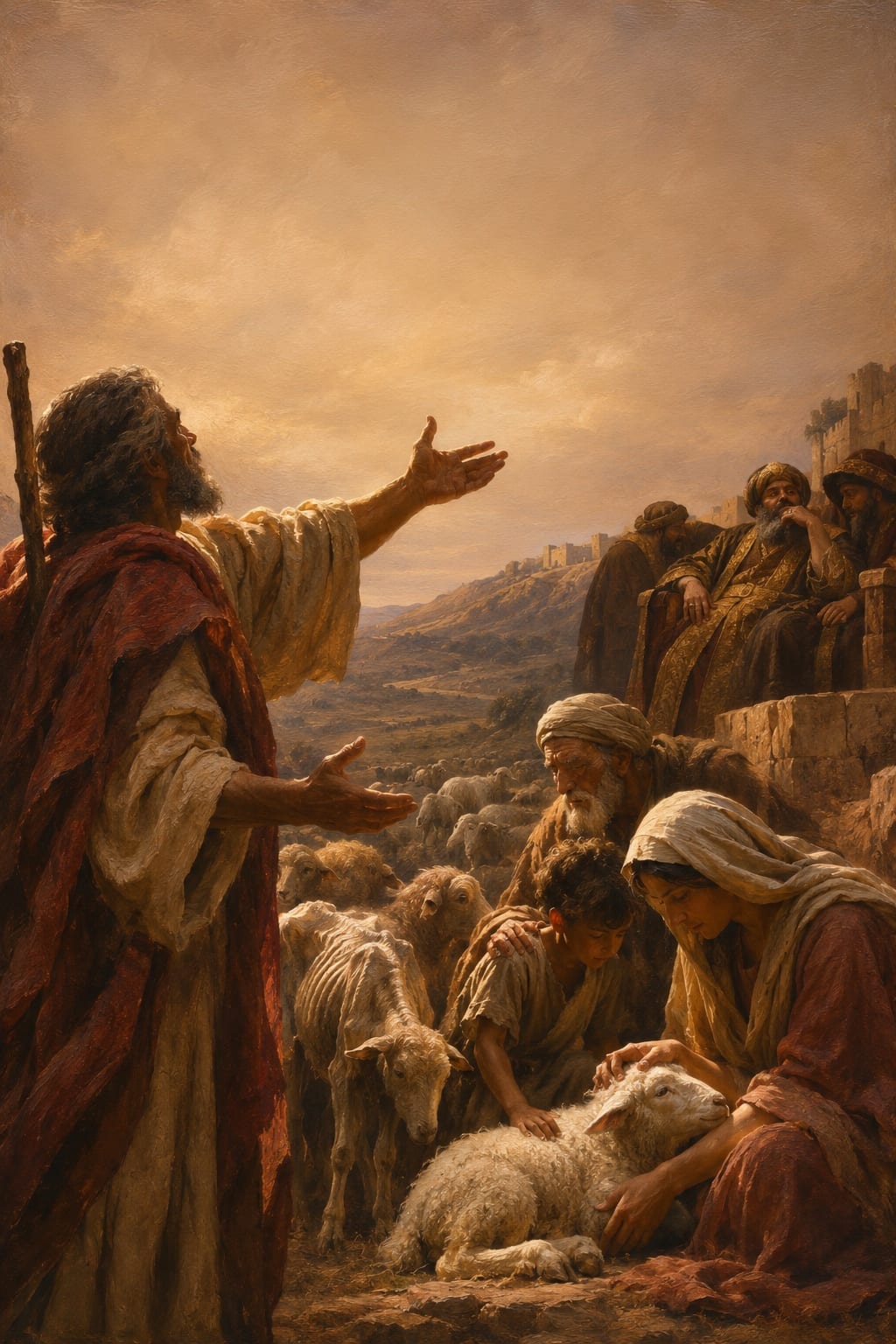
The Flock That Told the Truth About the Shepherd
Ezekiel 34:1-164 min
Ezekiel 34 records God's indictment of Israel's leaders who consumed the flock instead of caring for it, then reveals the diagnostic principle that a leader's character is measured not by their words or image but by the condition of the most vulnerable under their authority.
Scripture
Ezekiel 34:1-16
Key moment Ezekiel 34:10-12
Read
Ezekiel receives a word against the shepherds of Israel, and the language is strikingly concrete. God does not begin with abstract accusations about ideology or intention. He looks at what the shepherds consumed: the curds, the wool, the choice animals. Then he looks at what they neglected: the weak went unstrengthened, the sick unhealed, the injured unbound, the strays unrecovered, the lost unsearched for. The indictment reads like an audit — not of the shepherds' theology, but of their outcomes.
Notice how the charges escalate. Neglect comes first. The shepherds simply did not do the work of care. But then something darker emerges: "You have ruled them harshly and brutally" (34:4). What began as indifference became exploitation. This is the trajectory of self-serving authority; it rarely stays passive. People who use their position for personal benefit eventually need to suppress those who might expose or threaten that arrangement. The flock was "scattered because there was no shepherd" (34:5), and once scattered, they became food for every predator.
God's response is not reform. It is removal. "I am against the shepherds and will hold them accountable for my flock" (34:10). Then comes the counter-portrait: God Himself will search for the scattered sheep, rescue them from the places where they were driven on a day of clouds and darkness, bring them to good pasture, bind up the injured, strengthen the weak. Every specific failure of the false shepherds becomes a specific promise from the true one. The passage functions as a mirror held up between two kinds of authority — one that feeds itself on the flock, and one that feeds the flock from itself.
What makes this text so enduring is the diagnostic it provides. God does not ask the shepherds to give an account of their vision statements or their public reputation. He looks at the flock. The scattered, the bruised, the hungry, the lost — their condition is the testimony. A shepherd's character is legible in the bodies and spirits of those under their care, especially those with the least power to resist or leave.
Today
This passage hands us a remarkably practical tool for discernment. When you need to evaluate someone in authority — a pastor, a boss, a political leader, a parent, a mentor — Ezekiel 34 says: look at the vulnerable people around them. Not the inner circle who benefits, not the public image they curate, but the ones at the margins of their influence. Are the weak getting stronger? Are the injured being tended? Or are people being scattered, silenced, exploited while the leader accumulates more?
The principle cuts in two directions. It helps us recognize harmful leaders before their failures become catastrophic. Scattered, fearful, diminished people around a leader are not incidental; they are evidence. But it also gives us a standard for our own authority, however small. Each of us shepherds something — a family, a team, a friendship, a classroom. The question God asks is not "Did you appear competent?" but "What happened to the most vulnerable person in your care?"
There is deep comfort here too. God does not leave the flock to fend for itself after the false shepherds are removed. He steps in personally: searching, gathering, feeding, binding. If you have been the scattered sheep, wounded by someone who was supposed to protect you, this passage says God sees the full picture. Your condition is not invisible to Him. He is not fooled by the shepherd's reputation, and He has already committed Himself to your recovery.
Pause
Take a slow breath.
Sit with what you've read.
Ponder
When you think about the leaders or authority figures in your life, what does the condition of the people around them reveal?
Where do you hold shepherding responsibility — even informally — and how are the most vulnerable people in that space actually faring?
Have you ever been the scattered sheep under a self-serving shepherd? What would it mean to let God's promise in verses 11-16 speak into that wound?
Pray
A prayer
Father, Shepherd of Israel, you see what is hidden behind closed doors and polished reputations. You read the condition of the flock and you hold leaders accountable for what they were given to protect. Grant me discernment to recognize true shepherds from false ones — not by their words, but by the fruit of their care. Where I have been scattered or wounded by those who should have protected me, gather me. Bind what was broken. Lead me to good pasture. And where I hold authority over others, keep me honest. Let me not consume what I was meant to tend. Your kingdom come in every space where power is held over the vulnerable.
Amen.
The Shepherd sees. The Shepherd comes.You were never meant to be consumed. You were meant to be fed.