The Genealogy Hidden in a Harvest
Ruth 2:1-4:225 min
Ruth 4:18-22 closes a quiet village story with a genealogy that reaches toward David and, ultimately, Jesus. The small kindnesses of a widow, a foreigner, and a landowner become the hinge on which redemption turns.
Scripture
Ruth 2:1-4:22
Key moment Ruth 4:18-22
Read
Bethlehem in the days of the judges was not a promising stage for salvation history. The book of Judges ends with the grim refrain that everyone did what was right in their own eyes. Into that moral fog, the book of Ruth opens with a famine, three funerals, and two widows walking home with empty hands.
None of them knew they were living inside a genealogy.
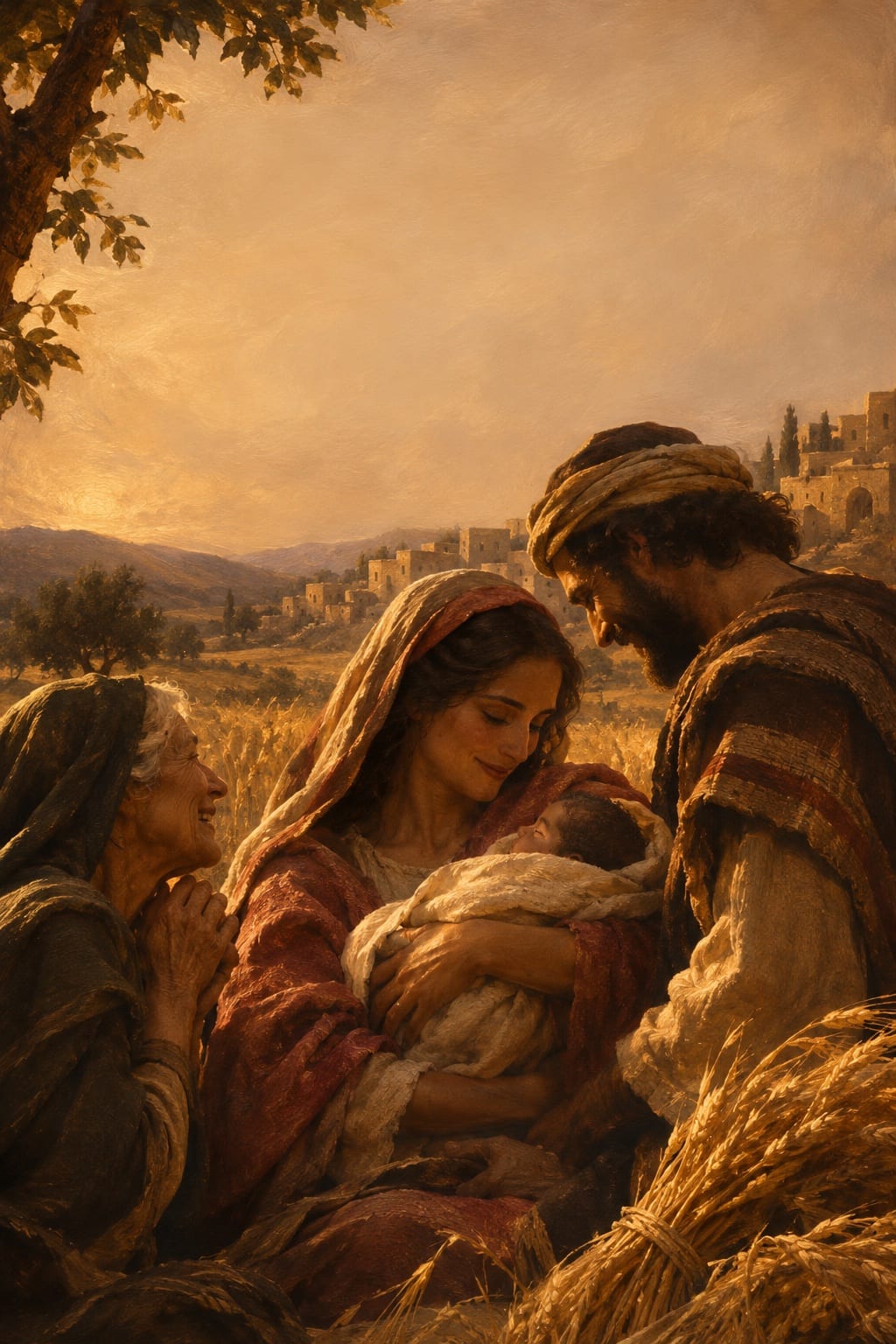
Ruth gleans in a field because she and Naomi need to eat. That is the whole reason. She is not strategizing a dynasty; she is picking up leftover barley so her mother-in-law will not starve. Boaz notices her, not because he has received a prophecy, but because he is the kind of man who notices. He greets his workers with blessing. He tells them to leave extra grain on purpose. He protects a vulnerable foreigner when he did not have to.
The Hebrew word that hums underneath the whole book is hesed — covenant kindness, loyal love, the kind of faithfulness that goes beyond what duty requires. Naomi names it when Boaz shows generosity. Boaz names it when Ruth chooses him over younger men. It is the quiet virtue of people who keep small promises when no one is watching.
Then comes the city gate. A nearer kinsman could have redeemed the land, but he declines when he learns Ruth comes with it. Boaz steps in publicly, formally, with ten elders as witnesses. A sandal changes hands. A marriage is arranged. A child is born.
And then the narrator does something startling. After pages of intimate, human detail — harvest, threshing floor, whispered conversations, a baby in Naomi's arms — the book ends with a list of names.
Now these are the generations of Perez: Perez fathered Hezron, and Hezron fathered Ram, and Ram fathered Amminadab, and Amminadab fathered Nahshon, and Nahshon fathered Salmon, Salmon fathered Boaz, and Boaz fathered Obed, Obed fathered Jesse, and Jesse fathered David.
-- Ruth 4:18-22
Ten names. Generations compressed into a single breath. The genealogy is the narrator's way of turning the camera around. The camera had been close on Ruth's face in the barley field, on Naomi weeping at the city gate, on Boaz counting out grain. Now it pulls back, back, back, until we see that the whole story has been sitting inside a larger story the characters could not see.
David is in the last line. And Matthew will later take this same genealogy and carry it further, through David, through exile, through silence, all the way to Jesus who is called Christ. Ruth and Boaz are great-grandparents of a king, and distant grandparents of the King.
They did not know. That is the point. They were simply faithful in the field they had been given.
Today
We tend to imagine God's providence as the dramatic interventions: the parted sea, the pillar of fire, the voice from heaven. Ruth quietly insists on something different. Providence here looks like a widow deciding to glean rather than give up. It looks like a landowner being generous with his edges. It looks like a community showing up at the gate as witnesses.
There is a strange freedom in this. Ruth was not coerced into her loyalty to Naomi. Boaz was not compelled to be kind. They chose, freely, out of love and covenant and conscience, and yet every choice was woven into a design larger than their lifetimes. Their freedom and God's purpose were not in competition. They were collaborating.
You will probably not feel like you are building a genealogy today. You will feel like you are answering an email, sitting with a friend who is grieving, forgiving someone who has not apologized, showing up for a job that does not always feel meaningful, being patient with a child who is testing you. These are your fields of barley. These are your edges to leave ungleaned.
The paradox of Ruth is that ordinary faithfulness is never only ordinary. The small kindness offered to the person in front of you may be a thread God is weaving into something you will never see finished. A descendant you will never meet. A healing you will never witness. A Christ who arrives generations after your name is forgotten.
This does not make your choices heavier. It makes them lighter. You do not have to engineer significance. You only have to be faithful in the place you have been given, with the people who have been given to you, today. God is capable of handling the genealogy.
Pause
Take a slow breath.
Sit with what you've read.
Ponder
What small act of hesed — loyal, unrequired kindness — is in front of you this week, and what would it look like to actually do it?
Where have you been waiting for a dramatic sense of calling before you are willing to be faithful in the ordinary?
Whose faithfulness, generations before you, is quietly shaping your life right now — and who might you be shaping without knowing it?
Pray
A prayer
God of Ruth and Boaz, God of quiet fields and unnoticed kindness, hallowed is your name in the small places, in the barley rows and the city gates, in the conversations no one records. Let your kingdom come in the ordinary hours of my day. Let your will be done through the choices I am tempted to think do not matter. Forgive me for waiting to be faithful until the moment feels large enough. Forgive me for overlooking the people in front of me while I search for a calling somewhere else. Give me today my daily portion of hesed — loyal love for the ones you have placed in my life. Make me generous at the edges. Make me patient at the gate. Make me willing to keep promises no one is watching me keep. And when I cannot see how any of it connects, teach me to trust that you are writing a genealogy I do not need to read. It is enough to be one faithful name inside it.
Amen.
Go gently into your ordinary day.Your small faithfulness is not small to God.