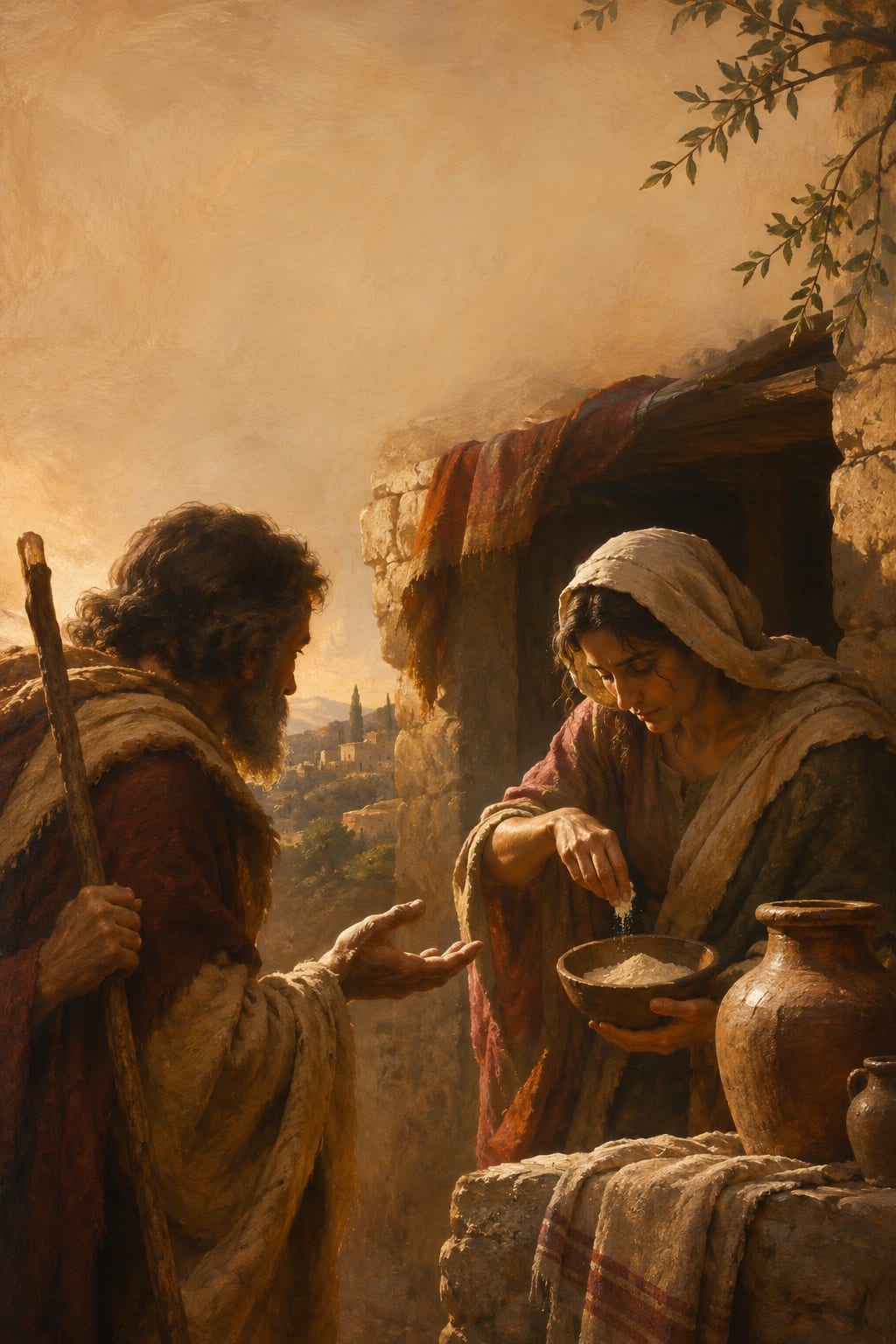
The Jar That Should Have Been Empty
1 Kings 17:8-164 min
A starving widow is asked to give away her last handful of flour — and discovers that God's provision doesn't arrive all at once but renews itself daily, turning her emptiest moment into a doorway of sustained grace.
Scripture
1 Kings 17:8-16
Key moment 1 Kings 17:14-16
Read
Drought had settled over the land like a curse. The brooks dried up, the fields cracked, and hunger became ordinary. Into this landscape God sent Elijah — not to a wealthy patron or a king's storehouse, but to a Sidonian widow gathering sticks outside the gates of Zarephath. She was preparing a final meal. Flour scraped from the bottom of a jar, oil tilted from an almost-empty jug. Enough for two small cakes, enough for a goodbye dinner with her son. Then they would wait to die.
What Elijah asked next borders on the unreasonable. "Make me a small cake of bread first." First. Before you feed your child, before you eat yourself. The Hebrew word for her jar — kad — is the same word used for a common clay vessel, fragile and unremarkable. God chose to stage His provision inside the most ordinary container she owned. Nothing golden, nothing dramatic. Just a cracked jar that kept refilling.
"The jar of flour was not used up and the jug of oil did not run dry, in keeping with the word of the Lord spoken by Elijah."
-- 1 Kings 17:16
Notice what didn't happen. The widow didn't wake up to a warehouse of grain. She didn't receive a lump sum that solved the famine. Each day she reached into that jar and found exactly enough — never overflowing, never absent. God's faithfulness came measured in handfuls, and she had to return to the jar every single morning believing it would be there again. The miracle required repeated trust, not just a single act of courage.
Today
Most of us aren't facing literal famine, but we know the arithmetic of scarcity. The bank account that won't stretch. The emotional reserves that ran dry months ago. The relationship where you've given everything and there's nothing left to offer. You count what remains and start rationing, calculating exactly how long you can survive on what's left.
Into that math, God sometimes asks something that looks like nonsense: give from the deficit. Serve when you're depleted. Extend generosity when self-preservation screams the opposite. The widow's story doesn't promise that obedience erases scarcity overnight. She still lived through a famine. Her kitchen didn't transform into a bakery. But she never went hungry.
There's a particular kind of faithfulness embedded in "enough for today." We crave the full pantry, the certainty of months secured in advance. God often works closer to the bone than that. The flour in the jar teaches us that provision and abundance aren't always the same thing — provision is having what you need at the moment you need it, and finding it there again tomorrow.
If you're staring at your own handful of flour right now, the invitation isn't to pretend it's more than it is. It's to open your hands anyway. The God who sent a prophet to a widow's door — who chose the smallest jar in the poorest house in a foreign town — is the same God who promises that His mercies are new every morning. Not stockpiled. New.
Pause
Take a slow breath.
Sit with what you've read.
Ponder
What is the 'handful of flour' in your life right now — the resource you're afraid isn't enough?
Where has God asked you to give or act from a place of scarcity, and what happened when you did?
How comfortable are you with 'enough for today,' and what would it take to trust the jar again tomorrow?
Pray
A prayer
Father, Provider of daily bread, Your kingdom comes even into famine. Your will unfolds even in the mathematics of not enough. Forgive me for the times I've clutched my last handful so tightly that my fists couldn't open to receive what You had next. I confess my fear of running out — of money, energy, hope, love. Give me today what today requires. Not a stockpile against tomorrow's worry, but the flour and oil I need for this single day. Teach me that Your faithfulness isn't less real because it arrives in portions rather than surpluses. Deliver me from the lie that scarcity means abandonment. Yours is the jar that never empties, the oil that never runs dry, the grace that is sufficient — today and tomorrow and after that
Amen.
The jar will be there tomorrow.His mercies are new every morning — not stockpiled, new.