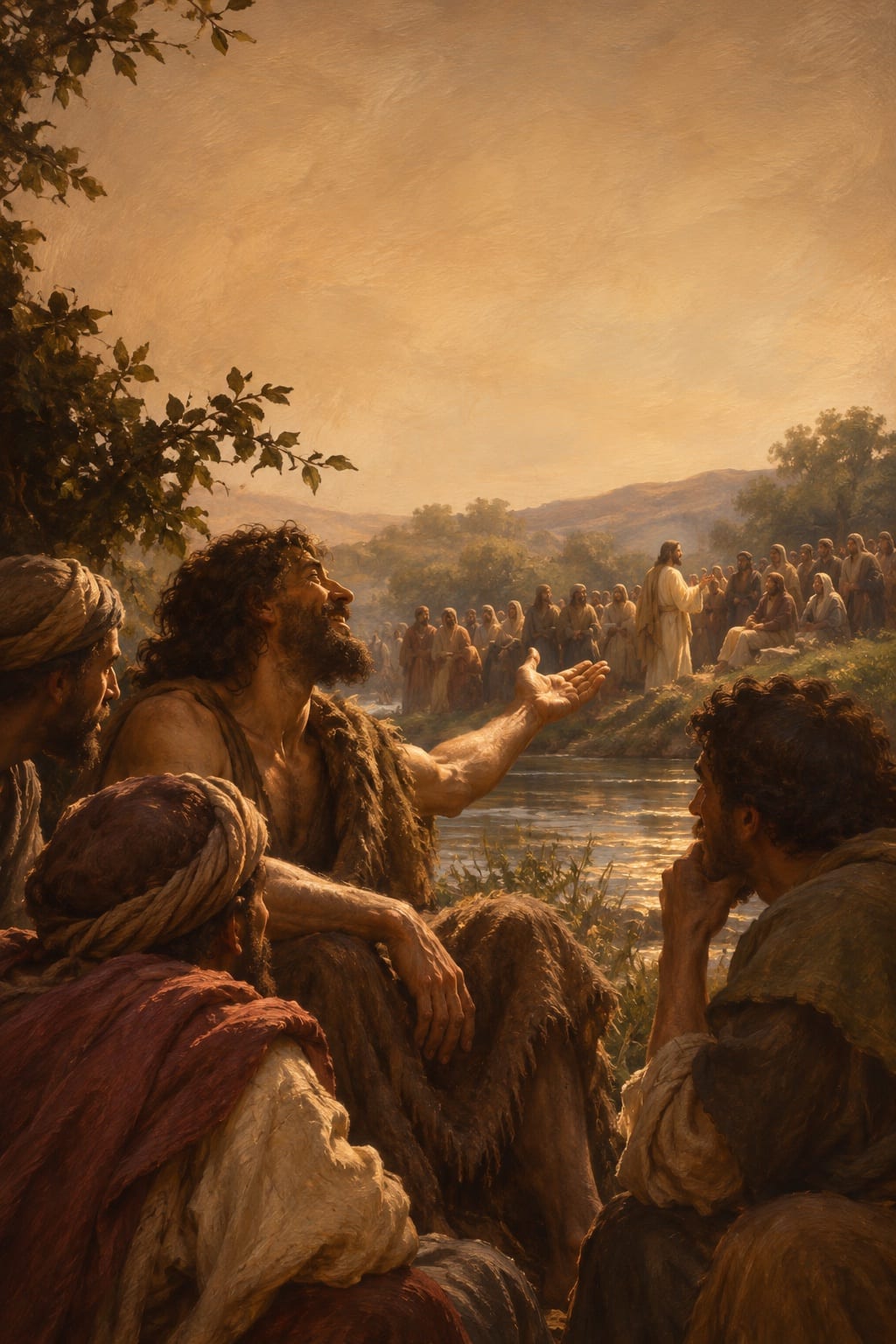
The Joy of the Friend of the Bridegroom
John 3:22-366 min
John the Baptist's disciples come anxious that the one he baptized is drawing larger crowds, and John names the surpassing as good news — the joy of the friend of the bridegroom rejoicing at the groom's voice.
Scripture
John 3:22-36
Key moment John 3:29-30
Read
The disciples come to John worried.
They have walked with him in the wilderness. They have eaten the locusts and the wild honey. They have stood beside him in the river day after day as the crowds confessed their sins and went down into the water under his hand. He is the prophet, the Elijah-figure, the voice crying out. He is the man around whom this whole movement formed.
And now there is a competitor. Not just a competitor — the man their master baptized.
Rabbi, he who was with you across the Jordan, to whom you bore witness — look, he is baptizing, and all are going to him.
Notice the wound under the words. All are going to him. The disciples are not theologians here. They are loyal. They are watching the crowds shift, and they are coming to their teacher with the kind of report that wants permission to be jealous on his behalf. Are you going to let this happen? Are you going to fight for what is yours?
John's answer is one of the great refusals of the gospels.
A person cannot receive even one thing unless it is given him from heaven... He who has the bride is the bridegroom. The friend of the bridegroom, who stands and hears him, rejoices greatly at the bridegroom's voice. Therefore this joy of mine is now complete.
-- John 3:27, 29
The Greek for friend of the bridegroom is philos tou nymphiou — a specific role in a Jewish wedding. Not a guest. Not a relative. The shoshbin, the friend tasked with arranging the wedding, walking the groom to the bride, standing outside the chamber to listen for the groom's voice of joy and then announcing it to the world. His whole job is to ready a moment that does not finally include him.
John refuses to be his own movement. I am not the Christ. He had said it earlier. He says it again now, stripped of every consolation. He must increase. I must decrease. The Greek is even sharper — ekeinon dei auxanein, eme de elattousthai. That one must grow. I must become less. The verb is divine necessity, the same word the Gospel of John uses for the cross. This is the order of the kingdom. There is no version of John's faithfulness that does not run through his shrinking.
And watch the keynote. It is not loss. It is joy. This joy of mine is now complete. The man whose crowds are walking away describes himself as a man whose joy has just been fulfilled. The completion of his ministry is the moment another's outgrows his.
It could not look more different from his disciples' anxiety. They came in the language of zero-sum: all are going to him. He answers in the language of a wedding: the bride was never mine.
Today
There is a particular grief in being the one who prepared the way for someone whose calling has now outpaced your own. Maybe you discipled them. Hired them. Pastored them. Trained them. Wrote the recommendation. Opened the door. They were the apprentice and you were the master, and now they are doing things you cannot do, reaching ground you cannot reach, drawing crowds your platform never drew.
There is a sister grief, sharper, on the other side. You are the apprentice who is starting to surpass. The gifting is moving in you in a way it does not move in the one who taught you. You feel the awkwardness of stepping past the ceiling of your mentor without knowing whether it is pride or providence or both. You do not want to dishonor where you came from. You also cannot, in good conscience, stay small to keep the room comfortable.
John the Baptist stands at the hinge of both. He is the master being surpassed and he is the mentor who prepared the surpassing on purpose. His refusal is to read either side as loss.
This is rarer than the church admits. We can preach decreasing as long as no one is actually asked to decrease. We can affirm the next generation as long as our crowds do not actually walk to them. The friend of the bridegroom is a different category. He waits in the dark outside the chamber for a voice he did not produce, in a celebration he did not author, for a marriage he is not in. And his joy is not survived. It is complete.
If you are the one being surpassed, the gospel is asking whether your joy can be in the bridegroom's voice and not in your own ministry's stability. If you are the one surpassing, the gospel is asking whether you can rise without contempt for the John who handed you the river. He must increase. I must decrease. In the kingdom, that sentence does not destroy either of you. It marries both of you to a joy that is bigger than the place you each occupy in it.
Pause
Take a slow breath.
Sit with what you've read.
Ponder
Where in your life is the temptation to read someone's rise — or your own — in the language of zero-sum, when the gospel is offering you the language of a wedding?
If you are the John in this story, what would it look like to wait in the dark outside the chamber and let your joy be the bridegroom's voice rather than your own crowds?
If you are the apprentice who is surpassing, how can you rise without contempt for the one who handed you the river?
Pray
A prayer
Bridegroom of the Church, you whose voice is the joy the friend stands outside the chamber to hear, your name be honored above every name I have built, every crowd I have gathered, every ministry I have carried. Hallowed be your name where mine has wanted to be hallowed instead. Let your kingdom come in the increase of those I have prepared, and your will be done in my decrease. Give me today the strange daily bread of John — the joy that is complete in another's rising, the gladness of the friend of the bridegroom, the freedom of a man who has remembered the wedding was never his. Forgive me where I have read someone's rise as my loss. Forgive me where I have stayed small to make my mentor comfortable, and where I have stepped past them with contempt instead of gratitude. Keep me from the language of zero-sum. Keep me from confusing my platform with your kingdom. Teach me to listen for your voice in the dark outside the chamber and to call my brothers and sisters to the wedding with joy. And in the long, slow obedience of decreasing, let me learn the only line that finally matters: he must increase, I must decrease.
Amen.
Wait in the joy.The Bridegroom is speaking.