The Master Who Wouldn't Let Them Pull
Matthew 13:24-303 min
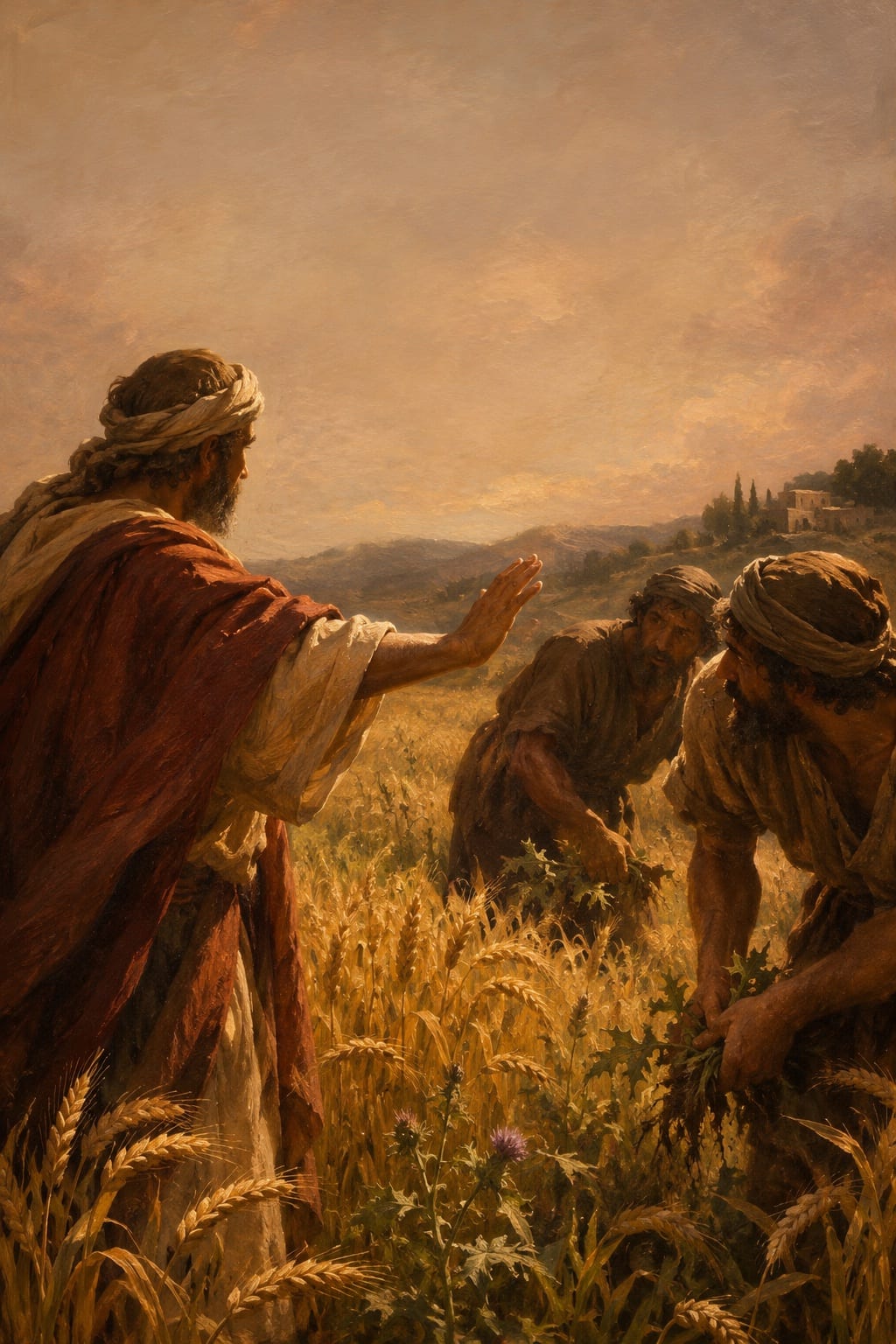
Jesus tells of a farmer who refuses to let his servants tear up weeds among the wheat. His patience with a mixed field is not approval of evil; it is care for what is real.
Scripture
Matthew 13:24-30
Key moment Matthew 13:28-30
Read
It is harvest country. A farmer plants good seed in his field and goes home to sleep, like any farmer would. While he sleeps, an enemy slips between the rows and sows zizania, what most translations call tares or weeds.
Zizania is the detail most readers miss. It is darnel, a poisonous lookalike to wheat. In the early stages of growth, even an experienced farmer cannot tell the two apart. Only as the seed-heads form does the difference become visible. By then the roots are tangled. Pull one, you pull the other.
When the servants notice, they react the way we react. Their first instinct is removal. Do you want us to go and pull them up? (Matthew 13:28). The question carries the assumption every reader brings: the right response to bad seed is to rip it out. The faster, the better.
The master does not agree.
No, while you are pulling the weeds, you may uproot the wheat with them. Let both grow together until the harvest.
-- Matthew 13:29-30
Notice what he does not say. The weeds are not fine, and good and evil are not equally welcome in his field. He calls the weeds what they are. His no is not approval; it is timing.
A harvest is coming. The reapers, the master tells us later, will sort the field. Until then, both grow. Restraint here is care for the wheat, not tolerance for the weeds. The master is patient with the field because he loves what is real in it.
Today
Most of us read this parable and feel its sting in two directions.
The first sting is outward. We can see the weeds in the church, in our families, in the country, online. Hypocrisy, corruption, cruelty masquerading as conviction. We want a quick reckoning. The servants' question is ours, should we pull them up? The master's no does not mean stand down. It means do not become the kind of person who tears up wheat trying to be rid of weeds. Be careful with the field, even when you are right about what is in it.
The second sting is inward. If you have ever watched something good in your own life grow in the same soil as something painful, you know the temptation to scorch the whole field and start over. The master refuses that too. He sees the wheat in you, even when it is rooted next to weeds you wish you could yank out tonight. His patience is not blindness. It is the long love of a farmer who will not lose what he planted.
The freedom is this: you do not have to sort the field today. There will be a harvest. You can leave the reaping to the reapers, and tend instead to whatever is growing.
Pause
Take a slow breath.
Sit with what you've read.
Ponder
Where in your life are you most tempted to play servant, pulling weeds before the harvest?
What in you is wheat? Could you name it without flinching?
What would change today if you trusted that the master is not indifferent to what's broken, only careful with what's real?
Pray
A prayer
Patient Master of the field, Hallowed is your name, the One who plants good seed even in soil where enemies sow at night. May your kingdom come where we are tearing at the dirt. May your will be done in the slow time you keep. Give us today the discernment to leave alone what we are not the harvest for. Forgive us for the wheat we have uprooted in our hurry. Forgive us when our zeal for purity damaged what you were growing. Lead us not into the temptation of fixing every field, and deliver us from the lie that patience is permission. Let us tend, not tear. Let us trust the harvest is coming. Yours is the kingdom, and the field, and the long view that we do not yet have.
Amen.
Tend the field.The harvest belongs to him.