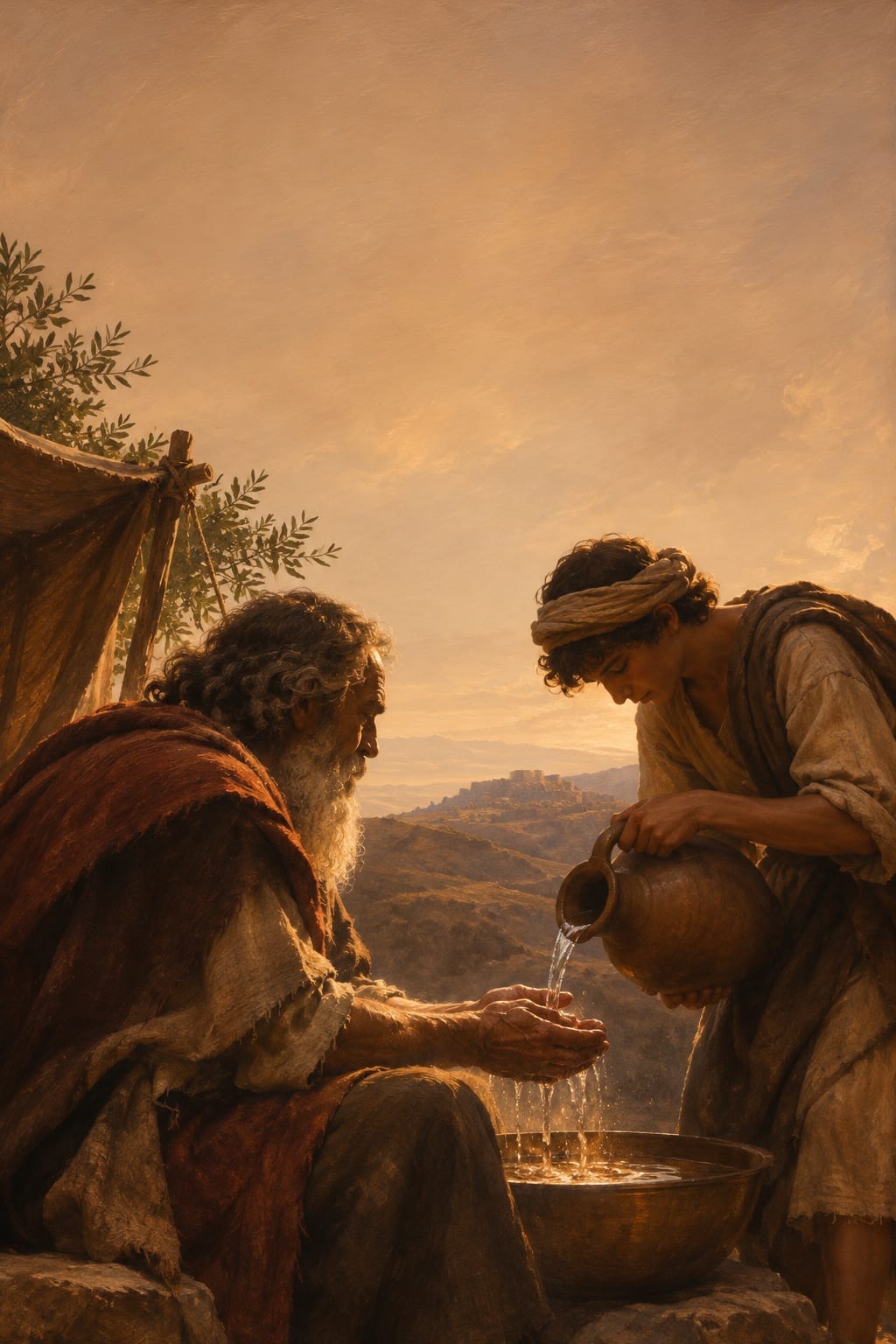
The One Who Poured Water on Elijah's Hands
1 Kings 19:19-21; 2 Kings 3:116 min
Before Elisha is a prophet, his only title is the boy who pours water on his master's hands — because the years near someone are how God forges the years after them.
Scripture
1 Kings 19:19-21; 2 Kings 3:11
Key moment 2 Kings 3:11
Read
There is a moment, years before any miracle, when a young man slaughters his own oxen and burns the plow.
Elisha is in the field, twelve yoke of oxen ahead of him, when Elijah passes by and throws his cloak across his shoulders. No words. Just the mantle, dropped and lifted again, and a man walking on. Elisha runs after him. Let me kiss my father and my mother, and then I will follow you. Elijah's reply is famously cryptic: Go back again, for what have I done to you?
What Elisha does next is not asked of him. He goes home, takes the yoke of oxen — his livelihood — and slaughters them. He breaks up the wooden plow and uses it as fuel. He cooks the meat over the fire of his old vocation and feeds it to the people. Then he gets up and follows Elijah.
And disappears.
The text simply says: He arose and went after Elijah and assisted him. In Hebrew, yesharetehu — he ministered to him, attended to him, served him. We do not hear from Elisha again for years. Multiple chapters pass. Whole regimes of Israel cycle through. Elijah continues to confront kings and pray fire from heaven. Elisha is somewhere in the background, doing what young attendants did: carrying the bag, fetching the bread, pouring the water.
This is not a flattering interlude. It is a long one.
When Elisha finally re-enters the narrative as a named figure, the king of Israel is in trouble in the wilderness, looking for a prophet. One of his servants speaks up:
Elisha the son of Shaphat is here, who poured water on the hands of Elijah.
-- 2 Kings 3:11
That is his title. The one who poured water on Elijah's hands. In ancient Near Eastern protocol, pouring water on a master's hands before a meal was the duty of the most personal servant. It is not the title of a prophet. It is the title of an attendant. After all this time, after all this proximity, the credential the servant offers the king is not Elisha, the man of fire, but Elisha, the one who handled the basin.
And that is the credential that gets the king his miracle. The water in the wadi. The defeat of Moab. Everything Elisha is about to become is unlocked, in the king's eyes, by the basin he carried for years.
The Hebrew Bible is quietly insistent about this pattern. Joshua is Moses' aide (mesharet) for forty years before he leads anyone across the Jordan. Samuel grows up running errands for Eli in the temple. David tends his father's sheep until the prophet shows up with the oil. Mary spends thirty years raising the Word made flesh in a small Galilean town before the wedding at Cana ever happens. The pattern is too consistent to be accidental.
The water-pouring is not a prelude to the prophetic life. It is part of it. It is the part where God forms the inner posture of the one who will later be trusted with fire. Elisha does not become a great prophet despite the bowl. He becomes a great prophet through it.
When the chariots come and Elijah is taken, Elisha will pick up the mantle that fell. He will strike the Jordan and ask, Where is the Lord, the God of Elijah? The river will split. He will go on to do, by traditional count, twice the recorded miracles of his master.
But none of it happens before the bowl.
Today
You may be in a season where the only assignment God has given you is proximity.
You had bigger ideas about this year. You thought, by now, you would be leading the thing, building the thing, named in the room you used to only carry chairs into. Instead you are still doing the equivalent of pouring water on someone else's hands. You are second-seat to a vision that is not yet yours. You are doing the unglamorous, unseen, towel-and-bowl work of an apprentice. The miracles you imagined are nowhere in sight. The mantle has not fallen. You are wondering if the call was real, or if you missed a turn somewhere and ended up in someone else's story instead of your own.
Elisha would tell you the bowl is the story. Not a delay before it. Not an audition for it. The actual story.
What is happening in these years is not that God is testing your patience. He is forging your interior. He is teaching you how to be near someone whose ceiling you might one day exceed without resenting them for the smallness of the seat you currently occupy. He is giving you the long, slow education of attending to another person's vision until something in you is purified of the need to be the one in front. He is letting your name be associated with a basin until you have become the kind of person God can finally trust with a mantle.
The miracles will come. They almost always come, in scripture, after the bowl. Iron will float. The widow's oil will multiply. Naaman will be cleansed. Lepers will leap. The chariots of fire will tear the sky for someone, and the one who has been pouring water for years will finally lift his eyes and see what God has been quietly preparing him to receive.
In the meantime: pour the water well. Pour it like it matters. Because it does. The bowl in your hands today is the apprenticeship that makes the mantle wearable tomorrow.
Pause
Take a slow breath.
Sit with what you've read.
Ponder
What is the bowl in your life right now — the small, unseen, second-seat work that feels like a delay but might be the actual formation?
Where are you tempted to resent the smallness of the seat you currently occupy, and what is that resentment trying to protect?
If proximity is the assignment for this season, who has God placed you near, and what could you receive from being there that you cannot receive anywhere else?
Pray
A prayer
Lord God of Elijah and Elisha, you are the One who calls in the field, drops the mantle, and then disappears for years into the long hidden work of forming the next prophet through a bowl. Let your kingdom come in the season where I am only an attendant, and let your will be done in the slow purification of my need to be in front. Forgive me for despising the towel and the basin. Forgive me for the days I have measured my worth by my title and resented the seat you have asked me to occupy. Give me, today, the steady hands of the one who pours water well. Make me faithful in the small acts of nearness. Teach me to attend to another person's vision without losing my own, and to wait for the mantle without grasping at it. When the chariots come and the river finally splits, let me be the kind of soul who remembers that none of it was self-made. The bowl was always your gift. So is the fire.
Amen.
Pour the water well.The mantle is being readied for the hands that have learned the bowl.