The Pride That Hides Inside Refusing the Towel
John 13:1-177 min
Peter, who will lead the church, must first let Jesus kneel with the towel — because the discipleship that ends in washing others always begins with being washed.
Scripture
John 13:1-17
Key moment John 13:6-9
Read
It is the last meal, and the rabbi takes off his outer robe.
John slows everything down for this scene. Before the bread, before the betrayal, before the long discourse, there is this: Jesus, knowing that the Father had given all things into his hands, and that he had come from God and was going back to God, rose from supper. He laid aside his outer garments, and taking a towel, tied it around his waist.
He is fully aware of his authority. The text is at pains to tell us this. Knowing all things had been given into his hands. And it is precisely from that knowledge that he reaches for the towel. Not despite his power, but because of it.
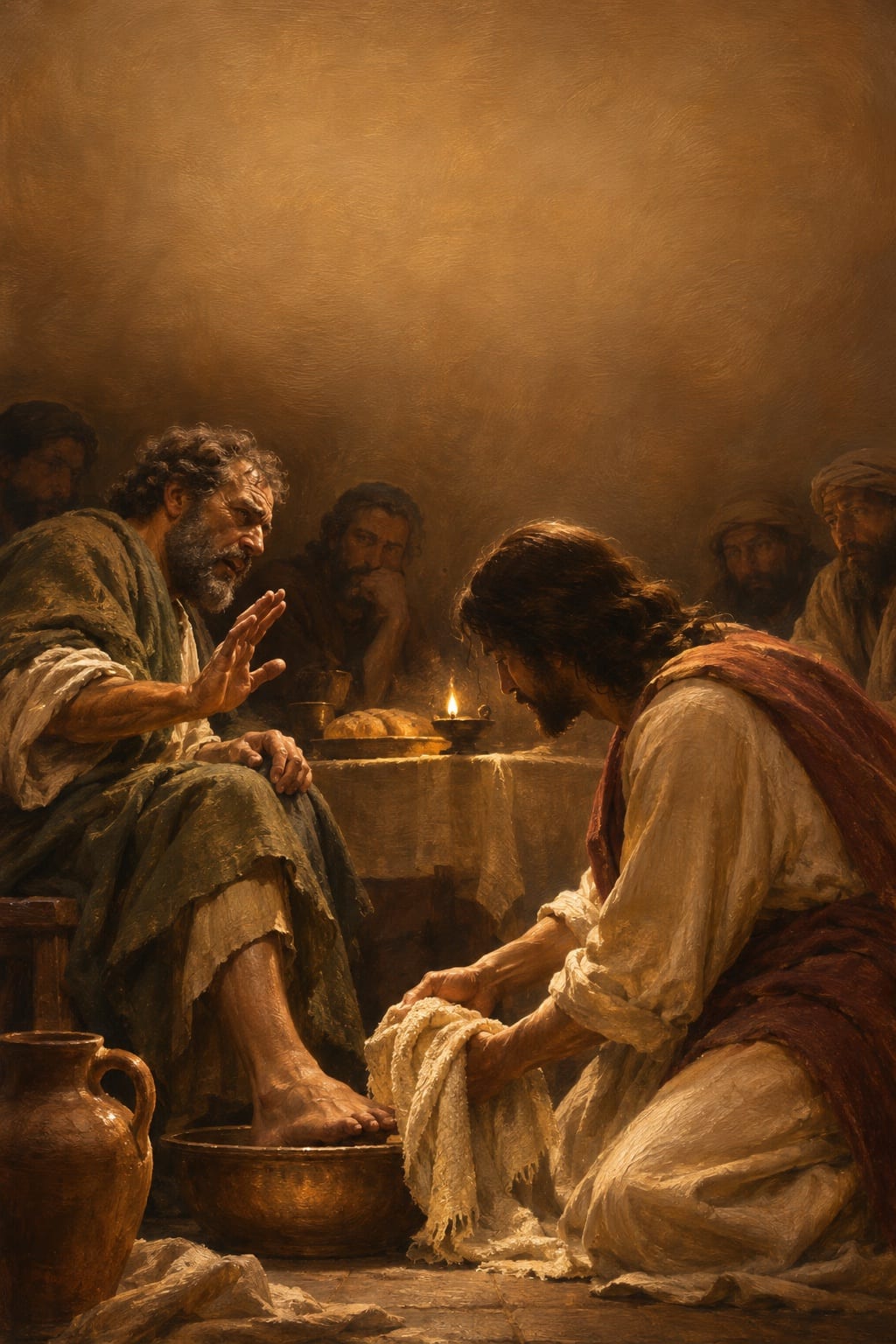
Foot-washing in that culture is the lowest task in the household. It is reserved for non-Jewish slaves; a Jewish servant could not be required to do it. The disciples have walked the dusty road in sandals to this upper room, and the basin sits there, untouched, because no one in the room has been willing to take the role of the slave. They have been arguing again, Luke tells us elsewhere, about who is the greatest. So Jesus stands up, ties the towel around his waist, and answers the argument with his body.
He goes around the table. We are not told what the others do as he reaches them. We can imagine the silence. The shock of watching the rabbi crouch in front of you with a basin.
Then he gets to Peter.
Lord, do you wash my feet?
-- John 13:6
Peter cannot bear it. He has been the bold one all along. He walked on water for three steps. He confessed Jesus as the Christ. He swore he would die for him. And here is his teacher kneeling at his feet, and every theology Peter has knit together about who-serves-whom in the kingdom of God comes apart in his hands.
Jesus answers gently. What I am doing you do not understand now, but afterward you will understand.
Peter doubles down.
You shall never wash my feet.
-- John 13:8
Hear what is in that never. It sounds like reverence. It sounds like humility. I am not worthy. But Jesus exposes what is actually underneath, and his answer is one of the sharpest lines in the Gospels.
If I do not wash you, you have no share with me.
-- John 13:8
Ouk echeis meros met emou. You have no portion with me. The same word for inheritance. To refuse to be washed is to refuse the relationship. Peter is being told that the kingdom does not begin with him serving Jesus; it begins with Jesus serving him. And until he can let himself be tended to, he is outside the room.
Peter swings the other direction with characteristic excess.
Lord, not my feet only but also my hands and my head.
-- John 13:9
The pendulum from refusing everything to demanding everything is still about Peter being the one in control of the transaction. Jesus quietly trims him back: the one who has bathed does not need to wash, except for his feet. You are already mine. Just receive what I am giving you tonight.
When Jesus is finished, he puts his outer robe back on, sits down, and tells them what they have just witnessed. If I then, your Lord and Teacher, have washed your feet, you also ought to wash one another's feet. The lesson is in two acts. First the receiving. Then, only then, the imitating.
The man who could not let his feet be washed is the same man who, days later, denies even knowing the one who washed them. The pride that hid inside you shall never wash my feet is the same pride that says I do not know him by the fire. He has to be restored on a beach, fed breakfast he did not catch, asked three times do you love me, before he can finally feed the lambs. The pattern holds. Receive first. Then serve.
Today
You may be the most competent person in your life.
You show up. You carry. You anticipate what other people need before they have to ask. You are the friend who brings the meal to the new mother, the colleague who covers the gap, the sibling everyone calls when something falls apart. Service is your native language. You are fluent in giving.
And you are almost completely unable to be on the other side of the basin.
When someone tries to tend to you, you deflect. You change the subject. You insist you are fine. You make a joke. You do the dishes in their kitchen while they are trying to hand you tea. You tell yourself this is humility. You tell yourself you do not want to be a burden. You tell yourself other people need it more. The truth is harder. There is a pride that hides inside refusing the towel. It is the pride of being the one who never needs anything. It is the pride of being indispensable, irreproachable, self-sufficient. It is the pride that lets you stay in control of every transaction, including the ones with God.
Jesus will not let Peter keep that pride, and he will not let you keep it either. If I do not wash you, you have no share with me. The kingdom is not first a place where you serve him. It is first a place where he serves you. The towel he ties around his waist on the last night of his life is not a costume he is trying on. It is who he is. And the discipleship he is offering you is the discipleship that begins with letting him kneel.
This is the apprenticeship for everyone who will eventually lead, build, give, or pastor anything. You cannot wash feet you have refused to let be washed. The water has to come for you first. Today, that might mean letting a friend pray for you out loud. Letting your spouse bring you the cup of tea without rinsing the kettle yourself. Letting Jesus, in the quiet of the morning, simply love you before you have done one useful thing for him. Stop pulling your foot back from the basin. Let him be your Lord by being your servant first.
Pause
Take a slow breath.
Sit with what you've read.
Ponder
Where in your life are you saying you shall never wash my feet in the language of competence — deflecting care, refusing help, performing self-sufficiency?
If receiving from Jesus has to come before serving for him, what is the smallest act of being tended to you can let happen this week without rerouting it?
What pride is hiding inside your version of humility, and what would it cost you to let it be exposed?
Pray
A prayer
Lord Jesus, the One who knew all authority was in your hands and chose the towel, you are the Servant-King, the Rabbi who kneels, the Lord who refuses to be loved without first being allowed to wash. Let your kingdom come in the parts of me that have armored themselves with competence, and let your will be done in the slow undoing of my self-sufficiency. Forgive me for the pride that wears the costume of humility, for the never I have spoken to your kindness, for the way I have tried to keep our friendship a transaction in which I am always the giver. Kneel in front of me today. Wash what I have been ashamed of. Tend to the parts of me I have hidden even from myself, the dust I have walked in and pretended did not stain. Give me the courage to lift my foot toward the basin and leave it there. And when I am clean, send me out to wash other people's feet, but never before I have remembered whose feet were washed first.
Amen.
Let him kneel.You are washed before you wash anyone.