The Runaway Who Named God
Genesis 16:7-144 min
When Hagar fled into the wilderness, pregnant and discarded, she became the first person in Scripture to give God a name — El Roi, the God who sees. Her story reveals that God's gaze finds us precisely where everyone else's has turned away.
Scripture
Genesis 16:7-14
Key moment Genesis 16:13-14
Read
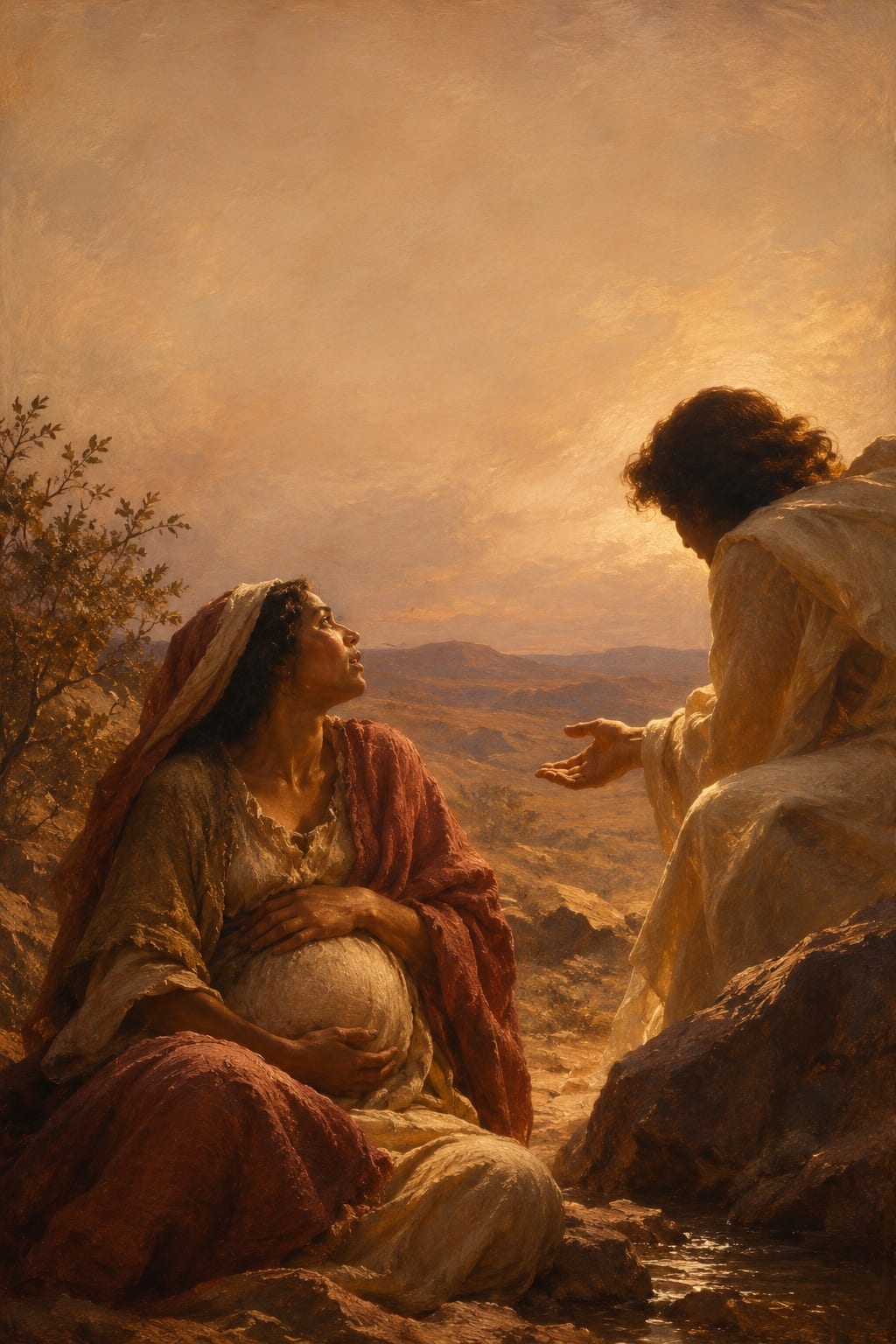
She was a slave, pregnant, and running. The text doesn't romanticize her flight — Hagar left because the household that was supposed to protect her had crushed her instead. Sarai dealt harshly with her, and Abram, the man of faith, shrugged and looked away. So Hagar did the only thing left: she ran toward nothing, into the desert between Shur and Egypt, a woman with no status, no resources, and no plan beyond away.
The angel of the Lord found her beside a spring of water in the wilderness. Notice the verb: found. Not summoned. Not punished. Found — the way you find something precious that's been lost. And the first thing God did was speak her name. "Hagar, servant of Sarai, where have you come from and where are you going?" He already knew. The question wasn't for His benefit; it was an invitation for her to hear herself tell the truth. She answered with raw honesty: "I am fleeing from my mistress Sarai."
What follows is complicated. God told her to return and submit — a hard word that resists easy commentary. But wrapped inside that hard word was an extraordinary promise: her son would become a great nation, his name Ishmael, meaning God hears. A slave woman in the ancient Near East had no legal standing, no inheritance rights, no voice. God gave her all three in a single conversation.
Then Hagar did something no one else in the entire Bible does — she gave God a name. El Roi, the God who sees me. "Have I really seen the one who sees me?" she whispered. The well became Beer Lahai Roi, the well of the Living One who sees. In that barren place between nowhere and nowhere, a dismissed woman looked at God and said: You looked at me first.
Today
Most of us know what it's like to feel invisible in a room full of people. Maybe the invisibility is social — you're the one others talk past, plan around, forget to invite. Maybe it's deeper: shame has convinced you that being truly known would only confirm what you fear about yourself. So you learn to manage impressions, keep the real story locked away, and run your own quiet version of Hagar's flight toward Shur.
Vulnerability feels like exposure, and exposure feels like danger. That instinct isn't wrong — people do hurt what they can see. Hagar knew that firsthand. But the wilderness has a strange gift buried in its emptiness: there is no audience left to perform for. When every pretense has been stripped, when you're sitting beside whatever spring you've stumbled upon with nothing left to offer, God's seeing becomes something different from surveillance. It becomes recognition. He speaks your name, not your label.
Hagar's story doesn't end with escape. It ends with her walking back into a hard situation carrying a promise and a name she gave to God Himself. The circumstances didn't immediately soften, but she was no longer unseen. That changes everything — not because the desert disappears, but because Someone met you in it, called you by name, and said your future matters. The dignity God gives isn't contingent on anyone else's recognition. El Roi saw Hagar before Abraham's household ever valued her, and He sees you in the hidden places you haven't shown anyone else.
Pause
Take a slow breath.
Sit with what you've read.
Ponder
Where in your life right now do you feel most invisible — and what would it mean to believe God's attention is already there?
Hagar told God the honest truth about her situation without dressing it up. What truth have you been reluctant to say out loud, even to God?
Is there a 'wilderness spring' — a quiet, unexpected place — where you've sensed God meeting you recently?
Pray
A prayer
El Roi, God who sees me, You found Hagar beside a spring in the desert when no one else was looking for her. You spoke her name before You spoke Your instructions. I confess that I have hidden — from others, from myself, sometimes from You — because being seen has felt more like a threat than a gift. Forgive me for believing that my invisibility was the final word. Let Your kingdom come into the overlooked corners of my life, the places I've decided don't matter. Give me today the courage Hagar had: to answer honestly when You ask where I've come from, and to trust that You already see where I'm going.
Amen.
You are seen, and you are named.El Roi's gaze has never turned away from you — not once.