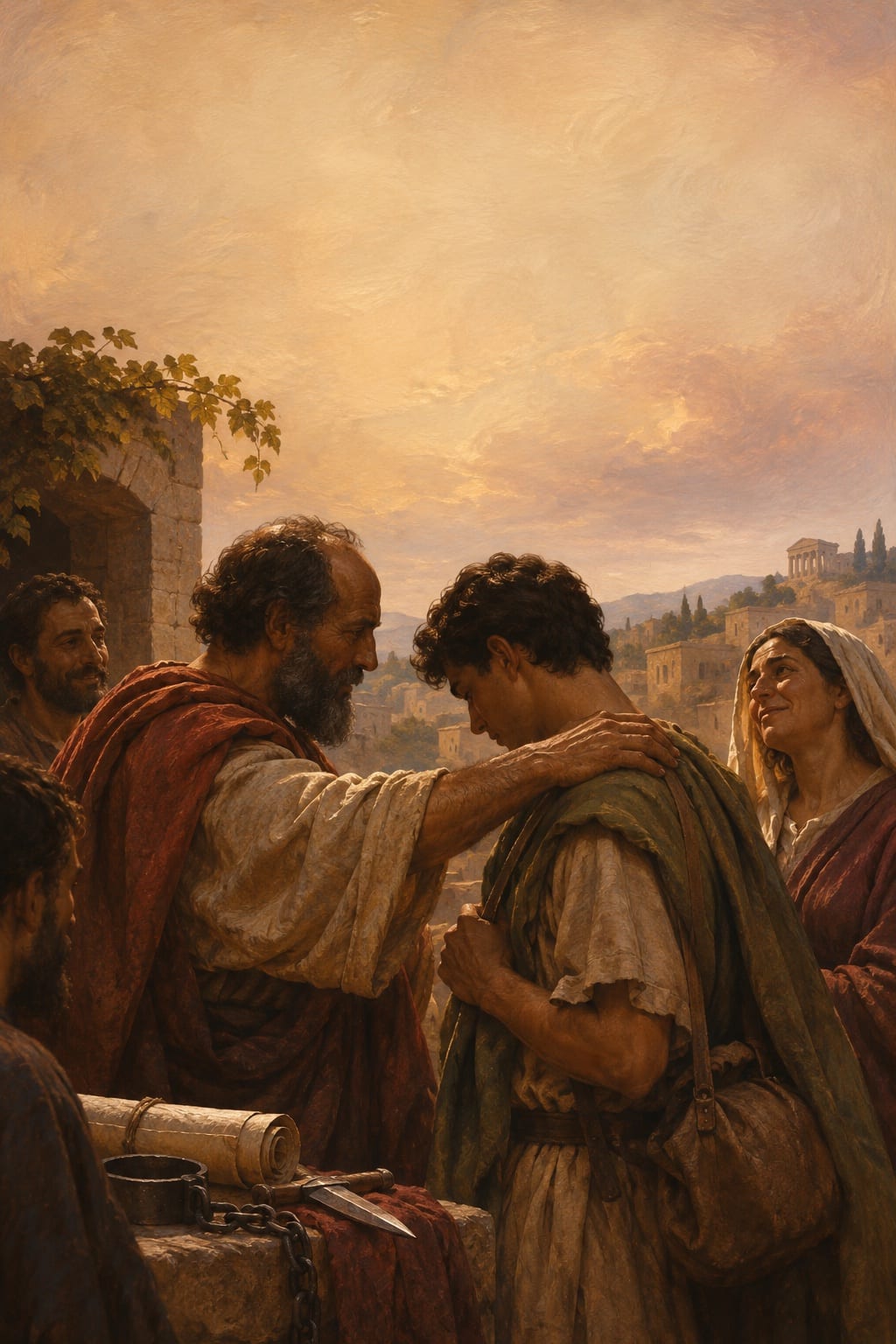
The Son in the Faith Who Stayed Under the Cost
Acts 16:1-58 min
Timothy joins Paul knowing what it will cost him — a knife, displacement, riots, chains — and becomes the apostle's most loved son in the faith.
Scripture
Acts 16:1-5
Key moment Acts 16:1-3
Read
Paul comes back through Lystra and finds a young man with a divided pedigree.
Luke gives us Timothy in three quick brushstrokes. A disciple was there, named Timothy, the son of a Jewish woman who was a believer, but his father was a Greek. He was well spoken of by the brothers at Lystra and Iconium. That is all the introduction we get. A mixed-marriage household. A believing mother (Eunice) and a believing grandmother (Lois) who, as Paul will later remind him in 2 Timothy, taught him the sacred writings from childhood. A father who is conspicuously absent from the spiritual formation of his son. A reputation, by his late teens or early twenties, that the surrounding churches had already noticed.
Lystra is not a happy place to be a missionary. The last time Paul was here, the crowd that had tried to worship him as a god turned around and stoned him so badly they dragged him outside the city assuming he was dead. Timothy may very well have been there that day. He may have been one of the people who watched the apostle stand back up and walk back into the city that had just tried to murder him. If he was, then what happens next has a particular weight.
Paul wanted Timothy to accompany him.
-- Acts 16:3
Three words, in our translation. Wanted to accompany. The Greek is ēthelēsen ex-elthein syn autō — he willed for him to go out together. Paul, the man who has been beaten with rods, stoned, run out of cities, plotted against, the man whose ministry leaves a trail of riots, looks at this young disciple and decides he wants him under his wing.
And then Luke tells us the cost.
He took him and circumcised him because of the Jews who were in those places, for they all knew that his father was a Greek.
-- Acts 16:3
This is one of the most controversial verses in Acts. Paul, who has just spent years arguing in Galatia that Gentiles must not be circumcised, takes a knife to a young man whose father was Greek so that the synagogues will not be closed to him as they travel. The text does not explain Timothy's feelings. It simply shows us a young disciple, in his early twenties at most, willing to undergo a painful, public, irreversible procedure for the sake of a mission and a man he has decided to follow.
This is the moment Timothy's apprenticeship begins. With a knife. With a price.
And it does not stop there. Over the years that follow, Timothy will be present for the riot in Thessalonica, the conversion of Lydia in Philippi, the arrest in Philippi (he is one of the we in Luke's narrative for some of this), the long-night labors in Corinth, the silversmith riot in Ephesus, the journey to Jerusalem, the imprisonments. He will be sent ahead by Paul, sent back to check on churches, sent into difficult congregations to handle conflict. He will get sick. He will be timid. He will weep, often enough that Paul has to mention his tears in his last letter. He is not the iron-willed, charismatic kind of leader. He is a sensitive, faithful, sometimes overwhelmed young man who has decided that being near this apostle is worth what it costs him.
And somewhere along the way, the relationship turns.
In Philippians, near the end of his life, Paul writes: I have no one like him, who will be genuinely concerned for your welfare. For they all seek their own interests, not those of Jesus Christ. But you know Timothy's proven worth, how as a son with a father he has served with me in the gospel.
As a son with a father.
-- Philippians 2:22
That line costs everyone reading it. Paul does not write as an assistant with his boss. Not as a junior with his superior. As a son with a father. The apprenticeship has produced a kinship the original commitment could not have predicted. Timothy left a household with a believing mother and an absent father, and he found a spiritual father in a difficult, controversial, sometimes prickly apostle who poured his whole life into him.
The demand never softened. The intensity never let up. Paul will be writing to Timothy until the very end, sending him into messes, asking him to come quickly, asking him to bring the cloak and the books and the parchments. The last surviving letter we have from Paul is, almost certainly, a letter to Timothy. Do your best to come to me soon. The old apostle, in chains, asking for his son.
This is what staying under cost. Not a romance. A formation. The demanding mentor became a father. The young disciple became a son. The exchange was costly the whole way through. And the New Testament keeps both their names together, like a hyphenated kinship the church cannot stop reading aloud: Paul and Timothy, servants of Christ Jesus...
Today
You may be in a season of staying under a mentor whose intensity is shaping you in ways you cannot yet name.
They are real. They are not a curated leader from a podcast. They are demanding. Sometimes they are wrong. They cost you things. They make decisions about your life that you would not have chosen, and they ask of you a level of submission that the modern world considers, frankly, a little embarrassing. You see their flaws. You feel the weight of their expectations. There are days you think about leaving and finding a softer arrangement. There are days you cannot tell whether the formation you are receiving is sanctification or compliance.
Timothy lived under a demanding apostle for the better part of two decades. He paid in flesh, in geography, in safety, in reputation. He inherited Paul's enemies along with Paul's commission. He was sent into churches he had not chosen, given problems he had not created, asked to fix conflicts he had not started. Paul was an intense man. There is no version of the New Testament that softens that. He could be sharp; he was, at one point, sharp enough that he and Barnabas split. He could be heavy in his expectations. He carried the kind of fire that burns whoever stands closest to it.
And Timothy chose to stand closest.
What staying under cost him produced what nothing else could have produced: a sonship. A kind of trust between two men that the modern, frictionless idea of mentorship cannot manufacture. The spiritual fatherhood Paul felt for Timothy was earned in a thousand uncomfortable nights, a thousand difficult assignments, a thousand small surrenders to a relationship that demanded more than mere employment ever could. By the end, Paul could not write a letter without naming him. The kinship the apprenticeship eventually became was worth every painful chapter the apprenticeship had cost.
If you are staying under someone whose intensity is forming you, hear this carefully. The demand is not the betrayal you sometimes suspect it to be. The cost is not a sign you are in the wrong place. The exchange of everything ordinary for everything formative is exactly the trade Timothy made, and it produced a man the early church would later trust to lead Ephesus. Stay under, when staying under is right. Pay the cost, when the cost is the curriculum. Honor the flawed person God has placed in front of you. Let the apprenticeship do its slow work.
The sonship comes later. It almost always does. And when it comes, the person you have served for years will look at you and say, in the language Paul gave us, as a son with a father, you have served with me. That sentence is worth the long obedience that produced it.
Pause
Take a slow breath.
Sit with what you've read.
Ponder
Where in your life are you staying under a mentor whose intensity is shaping you in ways you cannot yet name, and what is the cost you keep wanting to renegotiate?
What in you is being forged through this apprenticeship that could not be forged in a softer, more frictionless arrangement?
If sonship is what the long obedience eventually produces, how does that change the way you read this current chapter under your mentor?
Pray
A prayer
Lord Jesus, the One who placed Timothy under Paul and Paul under no one but you, you are the Master who calls disciples into apprenticeships that cost everything ordinary, the One who turns demanding mentors into spiritual fathers and reluctant young followers into beloved sons. Let your kingdom come in the relationship I am tempted to escape, and let your will be done in the formation I cannot yet name. Forgive me for measuring my mentor against an ideal you never promised, and for the days I have used their flaws as a reason to withdraw the submission you were asking of me. Give me the courage of the young man at Lystra who let the knife do what the knife had to do for the sake of the mission. Make me faithful in the long apprenticeship, willing to carry the weight, willing to inherit the enemies, willing to learn the gospel through the hands of the imperfect father you have given me. And in your time, turn the apprenticeship into a sonship that the church will read aloud long after both of us are gone.
Amen.
Stay under faithfully.The sonship comes after the long obedience.