The Weight You Were Never Meant to Carry Alone
Mark 10:13-167 min
When the disciples saw children as interruptions to important kingdom work, Jesus turned their hierarchy upside down — declaring that the Kingdom itself belongs to those who come with nothing but open hands and unhurried trust.
Scripture
Mark 10:13-16
Key moment Mark 10:14-16
Read
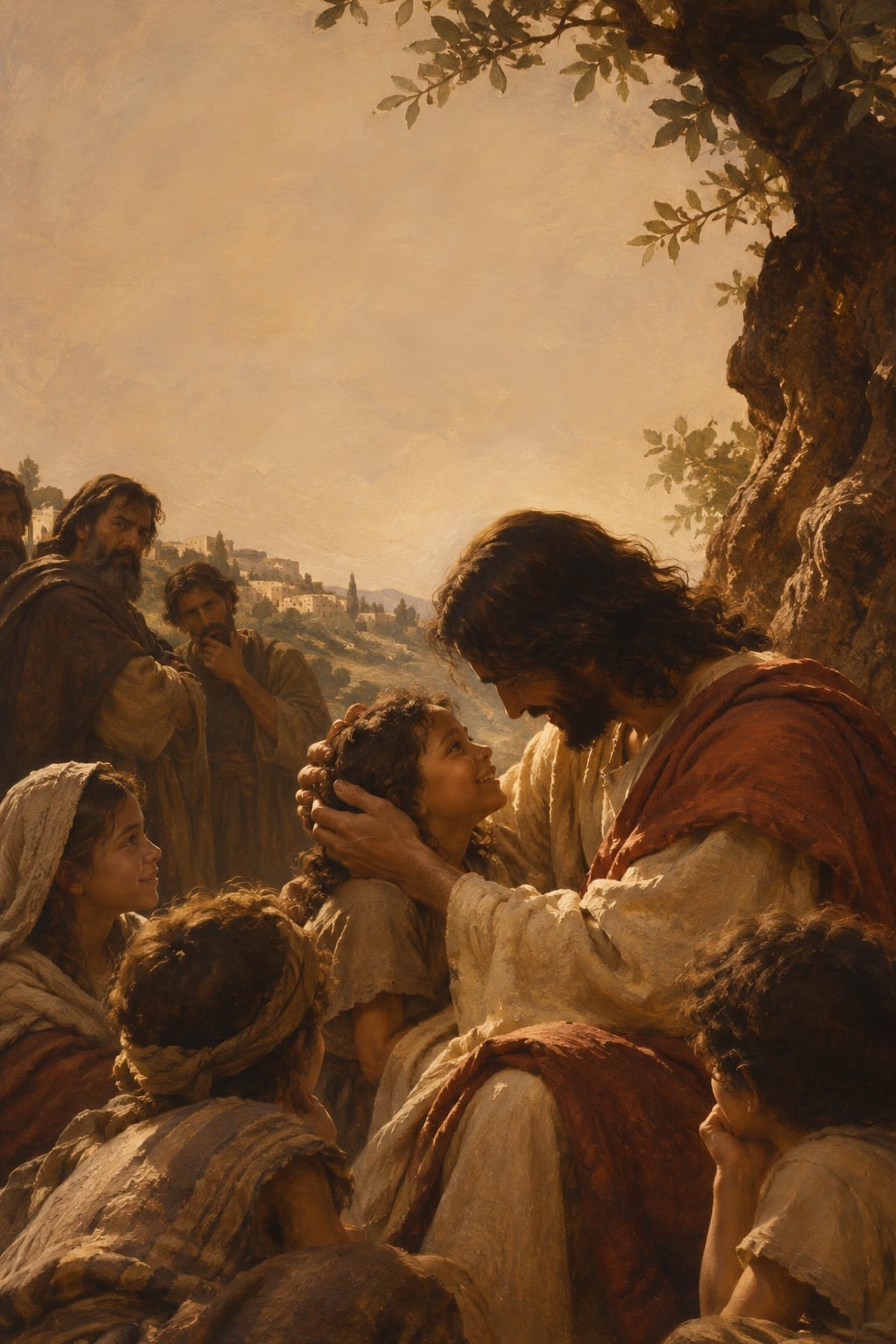
Picture the scene for a moment. Jesus has been teaching about divorce, fielding questions from Pharisees, navigating the kind of theological sparring that requires precision and stamina. The disciples are in full operational mode — managing crowds, filtering access, keeping the mission on track. They have important things to do. And then come the mothers, pressing through with their children, hoping Jesus might lay His hands on them and pray.
The disciples do what any good gatekeeper would do: they rebuke them. The Greek word here, epitimaō, is strong. It's the same word used when Jesus rebuked demons and silenced storms. The disciples weren't gently redirecting; they were shutting it down. He's busy. This isn't the time. There are more pressing matters.
And Jesus — who rarely showed frustration with the crowds, who patiently endured misunderstanding after misunderstanding — became indignant. Mark is the only Gospel writer who uses that word, ēganaktēsen. It means something deeper than annoyance. Jesus was grieved. He was disturbed at the gut level. Because the disciples had just blocked the very posture that unlocks everything.
"Let the little children come to me, and do not hinder them, for the kingdom of God belongs to such as these. Truly I tell you, anyone who does not receive the kingdom of God like a little child will never enter it."
-- Mark 10:14-15
Notice the verb: receive. Not build. Not earn. Not strategize into existence. Receive. The way a child receives something is fundamentally different from how an adult does. A child doesn't calculate whether they deserve it. They don't mentally rehearse what they'll owe in return. They don't hold the gift at arm's length, inspecting it for strings attached. They just open their hands.
Then Mark records something only he captures. Jesus didn't just bless the children from a distance or wave a hand over them in a general benediction. He took them in His arms. The Greek, enagkalisamenos, means He folded them into His embrace. He held them. And from that position of closeness, He placed His hands on them and blessed them.
This is the image Jesus chose to illustrate what the Kingdom looks like from the inside. Not a boardroom. Not a battlefield. Not even a pulpit. A child, folded into arms stronger than their own, receiving blessing they didn't earn and couldn't repay.
What makes this moment even more striking is its placement in Mark's Gospel. Just a few verses later, a rich young ruler will approach Jesus asking how to do enough to inherit eternal life. He'll list his accomplishments, his moral resume. And he'll walk away sad, because he couldn't let go of what he'd built. The children, who had nothing to offer and no resume to present, were already in the place the ruler couldn't find. They were already held.
Jesus Himself lived from this posture. He told His disciples plainly: "The Son can do nothing by himself; he can do only what he sees his Father doing" (John 5:19). The most consequential life ever lived was not powered by self-sufficiency. It was powered by dependence. Jesus prayed before every major decision. He withdrew to be with the Father when the crowds pressed hardest. He trusted the Father's timing even when it meant waiting, even when it meant Gethsemane. Even when it meant the cross.
The One who held the children was Himself held by the Father. And that holding was enough.
Today
If you're a new father, you know a particular kind of holding. There's a moment, maybe in the middle of the night, when your daughter falls asleep on your chest. Her whole body softens. Her fist unclenches. She isn't thinking about whether you'll pay the mortgage or whether your career trajectory is on track. She doesn't know what a career trajectory is. She just knows warmth, heartbeat, presence. She rests because you're there, and that's the whole equation.
You, meanwhile, are probably doing math in your head. Running tomorrow's schedule. Rehearsing a conversation with your boss. Wondering if you're doing enough, being enough, providing enough. Your body is in the rocking chair, but your mind is three weeks ahead, solving problems that may never materialize.
This is the tension the disciples embodied that day on the road. They were so focused on managing the mission that they almost blocked the very thing Jesus came to offer. And the rebuke wasn't harsh for harshness' sake. It was an invitation disguised as correction: You're working so hard to build something. But the thing you're building for? It's received, not constructed.
After a long season of leading, deciding, discerning, acting — all good and necessary things — there's a different gear available to you. Not a lesser gear. A truer one. The gear where you stop white-knuckling the future and let yourself be fathered.
Your daughter is teaching you something every time she falls asleep in your arms. She's showing you what trust looks like before the world complicates it. Before performance metrics and professional expectations and the quiet pressure to hold everything together. She doesn't rest in your arms because she's assessed your competence. She rests because you're her father. That's it.
God is not waiting for you to get the balance right between fatherhood and work before He blesses you. He's not holding provision hostage until you optimize your schedule. The kingdom doesn't belong to the ones who finally figure it out. It belongs to the ones who stop figuring and start receiving.
This doesn't mean abdication. Jesus wasn't passive. He worked, He taught, He confronted injustice, He sweat blood in prayer. But underneath all of that action was a root system of utter dependence. He could pour Himself out because He knew He was held. The doing flowed from the being-held, not the other way around.
You can lead well at work and come home and lead well at home. But the fuel for both is not your competence. It's your willingness to be small enough to be carried. To let the Father's arms be the thing underneath all your responsibilities, not your own grip strength.
So tonight, when you hold your daughter, let the picture preach to you. You are doing for her exactly what God is doing for you. And just as she doesn't need to understand how the furnace works to be warm, you don't need to understand how God will sort out every detail to be at peace. You just need to let your fist unclench.
Pause
Take a slow breath.
Sit with what you've read.
Ponder
Where in your life right now are you white-knuckling something that God is asking you to release into His hands?
What would it look like this week to receive one good thing — rest, provision, encouragement — without immediately calculating what you owe in return?
When you hold your daughter, what does her trust teach you about your own posture with God?
Pray
A prayer
Father, good Father, who holds all things together while I sleep, I confess that I have been gripping too tightly. I've carried the weight of provision and performance as though it all depended on my strength, my strategy, my next move. Forgive me for the arrogance hidden inside my anxiety — the quiet belief that if I stop striving, everything falls apart. Your kingdom come in my home, in my work, in the quiet hours when I rock my daughter to sleep and my mind races ahead to problems I cannot yet solve. Your will be done in the parts of my life I keep trying to control. Give me today what I need for today. Not next month's assurance, not next year's clarity. Just today's bread. Teach me to receive like the children You pulled into Your arms. Not earning, not performing, just opening my hands. I want to trust You the way my daughter trusts me — completely, without rehearsal, without a backup plan. Carry what I cannot carry. Hold what I cannot hold. And let me rest in the arms that have never once let go
Amen.
Let your fist unclench. You are held.The Father's arms have never once let go.