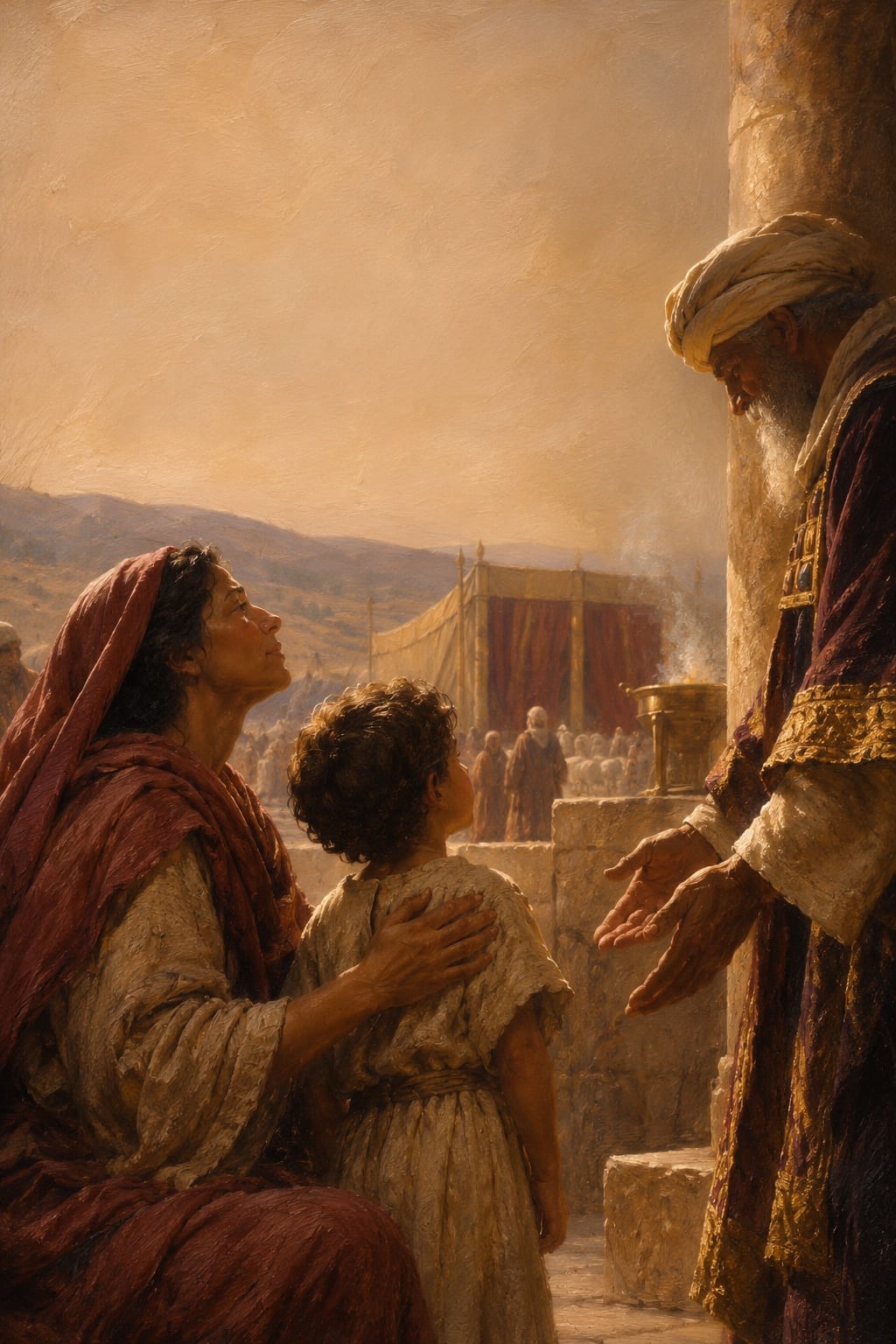
The Woman Who Gave Back What She Begged For
1 Samuel 1:1-287 min
After years of barrenness and anguished prayer, Hannah receives her son Samuel—and then returns him to the Lord's service at Shiloh, revealing that the deepest act of faith isn't receiving a blessing but releasing it back into God's hands.
Scripture
1 Samuel 1:1-28
Key moment 1 Samuel 1:27-28
Read
She had walked this road to Shiloh before. The same dust on her feet, the same hills rising in the distance. But everything else was different.
The last time Hannah made this journey, she was hollowed out. Peninnah's taunts rang louder than the festival songs, and Elkanah's love—real as it was—couldn't fill the empty place inside her. She had wept until her lips moved without sound, and the old priest Eli mistook her agony for drunkenness. That's how ragged grief can look from the outside: indistinguishable from someone who has lost control.
But God heard what Eli couldn't see. The Hebrew word for Hannah's prayer in verse 15 is shaphak—she "poured out" her soul. It's the same word used for pouring out water or blood, something that empties you completely. Hannah held nothing back.
And God answered. Samuel was born. His very name encodes the story: Shemu'el, which Hannah explains as "I asked the LORD for him." Every time she spoke her son's name, she was rehearsing the faithfulness of God.
Now picture what comes next, because it would have unfolded slowly. Hannah nursed Samuel through his early years, watching him grow from infant to toddler, hearing his first words, feeling his small hand wrap around her finger. She had time to bond, time to fall in love with this child in the specific, daily, unrepeatable way that mothers do. This was not a rushed transaction. She knew exactly what she was bringing to Shiloh.
"For this child I prayed, and the LORD has granted me my petition that I made to him. Therefore I have lent him to the LORD. As long as he lives, he is lent to the LORD."
-- 1 Samuel 1:27-28
The word translated "lent" is sha'al—the same root as "asked." Hannah creates a deliberate echo: I asked him from the Lord, and now I give him back to the Lord. The asking and the returning are bound together; they were never separate acts in her mind.
She arrived at Shiloh with a three-year-old bull, flour, and wine—a substantial offering, not an afterthought. She slaughtered the bull. She brought Samuel to Eli, the same priest who had once questioned her sobriety. And she said, in effect: You remember me. I was the desperate woman. This boy is the answer. And I'm leaving him here.
There is no record of Hannah wavering. No negotiation, no delay, no bargaining for one more year. The text moves with the same certainty Hannah carried. She had made this decision long before she packed for the journey.
What follows in chapter 2 is Hannah's song, and it's remarkable for what it doesn't contain. There is no grief in it, no reluctance, no self-pity. Instead, Hannah sings about the God who reverses everything—who lifts the poor from the dust, who fills the hungry, who breaks the mighty bow. She sings as a woman who has seen both sides of God's economy: the emptying and the filling, the asking and the releasing. She trusts that the same God who heard her weeping will watch over her son in ways she never could.
And here's what the text quietly tells us afterward, almost as a footnote: Hannah didn't disappear from Samuel's life. Each year she made him a little robe and brought it when she came for the annual sacrifice (1 Samuel 2:19). She stayed connected. She stayed faithful. She kept showing up with what she could offer. But she never tried to take him back.
Today
Most of us understand the prayer of desperation. We know what it is to ask God for something with everything in us—a child, a relationship, a job, healing, a second chance. The asking comes naturally when we're empty.
What catches us off guard is what happens after the answer arrives.
When the blessing finally comes, something shifts inside us. Relief hardens into protectiveness. Gratitude slowly calcifies into grip. We hold the answered prayer so tightly that our knuckles whiten, because we remember what it felt like to live without it, and we cannot go back there. The very memory of longing becomes the engine of anxiety.
Hannah's story confronts this with uncomfortable clarity. She didn't clutch Samuel. She didn't say, "God, you gave him to me, so he's mine now." She recognized something that most of us resist: the blessing was always God's. Her role was stewardship, not ownership.
This distinction matters in practical, daily ways. When a new business begins to grow, the temptation is to build walls around it, to control every variable, to treat it as proof of your own competence rather than an unfolding gift. When a child is born or adopted after years of waiting, the fear of losing them can become so consuming that it poisons the joy of having them. When a season of freedom finally opens up—after addiction, after debt, after a suffocating relationship—the impulse to guard that freedom can itself become a kind of prison.
Open-handed trust doesn't mean carelessness. Hannah still made the little robe every year. She was attentive, present, generous with what she could give. Dedication isn't abandonment; it's a posture. It says: This came from You, it belongs to You, and I will care for it as someone entrusted with a gift rather than an owner protecting a possession.
The paradox is that open hands receive more than clenched fists. When Hannah released Samuel, God gave her five more children (1 Samuel 2:21). That's not a formula—give one, get five—but it reveals something about how God works in a heart that trusts Him. Surrender creates room. Grip creates constriction.
Perhaps you're standing at your own Shiloh right now. Something you prayed for has arrived, and God is gently asking you to hold it differently than you planned. Not to give it away, necessarily, but to loosen your fingers. To stop treating it as the thing that keeps you safe and instead let it become the thing through which God works His purposes, even purposes you can't yet see.
Hannah's gift wasn't just her willingness to let go of Samuel. Her gift was the trust beneath the letting go—the deep, tested conviction that the God who heard her weeping in the temple was good enough to receive her boy. She didn't hand Samuel over to uncertainty. She handed him to a Person she knew.
Pause
Take a slow breath.
Sit with what you've read.
Ponder
What blessing in your life are you holding with a closed fist—and what fear is driving that grip?
How might the way you received something (through desperation, waiting, struggle) be shaping how you relate to it now?
If you trusted that God's purposes for your blessing were better than your plans, what would you do differently this week?
Pray
A prayer
Father of every good gift, You who heard Hannah's silent prayer and answered with a son, I confess that I am better at desperate asking than I am at grateful releasing. You have given me things I begged for, and I have held them as if they were mine alone. Forgive me for the fear that masquerades as responsibility, for the grip I disguise as gratitude. Your kingdom come in the blessings You have placed in my hands. Your will be done through them, not just my careful plans for them. Teach me that stewardship is not the same as control, that dedication is not loss but the deepest kind of keeping. Give me today the courage of Hannah—not a dramatic, once-for-all surrender, but the quiet faithfulness of making the little robe year after year. Help me stay open-handed with what You've entrusted to me, trusting that You are good enough, wise enough, and close enough to care for what I release. Lead me away from the anxious clinging that promises safety but delivers suffocation. Deliver me from the lie that I am the last line of defense for the people and purposes You have given me. For every answered prayer in my life belongs to You, and I am simply the grateful woman at the temple, returning what was always Yours
Amen.
Go forward with open hands.What God has given you is safe in His keeping—even when it's also in yours.