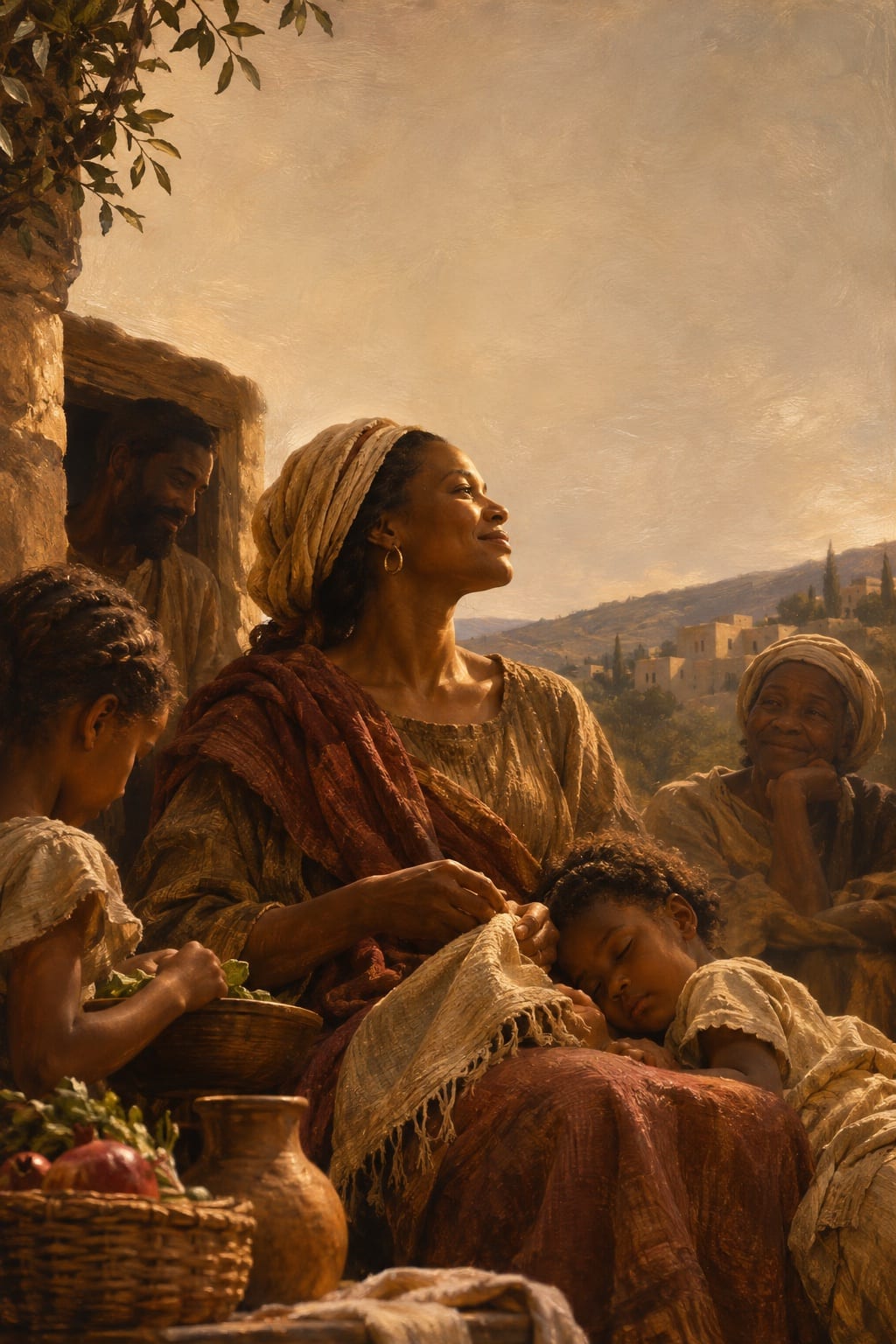
The Woman Whose Days Were Many
Proverbs 31:10-315 min
Proverbs 31 is not a daily checklist; it is a portrait of a life unfolding across many seasons. For the mother whose hours come to her in fragments, this poem offers a different clock.
Scripture
Proverbs 31:10-31
Key moment Proverbs 31:25
Read
She is three weeks in. The baby has just gone down for what the books call a nap and what experience calls a lottery ticket. She has maybe twelve minutes. Maybe forty. There is no way to know.
The Hebrew poet who wrote Proverbs 31 was not in her kitchen. He was building an acrostic, twenty-two verses lined up against the twenty-two letters of the Hebrew alphabet, the ancient form for everything that can be said about a thing. From aleph to tav, the whole alphabet was needed to describe one woman's life.
Notice that. A life. Not a Tuesday.
Read the poem slowly and you can almost hear time stretching out behind it. She considers a field and buys it; that is months of weighing, walking the boundary, drawing money together. From the fruit of her hands she plants a vineyard; vineyards take three to five years before the first usable harvest. She makes linen garments and sells them; flax must be grown, retted, spun, woven, dyed. Her lamp does not go out at night; that is years of evenings, not one heroic insomnia. She opens her hand to the poor; that is a habit, formed slowly. Her children rise up and call her blessed; her children have to grow first.
The poem is wide. The poet is showing us decades stacked on top of each other so they read like one paragraph.
She is clothed with strength and dignity, and she laughs at the days to come.
-- Proverbs 31:25
Laughs at the days to come. Not because the days are easy. Because she is not trying to fit them all into this one.
This is not a woman who finished her to-do list. This is a woman whose work was layered. Some of it was budding while other parts were being harvested. Some of it she could not even see yet. The vineyard she planted at thirty was poured into a cup at thirty-five. The wisdom on her tongue at sixty was being collected in her twenties, mostly in silence, mostly in interruption.
The poet does not tell us what any of her individual days looked like. He probably could not have. He is building a portrait the size of a whole life, and he needs every letter of the alphabet to do it.
Today
Three weeks postpartum, the day comes to you in fifteen-minute pieces. You cannot finish a meal, a thought, a sentence. You cannot promise anyone, including yourself, when you will be free. There is a particular grief in this. It is the grief of unowned time. You used to be able to point at an afternoon and say, this is mine, I will do this with it. Now the afternoons belong to someone seven pounds heavy who does not consult you.
It is tempting to read Proverbs 31 in this season and feel crushed. She gets up while it is still night. She runs a household and a business and a charity. Look at her productivity. Look at your laundry.
But the poem was never meant to be read that way. The poem is wide because a life is wide. What you are seeing in those twenty-two verses is forty years compressed into a single page. You are not failing the poem if your Tuesday looks like nursing and crying and a microwaved bowl of something. You are inside the poem. You are in one of its commas.
God is not asking you to cram a life of purpose into the hours your daughter does not need you. He is asking you to think in years. The vineyard you are planting right now is invisible. The wisdom that will eventually be on your tongue is being formed in this exact season of being interrupted. The strength you will one day wear like a garment is being woven, slowly, out of nights you do not remember in the morning.
The minutes you have are not stolen from your real life. The minutes you have are your real life, given to you fifteen at a time. You are allowed to receive them that way. You are allowed to set down the project of finishing. There will be decades for finishing. There will be vineyards.
For now there is this hour, and it does not belong to you, and that turns out to be a mercy. Time that does not belong to you is time you do not have to defend.
Pause
Take a slow breath.
Sit with what you've read.
Ponder
What would change if you measured your life in decades instead of days?
Which of your hidden, unfinished work might be a vineyard quietly growing toward harvest?
What would it feel like to stop wrestling this hour and let it belong to God instead of you?
Pray
A prayer
Father of all my years, You are not in a hurry, and you have never been in a hurry with me. Your kingdom is patient. Your will unfolds in seasons I cannot rush. Let it unfold in me the same way. Forgive me for trying to wrestle a whole life into hours that were never mine to own. Forgive me for measuring myself against a poem I was reading too fast. Give me this hour, and the next, and the small ragged ones after that, as gift rather than as something stolen. Teach me to hold them open-handed. Teach me to plant vineyards I will not see for years. Clothe me, eventually, with the strength and dignity of the woman who laughs at the days to come, because she trusts the One who is making them.
Amen.
Go gently. The vineyard is growing.Your life is wider than today.