The Young Man Who Would Not Leave the Tent
Exodus 33:7-116 min
When Moses returns to camp, Joshua stays in the tent of meeting — because the future leader of Israel is being formed in the hours no one is watching.
Scripture
Exodus 33:7-11
Key moment Exodus 33:11
Read
Outside the camp, far from the noise of Israel, Moses pitches a tent and calls it the tent of meeting.
The placement matters. After the golden calf, the people have proven they cannot be trusted with proximity. So the tent is set up at a distance. Anyone who seeks the Lord must walk out beyond the camp to find it. Worship costs the trip now. Casual access has been revoked.
When Moses goes out, all the people stand. They watch him from the doorways of their own tents. They see the pillar of cloud descend. They bow. The text gives us this exquisite line:
Thus the Lord used to speak to Moses face to face, as a man speaks to his friend.
-- Exodus 33:11
This is one of the most intimate descriptions of God in the entire Hebrew Bible. Panim el panim. Face to face. As a man speaks to his friend. The encounter is private. The people watch from a distance, but they cannot enter.
And then comes the line that changes the trajectory of Israel for the next forty years.
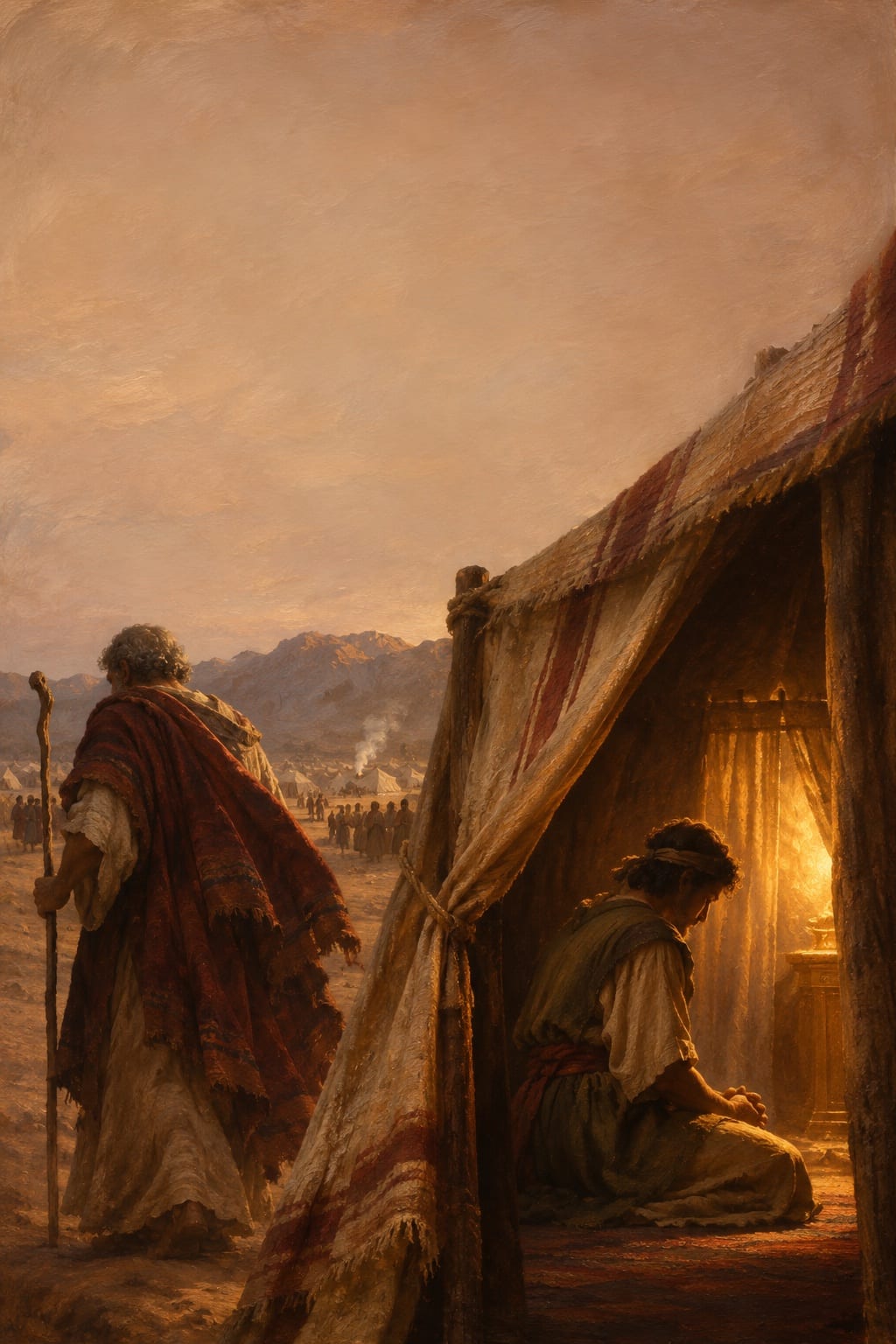
When Moses turned again into the camp, his servant Joshua the son of Nun, a young man, would not depart from the tent.
-- Exodus 33:11
Moses leaves. Joshua stays.
Israel goes back to its tasks. Children get fed. Tents get repaired. The day resumes. And a young man named Joshua remains inside the lingering presence, alone, doing nothing strategic, accomplishing no measurable thing. The Hebrew is striking: lo yamish mittok ha-ohel — he would not depart from inside the tent. He will not leave. He stays after the cloud has lifted off the conversation. He stays after his master has walked back to lead the nation. He sits in the room where God just spoke, the way you sit in a chair your father just got up from, breathing in the warmth.
We are told nothing about what Joshua does there. There is no transcript. No miracle. No commissioning. Just a young man who refuses to let the encounter end when the official meeting is over.
The word na'ar — young man, attendant — is doing quiet theological work. This same Joshua appeared earlier as Moses' aide on the mountain. He led the fight against Amalek while Moses' arms were held up. By the time of Numbers 11, he is described as Moses' attendant from his youth. And by the end of Deuteronomy, he is the man God hands the nation to: Be strong and courageous, for you shall bring the people of Israel into the land that I swore to give them.
The arc is unmistakable. The man who eventually leads Israel across the Jordan is the man who, decades earlier, would not leave the tent.
Moses' formation happened in burning bushes and signs and confrontations with Pharaoh. Joshua's formation happens in lingering. Quiet hours in the tent. Time spent inside the residue of God's voice when no one was looking. By the time the cloud finally settles on him in Numbers 27 — take Joshua the son of Nun, a man in whom is the Spirit, and lay your hand on him — the public anointing is just confirming what years of private lingering have already produced.
The great leader of the conquest was made in the hours no one saw.
Today
You may be the kind of person who instinctively knows how to lead.
You see what needs to happen. You can read a room, build a plan, mobilize a team. The ideas come fast. The moves feel obvious. And so the strangest thing about your current season is that God is not asking you to use most of it. He keeps placing you second-seat, under someone else's vision, in a position that feels several sizes smaller than the one you can already imagine yourself filling. He keeps inviting you not into more meetings, but into more lingering. More presence. More slow, unproductive hours in the tent after the official conversation is over.
Everything in you wants to leave. Leaving feels like obedience to your gifting. There are emails to send, people to lead, plans to advance. The lingering feels like waste.
Joshua would tell you that the lingering is the curriculum. He did not become the man who would lead Israel into the land by working harder than Moses. He became that man by staying in the tent longer. By saturating himself in a presence he had no public reason to be in. By making the inside of the conversation more familiar to him than the outside of it. The hours no one sees are the hours that are forming you for everything that is coming.
If God keeps signaling that the next chapter requires more lingering than leading, do not interpret that as a delay in your calling. It is the calling, for now. The future leader is being made on the chair Moses just got up from. The cloud has not lifted yet. Stay another hour. Stay until the room re-shapes you. The conquest of every Jordan you will one day cross is being prepared in the lingering you are doing today, when no one is watching, when there is officially nothing to do, when the only thing required of you is to remain.
Pause
Take a slow breath.
Sit with what you've read.
Ponder
Where in your life is God asking you to linger when your instincts are telling you to leave and go lead?
What would it mean to treat the unseen, unproductive hours in his presence as the actual training for the public hours that will come?
When the cloud lifts and the official meeting is over, what is it in you that finds it so hard to stay?
Pray
A prayer
Lord God who spoke to Moses face to face, you are the One who fills tents and lingers in chairs and forms leaders in hours no one sees. Let your kingdom come in the place where I want to be useful, and let your will be done in the place where you are asking me only to remain. Forgive me for treating lingering as waste. Forgive me for the moments I have rushed out of your presence to go do something measurable, when you were inviting me to stay another hour and become someone I could not become any other way. Make me a Joshua before you make me a leader. Let me be the young attendant who would not depart from the tent. Saturate me in the residue of your voice. Re-shape my interior in the silence that follows the official conversation. When the day comes that you hand me the river to cross, let me cross it as one who has spent more time in the tent than out of it.
Amen.
Stay another hour.The lingering is the apprenticeship.