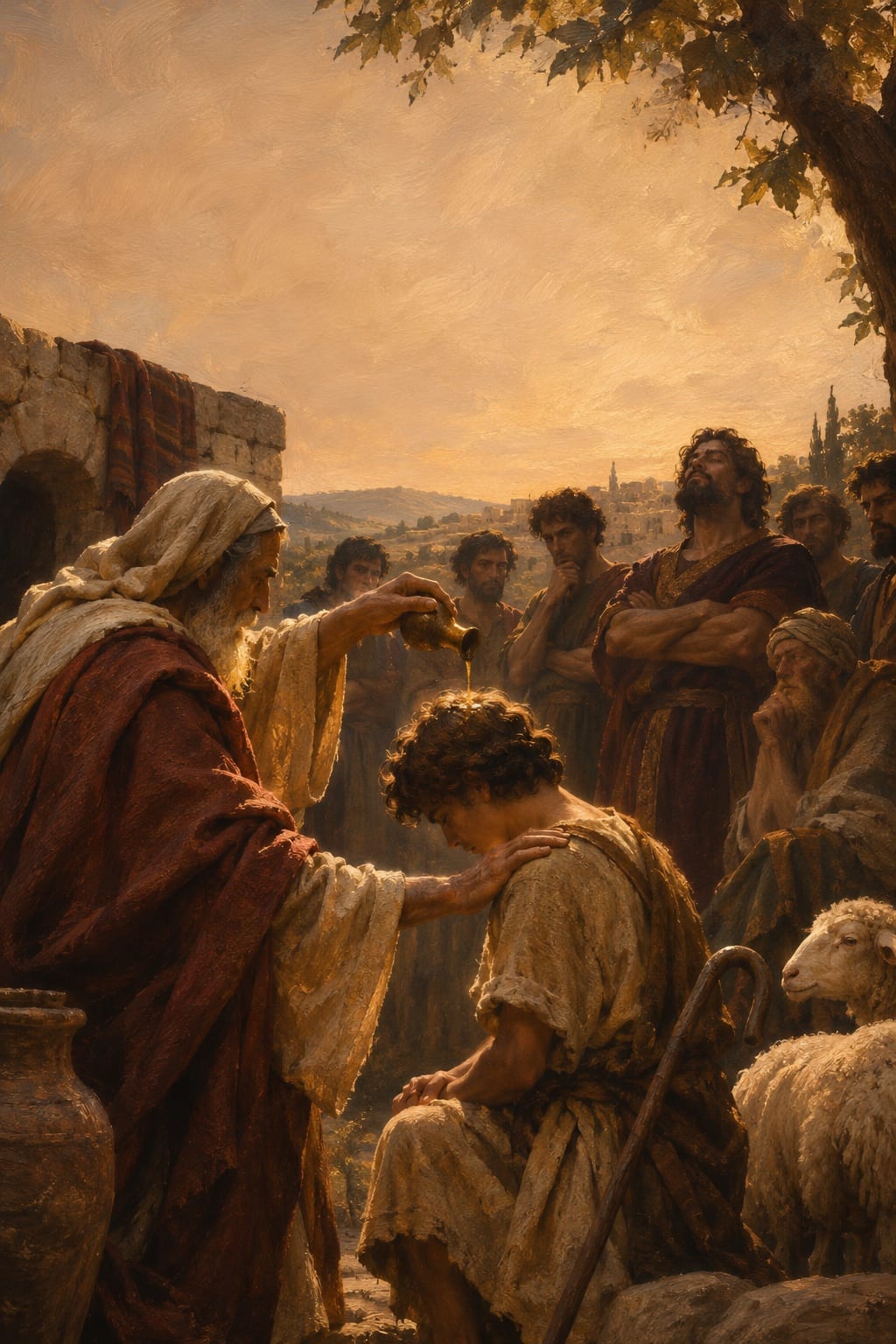
When God Walked Past Seven Sons to Find a Shepherd
1 Samuel 16:1-13; Matthew 7:15-20; James 2:1-95 min
God's selection of David over his older brothers, Jesus' fruit-inspection test, and James' warning against favoritism together form a biblical rubric for evaluating people by heart posture, observable fruit, and impartial dignity rather than surface credentials.
Scripture
1 Samuel 16:1-13; Matthew 7:15-20; James 2:1-9
Key moment 1 Samuel 16:7
Read
Samuel arrived at Jesse's house in Bethlehem already grieving. He had anointed Saul, believed in Saul, and watched Saul hollow out from the inside. Now God was sending him to find a replacement, and Samuel's track record for reading people was, by his own reckoning, unreliable. When Eliab walked in — tall, commanding, every inch the part — Samuel's instinct fired immediately: Surely this is the LORD's anointed. The old prophet was reaching for the oil before God stopped him.
Do not look at his appearance or at his physical stature, because I have refused him. For the LORD does not see as man sees; for man looks at the outward appearance, but the LORD looks at the heart.
-- 1 Samuel 16:7
Seven sons passed. Seven refusals. Each one forced Samuel to sit longer with his own faulty criteria. Height, bearing, birth order, confidence — none of it registered on God's scale. Only when they sent for the youngest, the one so unlikely that Jesse hadn't bothered to bring him in from the sheep, did God say, Rise, anoint him; this is the one. David's qualification wasn't his appearance. It was the unseen texture of his interior life, shaped in obscurity among the flock.
---
Jesus sharpened this principle into something remarkably practical centuries later. In Matthew 7:15-20, He warned that dangerous people often arrive in impressive packaging — sheep's clothing — and gave a single diagnostic: inspect the fruit. Not the promises, the presentation, or the résumé, but the yield. A good tree cannot produce bad fruit, and a diseased tree cannot sustain good fruit. The test requires patience; fruit takes seasons to grow and reveal itself. But it does not lie.
Proverbs 20:11 echoes this with blunt simplicity: Even a child is known by his doings, whether his work be pure, and whether it be right. Character is legible over time to anyone willing to watch.
---
James adds a third dimension. In James 2:1-9, he confronts the church for seating the well-dressed man in a place of honor while directing the poor man to the floor. This isn't just bad manners; James calls it a corruption of judgment itself. When we evaluate people through the lens of what they can offer us — status, wealth, connections, eloquence — we become, as he says, judges with evil thoughts. Favoritism doesn't just harm the person overlooked. It distorts the evaluator's capacity to see clearly at all.
Paul's fruit list in Galatians 5:22-23 — love, joy, peace, patience, kindness, goodness, faithfulness, gentleness, self-control — functions as a concrete set of character markers. These are not achievements someone can put on a résumé. They emerge from a life yielded to the Spirit over time, visible in how a person treats those who can do nothing for them, how they handle frustration, what they do when no one is watching.
Today
If you carry any kind of responsibility for people — hiring, mentoring, partnering, leading — you feel the weight of this daily. First impressions arrive with enormous persuasive force. Eloquence can mask emptiness. Credentials can substitute for character. And the pressure to decide quickly means we often default to whatever is most visible: charisma, confidence, pedigree.
Samuel's experience at Jesse's house suggests that even Spirit-filled people get this wrong. His instinct toward Eliab wasn't sinful; it was simply human. God didn't rebuke him harshly. He redirected him, seven times over, training Samuel's eye to look differently. That repeated correction is available to us too, if we're willing to slow down and let our first impressions be questioned.
Jesus' fruit test gives us a working method. Before entrusting someone with significant responsibility or trust, observe. How do they treat people with less power? What happens to their patience under sustained pressure? Do their private patterns match their public persona? Galatians 5 offers specific things to watch for — not as a checklist to weaponize, but as markers of the Spirit's genuine work that no amount of performance can counterfeit for long.
James' warning guards the process from a subtler corruption: our own self-interest. We are drawn to people who flatter us, who share our background, who elevate our status by association. Impartial evaluation requires naming those gravitational pulls honestly. The person God is directing you toward may be the one you'd naturally overlook — younger, quieter, less polished, still out with the sheep. Discernment is not a gift that replaces patience; it works through it.
Pause
Take a slow breath.
Sit with what you've read.
Ponder
When you think about the last few people you trusted quickly, what were the real criteria driving your confidence — their fruit over time, or something more immediate like eloquence, status, or likability?
Where might favoritism or self-interest be quietly distorting your ability to evaluate someone fairly right now?
If you applied the Galatians 5:22-23 markers to someone you're currently unsure about, what would you actually observe — and what would still need more time to see?
Pray
A prayer
Father who sees what is hidden, I confess that my eyes are drawn to surfaces. Like Samuel before Eliab, I reach too quickly for what looks right and miss what is right. Forgive the times I have judged by appearance, rewarded eloquence over integrity, or overlooked someone because they didn't fit my expectations. Give me Your eyes for the people in front of me. Teach me the patience to watch for fruit rather than grasping at first impressions. Guard my judgment from favoritism and self-interest. Where I must decide, grant me wisdom that is pure, peaceable, and without partiality — the wisdom James says comes from above. Lead me to the Davids still out with the sheep, and give me the courage to anoint what You have chosen, even when it surprises me.
Amen.
See as God sees. Watch. Wait. Trust the fruit.The heart He chooses is the one He will sustain.