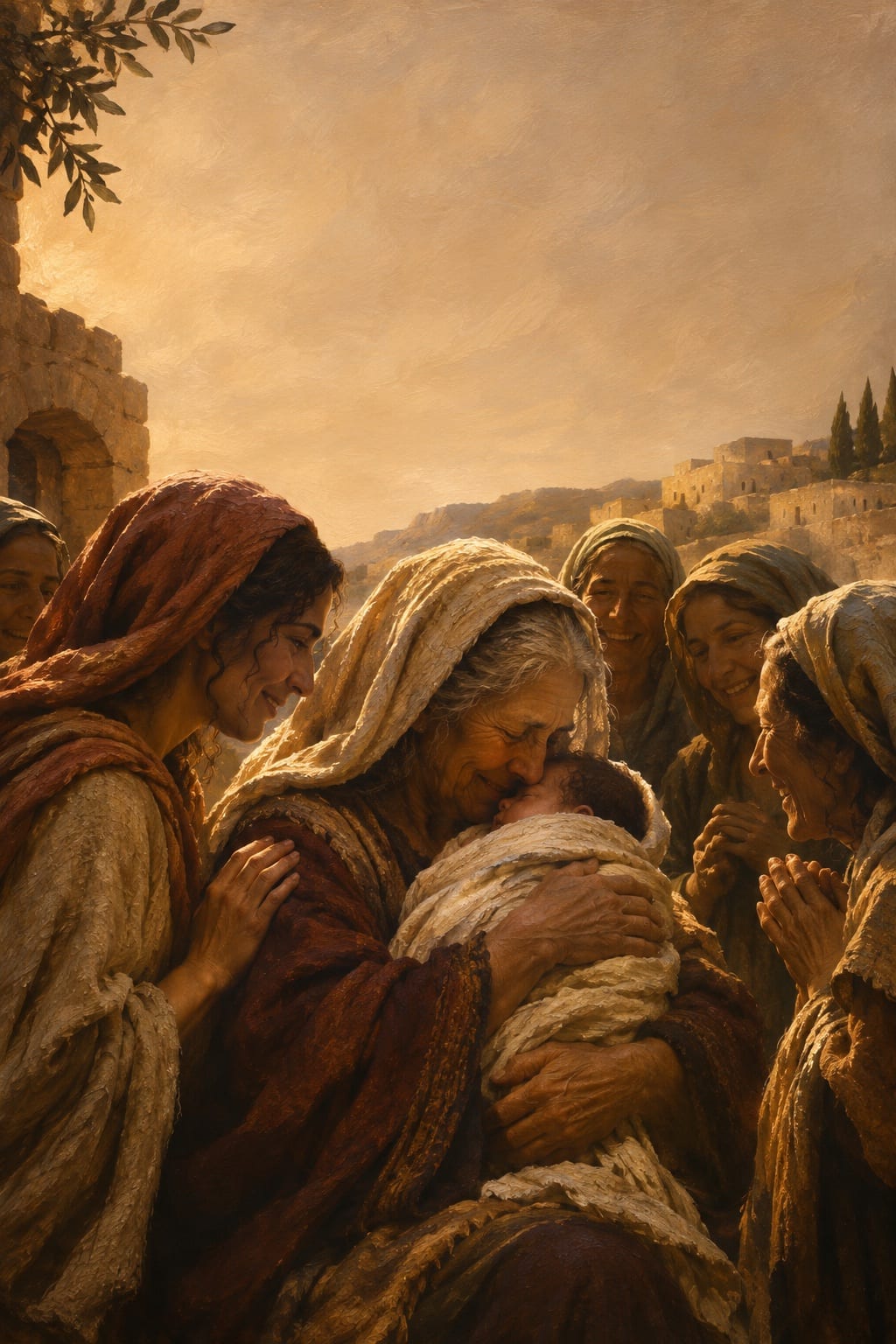
When Naomi Took the Baby to Her Bosom
Ruth 4:13-177 min
After Ruth gives birth to Obed, Naomi gathers the child to her chest and the women of Bethlehem speak his name. The story shows that being held by community is part of how God carries a mother, not evidence that she has failed.
Scripture
Ruth 4:13-17
Key moment Ruth 4:16-17
Read
Picture the room. A small house in Bethlehem, the smell of olive oil and warm bread, a woman three weeks past giving birth, a baby fussing in the corner, and an older woman with weathered hands reaching for him.
Ruth has just become a mother. The text says it plainly: the Lord enabled her to conceive, and she gave birth to a son. After years of marriage to Mahlon with no child, after widowhood, after walking from Moab to a country that was not hers, Ruth holds her own son. By every measure, this is her victory. Her body. Her labor. Her child.
And then verse sixteen does something quietly stunning.
Then Naomi took the child and laid him in her bosom and became his nurse.
-- Ruth 4:16
The Hebrew word for bosom here is cheq. It is the same word used for the lap of God in other passages, the place of intimate keeping. Naomi, the bitter one who had told the women of Bethlehem to call her Mara because the Almighty had dealt harshly with her, gathers this baby into the place of safest belonging. She becomes his omenet, his nurse, his caregiver. Not his mother. Ruth is his mother. Naomi is something else: a co-keeper. Hands that hold him so Ruth can sleep, eat, weep, recover.
And then the women of the neighborhood arrive. Notice the text: the women of the neighborhood gave him a name, saying, "A son has been born to Naomi." They name him Obed. Ruth does not name him. Boaz does not name him. The women do.
If you grew up in a culture that prizes the nuclear family, this can sound like overreach. Like the village is taking something from Ruth. But the original audience would have heard it differently. In the world of Ruth, a child was held by many hands from the very first days. The mother was kept upright by mothers, sisters, neighbors, aunts. To be alone with a newborn would have been the strange thing, the sad thing, the thing that meant something had gone wrong.
So here is the picture the chapter leaves us with: Ruth, the mother, recovering. Naomi, the older woman whose grief was so heavy she changed her name, now holding a baby against her chest and being called grandmother in everything but blood. The women of Bethlehem speaking the child's name into being. Boaz somewhere nearby, the legal redeemer, the one who made the harvest fields safe.
No one in this scene is doing motherhood alone. And no one is praised for trying.
The writer of Ruth ends the chapter with a genealogy: Obed, then Jesse, then David. The whole future of Israel passes through this baby in Naomi's lap. Which means the line of the Messiah was carried, in part, by a tired widow with steady hands and the women of a small town who showed up with food and a name.
This is not a story about Ruth being insufficient. It is a story about what sufficiency actually looks like in God's economy. It looks like a community of hands.
Today
You are three weeks in. Maybe four. The baby is real and so is the exhaustion that lives behind your eyes. People keep offering. Your mother-in-law wants to come over. A friend texted that she is making lasagna and just needs an address. Someone from church asked if they could bring groceries. Your partner keeps saying let me take him for an hour, please.
And something in you keeps saying no. Not out loud, maybe. But in the quiet way of pretending the kitchen is fine, of saying you slept okay when you did not, of holding the baby through a feeding you could have handed off because handing off feels like admitting something.
What does it feel like you would be admitting?
For a lot of new mothers, the answer underneath is some version of I cannot do this on my own, and I am supposed to be able to. The shame is not really about the dishes or the nap. It is about the gap between the woman you thought you would be and the woman who is currently crying in the shower because the baby is crying in the bassinet.
Ruth's chapter has a word for you in that gap, and the word is Naomi's bosom.
In the Bible, the mother who is doing it all alone is not the picture of strength. She is the picture of someone whose village has failed her. The picture of strength is a baby pressed against the chest of a woman who is not his mother, while his actual mother sleeps. That image is in Scripture on purpose. God put it there.
Receiving was never a fallback for when your own resources ran out. It was always the design. You were made for hands that are not your own to hold what you cannot carry alone right now.
So let me get specific, because freedom in this is specific.
Name one person. Not all of them. One. The friend who keeps offering lasagna. Your sister. The woman from the moms' group who said call anytime. Your mother. Your husband when he asks for the baby at 9pm.
And name one need. Not the whole impossible list. One. Someone to hold the baby for forty-five minutes so you can shower without listening for a cry. Someone to bring dinner Tuesday. Someone to come fold the laundry on the couch while you nurse and do not have to talk.
This week, ask that one person for that one thing. Out loud. In a text if your voice is too tired. Let them say yes. Let them come over. Let them put their arms out for the baby.
This is not weakness leaking out of you. This is Naomi walking through your front door. This is the village God built around you waking up to do what villages were built to do. The grace of Christ is not only the grace of being saved on a cross. It is also the grace of being held in a kitchen by someone who loves you while you eat something warm.
Pause
Take a slow breath.
Sit with what you've read.
Ponder
What is the story you tell yourself about what asking for help would mean about you as a mother?
Who is one person currently offering, and what is the one specific thing you could let them do this week?
Where in your life have you turned God's design for community into a private test of your own strength?
Pray
A prayer
God of Naomi and Ruth, God who put a baby in an old woman's lap and called it good, you know the room I am sitting in. You know the dishes and the laundry and the fear that if I let anyone close enough to see, they will see how unsteady I am. You are the One who carries lambs in your bosom. You are the One who knit this child together. Your kingdom is not a kingdom of solitary strength. Your kingdom comes through people walking in each other's doors with bread and steady hands. Let your will be done in my house this week. Give me bread for today, the kind I do not have to bake alone. Forgive me for the times I have called my self-sufficiency obedience, when really it has been fear wearing a competent face. Give me courage to name one need out loud. Give me courage to let one person meet it. When they come to the door, help me open it. When they reach for the baby, help me let go. When they sit on the couch and say nothing, help me cry if I need to. Thank you that receiving is not losing. Thank you that being held is not failing. Thank you for Naomi, and for whoever Naomi is for me right now.
Amen.
Go gently.You were never meant to carry this alone.