When the Brook Dried Up and God Didn't Explain Why
1 Kings 17:1-164 min
Through Elijah's journey from a drying brook to a starving widow's home, God reveals that His provision often comes through the last places we'd look — and that running out can be the beginning of finding more.
Scripture
1 Kings 17:1-16
Key moment 1 Kings 17:8-16
Read
Elijah had just delivered the most confrontational message in Israel's history. He told King Ahab that the sky itself would shut on his command. Then God did something strange: He didn't send Elijah to a fortress or a palace. He sent him to a brook — Cherith, east of the Jordan — to drink from a trickle of water and eat bread and meat delivered by ravens. Unclean birds. An undignified supply chain. But it worked, and Elijah drank.
Then the brook dried up. The text doesn't rush past this; it lingers. "After a while the brook dried up because there had been no rain in the land" (1 Kings 17:7). God didn't refill it. He didn't explain. The brook simply shrank, day by day, while Elijah watched. Every morning a little less. Every evening a little more mud where water used to be. God was not absent in the drying — He was present in it, preparing a redirect that Elijah could not have anticipated.
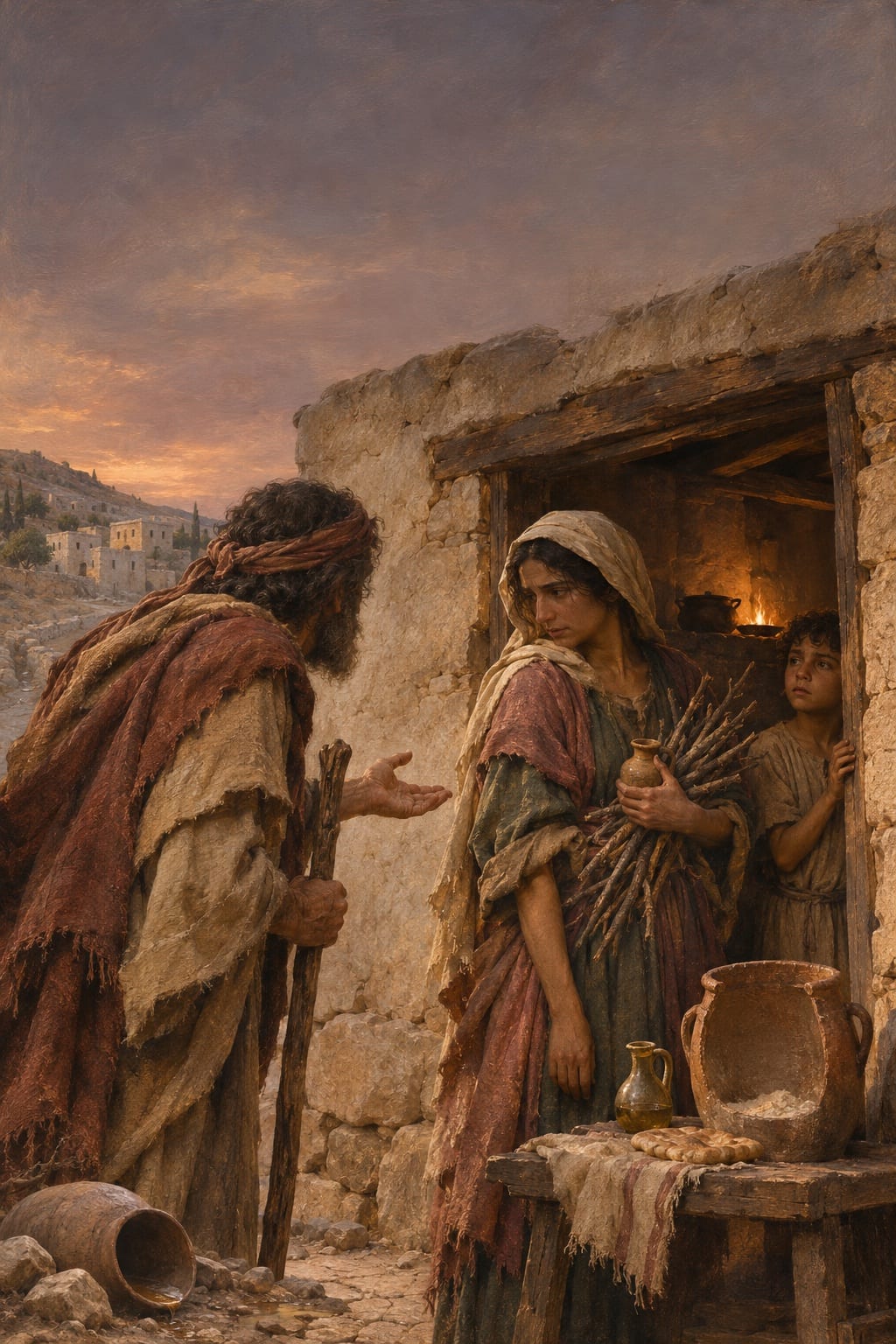
The word came: go to Zarephath in Sidon. This was Jezebel's homeland, Baal's territory. And the person God had "directed" to supply Elijah was a Gentile widow preparing her last meal. She told Elijah plainly: she had a handful of flour and a little oil, and after this final cake, she and her son would die. The Hebrew word used for God's direction here — tsivviti — is the same word used for the ravens. God commanded the ravens; God commanded the widow. But unlike the ravens, the widow had to choose to participate. She had to spend her last resources on a stranger before she saw any return.
What followed was not a sudden windfall. The flour was not multiplied into sacks. The oil didn't overflow. Each day, there was exactly enough. "The jar of flour was not used up and the jug of oil did not run dry" (1 Kings 17:16). The miracle lived in the repetition — daily, ordinary, just sufficient. God's abundance looked like a jar that should have been empty but never quite was.
Today
Most of us have had a brook dry up. A job that sustained us, a relationship that anchored us, a season of life that felt stable and good — and then, gradually or suddenly, it was gone. The temptation in those moments is to assume God has lost track of us. We stare at the diminishing water and conclude that provision has ended.
But Cherith dried up while God was watching. The drying was not a failure of divine attention; it was part of the divine plan. God sometimes removes a good thing not because He is taking something from us, but because He is taking us somewhere. The brook had to dry up for Elijah to move. If Cherith had kept flowing, Elijah would never have gone to Zarephath — and a widow and her son would have starved.
Notice, too, where God sent him: not to abundance, but to someone worse off than he was. The provision didn't look like provision. It looked like scarcity shared between two desperate people. That's often how God works — He threads His supply through community, through mutual vulnerability, through the willingness to give from what feels like not enough. The widow gave first, and then the jar never emptied. Elijah received from someone who had nothing, and both were sustained.
If you're watching something dry up right now — finances, energy, a path you were sure was right — consider that this may not be abandonment. It may be redirection. God's next provision might come in a form you wouldn't choose: an unfamiliar place, an unlikely person, a daily sufficiency rather than a dramatic surplus. The invitation is to open your hands, walk toward the strange new thing, and trust that the God who fed a prophet through ravens and a widow's last handful of flour has not run out of ways to sustain you.
Pause
Take a slow breath.
Sit with what you've read.
Ponder
What "brook" in your life has dried up or is drying up, and what emotions come up when you sit honestly with that loss?
Where might God be redirecting you that feels uncomfortable, unlikely, or too small — and what would it look like to take a step in that direction?
How has God provided for you in the past through means you never would have chosen yourself?
Pray
A prayer
Father, Provider of ravens and empty jars, Your kingdom comes in ways I do not expect — through drying brooks and widow's pantries and provision that looks nothing like what I imagined. Let Your will be done in my redirection, even when I cannot see where the path leads. Forgive me for confusing a dried-up brook with a dried-up God. Forgive me for clinging to familiar sources instead of following Your voice into unfamiliar territory. Give me today what I need for today. Not a surplus to hoard, but enough to walk in trust. Lead me where You will, even into Zarephath. I open my hands to receive from places I would not have chosen. In Jesus' name
Amen.
The jar is not empty yet.He who sustained Elijah through ravens and widows is sustaining you — one faithful day at a time.