Fed by Ravens, Sent to a Widow with Nothing
1 Kings 17:1-244 min
When God hid Elijah by a brook and then sent him to a starving widow, He revealed that divine provision rarely looks the way we expect — and that obedience in scarcity can become the doorway to abundance.
Scripture
1 Kings 17:1-24
Key moment 1 Kings 17:13-16
Read
Elijah had just pronounced drought over all Israel, and God's first instruction was not to flee to safety or stockpile supplies. It was to hide. "Go east and hide yourself by the brook Cherith." The word for hide here — sathar — carries the sense of being concealed, tucked away. God was not abandoning His prophet. He was positioning him in a place so obscure that provision itself would have to arrive on wings.
Ravens brought bread and meat, morning and evening. Consider the strangeness: ravens were unclean birds under the Law, scavengers by nature. God chose the unclean to feed the holy. He didn't send angels or friendly neighbors. He sent creatures any respectable prophet might have recoiled from. And the brook kept flowing — until it didn't. The water dried up, and the text offers no apology for the silence between the last trickle and the next word from God.
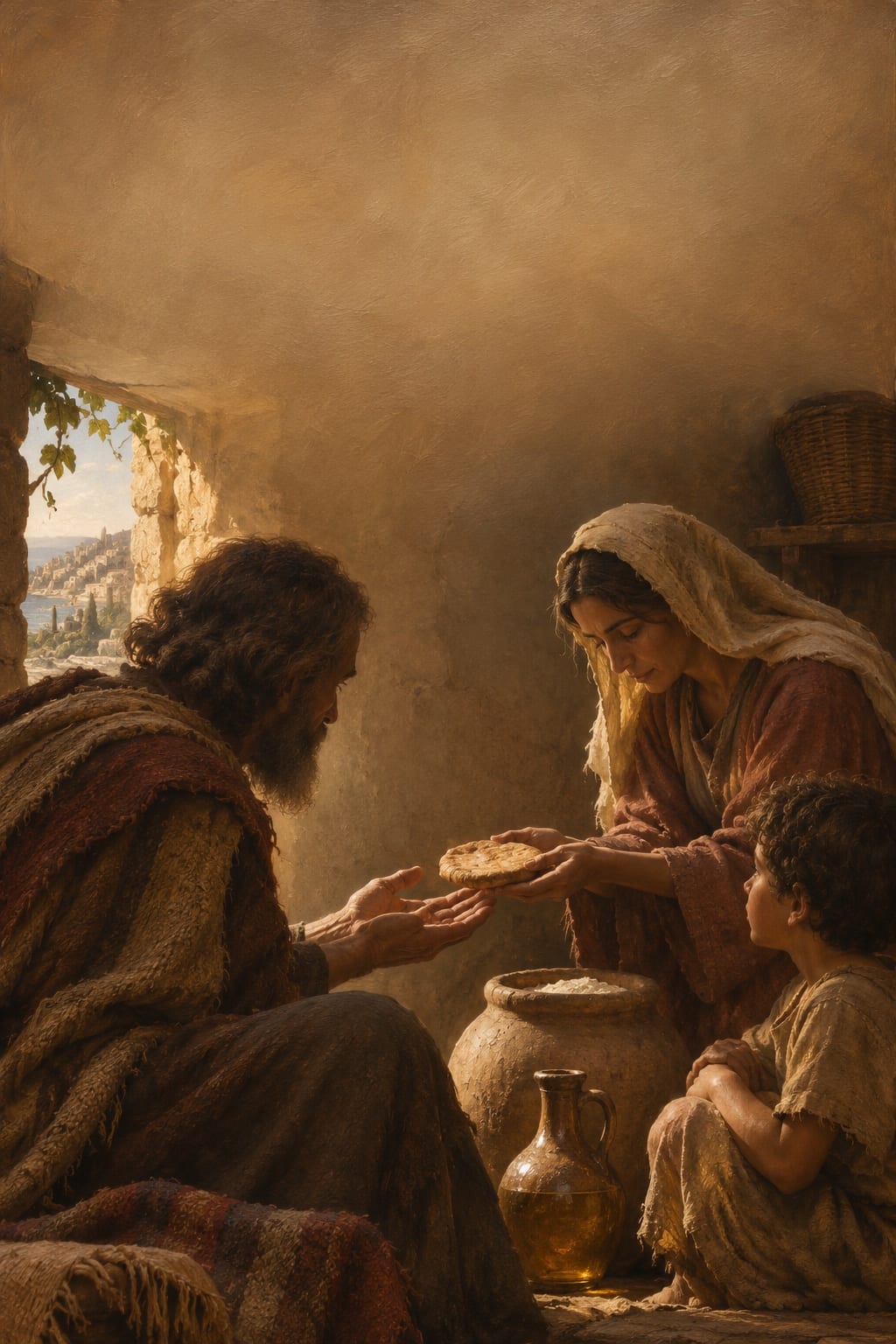
Then came the second strange instruction: "Arise, go to Zarephath... I have commanded a widow there to feed you." Zarephath sat in Sidon — Jezebel's home territory, pagan ground. The widow herself was gathering sticks to cook a final meal for her son before they starved. This was God's appointed provider. She had a handful of flour and a little oil. She had a death sentence on her table.
Elijah's request sounds almost cruel: "Make me a small cake first." But folded inside that uncomfortable ask was a promise — the flour would not run out, the oil would not fail. The widow's obedience, offered from the bottom of her emptiness, opened a jar that never went dry. Her scarcity became the very vessel God filled without ceasing.
Today
Most of us have a picture of what God's provision should look like: timely, dignified, arriving through channels that make sense. A raise, an opportunity, a person with resources. We rarely imagine ravens. We almost never imagine being sent to someone who has less than we do and being told, "This is My supply line."
But God's economy runs on different logic. He lets brooks dry up — not because He forgot, but because the next provision requires a new location and a deeper trust. The drying brook is not evidence of abandonment; it's the signal that something else is opening. Staying at a dry brook because it used to flow is its own kind of disobedience.
The widow's story presses further. She was asked to give from a place of genuine nothing. That request makes no sense until you see the pattern: God often multiplies what is offered, not what is hoarded. The handful surrendered became the supply that sustained a household through an entire drought. Scarcity offered back to God in trust has a strange, persistent habit of becoming enough.
If provision has arrived in your life through unexpected or uncomfortable means — through people or circumstances you wouldn't have chosen — you may be standing at Cherith. If you feel you have almost nothing left and someone is asking you to give from it, you may be standing in the widow's kitchen. Both places look like dead ends. Both turned out to be doorways.
Pause
Take a slow breath.
Sit with what you've read.
Ponder
Where in your life has a brook dried up, and are you still sitting beside it waiting for it to flow again?
Has God ever provided for you through an unlikely or uncomfortable source — and did you almost miss it because it didn't match your expectations?
What would it look like to offer the little you have left, trusting that God can multiply what is surrendered?
Pray
A prayer
Father, Provider of bread through ravens and abundance through empty jars, Your ways are not my ways, and Your supply lines look nothing like the ones I draw on my own maps. Forgive me for the times I've refused provision because it arrived in the wrong packaging, or stayed too long beside dry brooks because I was afraid to move. Give me the widow's courage — to open my hands when everything in me wants to clutch what little remains. Let Your kingdom come in the places of my scarcity. Teach me that what I surrender to You is never wasted, and that Your "enough" outlasts every drought I will ever face.
Amen.
The jar did not run dry.His provision outlasts every drought. Trust the hands that fed Elijah and filled the widow's jar.