When Ravens Became Waiters and a Widow Became a Warehouse
1 Kings 17:1-244 min
Through ravens at Cherith and a starving widow at Zarephath, God teaches Elijah—and us—that divine provision rarely looks the way we expect, and often arrives through the last sources we would choose.
Scripture
1 Kings 17:1-24
Key moment 1 Kings 17:8-16
Read
Elijah had just delivered the most dangerous message of his career: no rain would fall until he said so. And before the political fallout could reach him, God gave him a strange set of instructions. Go east. Hide by the brook Cherith. Drink from the water. Wait for ravens.
Ravens. In Levitical law, ravens were unclean birds. No respectable prophet would expect his meals delivered by scavengers. Yet every morning and evening, they came—bread and meat in their beaks, carried to a man sitting beside a shrinking stream. God's provision was real, but it arrived in a form that required Elijah to swallow his assumptions before he swallowed the food.
Then the brook dried up. This is worth sitting with: God's own provision ran out. The source He had chosen went empty, not because Elijah sinned or lost faith, but because God was moving him. The dried brook wasn't failure; it was a doorway. "Go to Zarephath... I have directed a widow there to supply you with food" (1 Kings 17:9).
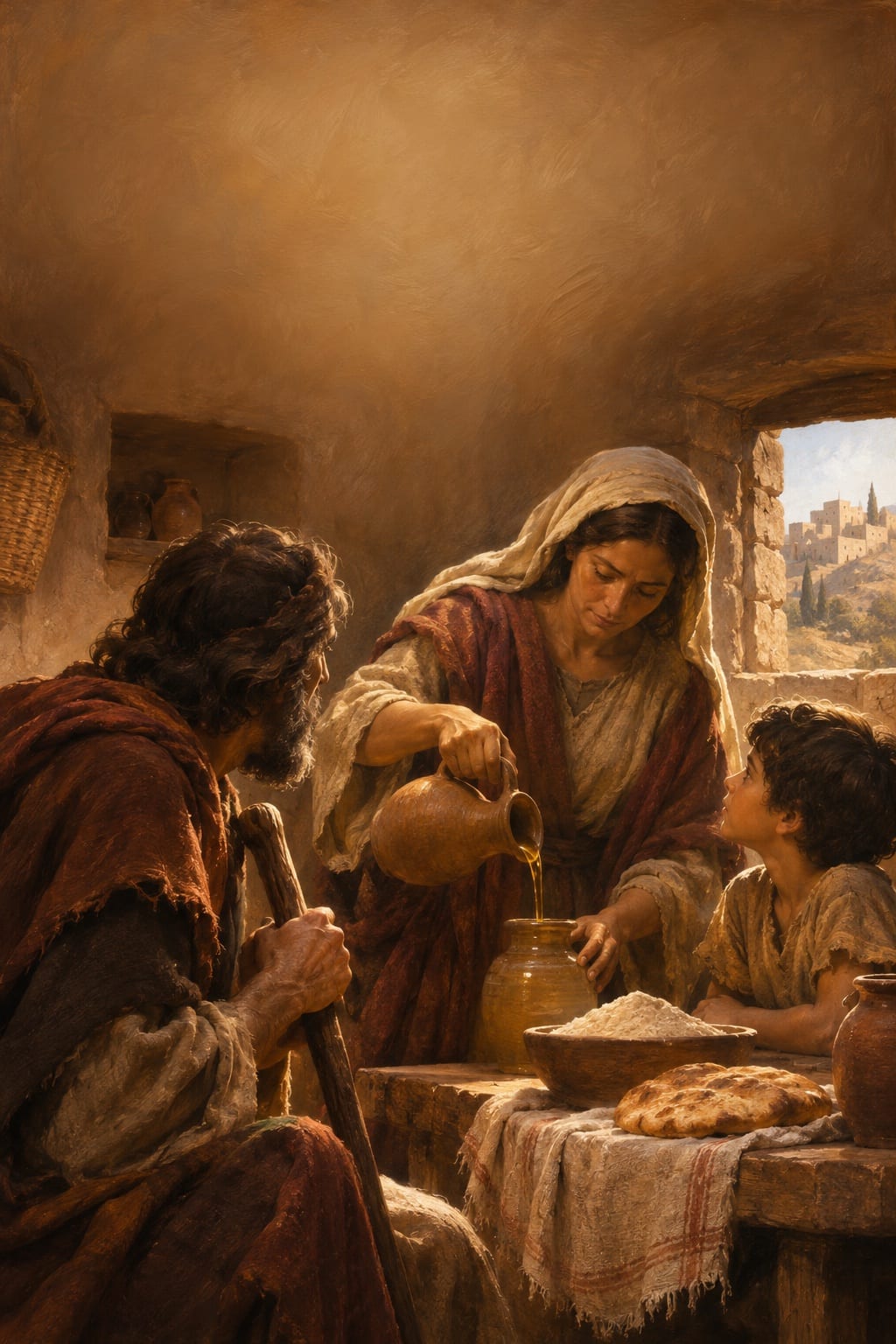
When Elijah arrived, the widow was gathering sticks to cook a final meal for herself and her son before they starved. She had nothing—a handful of flour, a splash of oil. She was the provision? This is God's strange arithmetic: sending a hungry prophet to a starving woman and calling it a supply chain. Yet when she obeyed, pouring out what little she had, the flour jar never emptied. The oil jug never ran dry. Day after day after day, just enough appeared in containers that should have been hollow. God didn't fill a storehouse for her all at once. He filled a handful at a time, and the handful kept coming.
Today
Most of us are more comfortable with provision we can measure. A salary, a savings account, a predictable path forward. When God provides through unexpected channels—an offhand conversation that leads to an opportunity, a stranger's generosity, a resource we once considered beneath us—we hesitate. We want the reliable stream, not the raven.
But Elijah's story presses a question: what if the provision you've been overlooking is the one God actually sent? Maybe you've dismissed it because it came from an unlikely person, or because it doesn't match the picture you had in mind. The widow almost missed her miracle because all she could see was her last handful of flour. She couldn't yet see that the handful was connected to an invisible supply.
Notice, too, that the brook dried up through no fault of Elijah's. Sometimes a good season ends not because you did something wrong but because God is redirecting you toward a deeper kind of dependence. The dried-up brook isn't punishment; it's preparation. It loosens your grip on the form of provision so you can receive the fact of it from wherever God sends it next.
And then there's the widow's courage. She gave away the last thing she had on the word of a stranger who said God would keep her alive. That kind of obedience isn't reckless—it's a calculated risk on the character of God. Sometimes the door to sustained provision swings open only when we stop hoarding what's already running out and let it move through our hands.
Pause
Take a slow breath.
Sit with what you've read.
Ponder
What form of provision have you been dismissing because it didn't arrive the way you expected?
Is there a 'dried-up brook' in your life right now that might be God redirecting you rather than abandoning you?
Where might God be asking you to give from your scarcity, trusting that the handful won't run out?
Pray
A prayer
Father, Provider of ravens and flour jars and every hidden supply line I cannot trace—I confess that I have often looked past what You were giving because it didn't match what I was expecting. Forgive me for measuring Your faithfulness by the size of the stream rather than by the steadiness of Your hand. Give me the courage Elijah needed beside that brook, and the courage the widow needed at her hearth. Where I am hoarding out of fear, loosen my grip. Where I have mistaken redirection for rejection, open my eyes. Let me trust that Your provision is no less real when it comes through unfamiliar hands. Keep me faithful in the handful, confident that You are faithful in the supply.
Amen.
The jar is not empty. It never was.He who kept the oil flowing keeps watch over you still.