The Bush That Burned but Didn't Burn Out
Exodus 3:1–148 min
At a bush that burned without being consumed, God interrupted Moses' ordinary workday to reveal His name and commission a reluctant shepherd to lead a nation — not because Moses was enough, but because I AM is.
Scripture
Exodus 3:1–14
Key moment Exodus 3:11-14
Read
Moses was eighty years old and tending someone else's sheep.
Forty years earlier, he had been a prince in Egypt — educated, powerful, positioned. He had tried to deliver his people once, on his own terms, and it ended with a dead Egyptian half-buried in the sand and Moses running for his life. Now he lived on the backside of the desert, married into a Midianite family, moving flocks from one sparse pasture to the next. Whatever ambitions had once burned in him had long since gone cold.
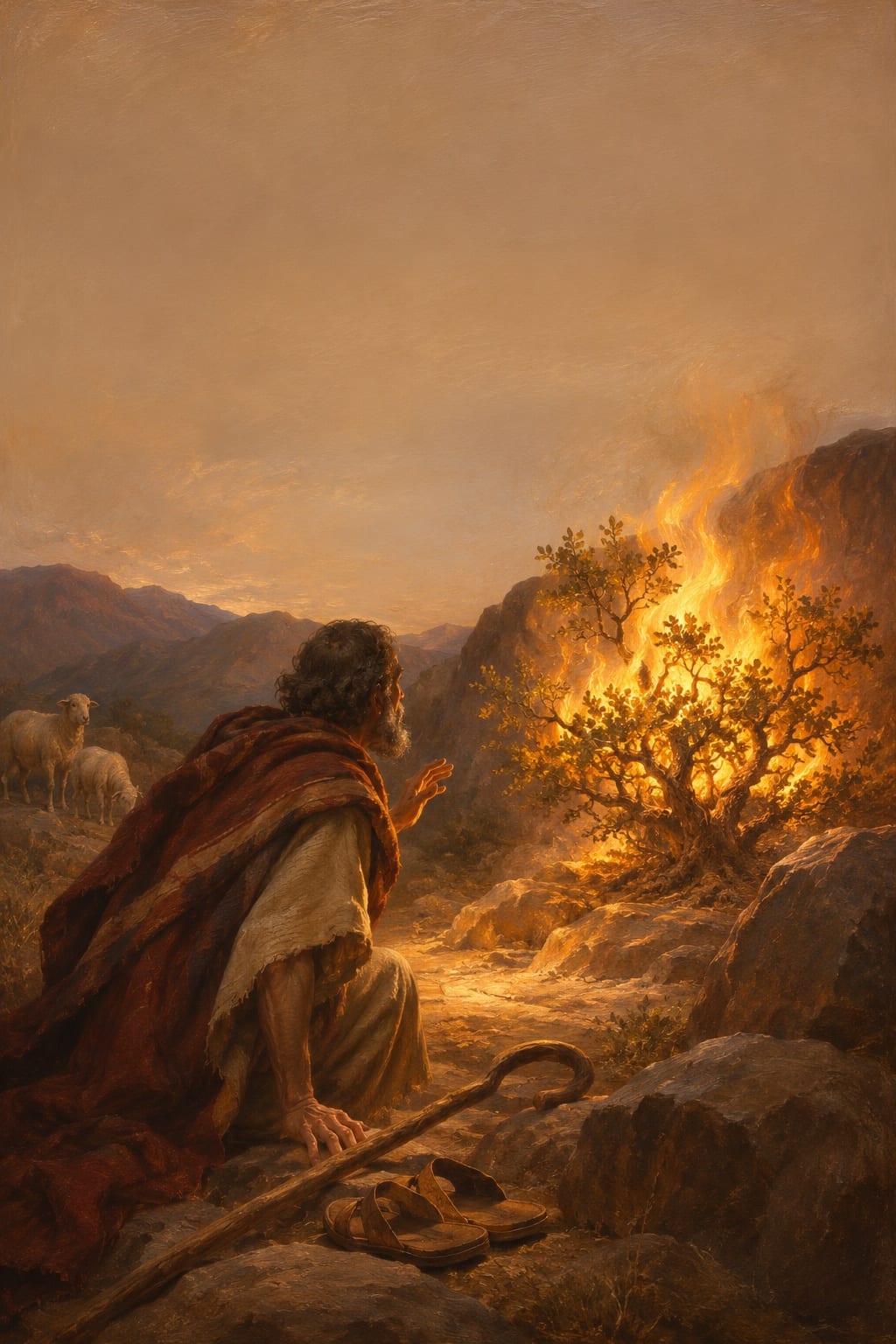
This is where the story begins — not in a temple, not on a mountaintop of prayer, but on an ordinary day at work. Moses led his father-in-law's flock to Horeb, and something caught his eye. A bush was on fire, which wouldn't have been unusual in the dry Sinai heat. What stopped him was that the bush kept burning. The flames didn't consume it. The branches didn't blacken and curl. It just burned and burned, alive with fire that fed on something other than fuel.
"When the LORD saw that he had turned aside to see, God called to him out of the bush, 'Moses, Moses!'"
-- Exodus 3:4
Notice that detail: God waited for Moses to turn aside. The burning bush was an invitation, not an ambush. God didn't shout across the desert at a man walking in the other direction. He set something strange and beautiful in Moses' path, and when Moses was curious enough to come closer, then God spoke. There's a gentleness in that, a respect for the pace of a man who had spent forty years recovering from failure.
"Take off your sandals," God told him, "for the place where you are standing is holy ground." The ground hadn't been holy yesterday when sheep grazed on it. It became holy because God was present. This is the first revelation: sacred space is wherever God chooses to show up, and He often chooses the places we'd least expect.
Then came the commission. God had heard His people crying under Egyptian slavery. He had seen their suffering. And He was sending Moses to Pharaoh to bring them out.
Moses' response was immediate and honest:
"Who am I that I should go to Pharaoh and bring the Israelites out of Egypt?"
-- Exodus 3:11
This wasn't false humility. Moses had real reasons to feel inadequate. He was a fugitive from Egyptian justice, an old man with a stutter (as we learn later in chapter 4), a shepherd with no army, no credentials, no standing. The last time he'd tried to intervene in Israel's suffering, it had ended in murder and exile. He knew exactly what his own strength looked like — he'd tested it and watched it fail.
God's answer to Moses' "Who am I?" is one of the most remarkable pivots in all of Scripture. He didn't answer the question Moses asked. He didn't say, "You're braver than you think" or "You have untapped potential." He didn't build Moses up at all. Instead, He redirected entirely:
"I will be with you."
-- Exodus 3:12
The question was about Moses' identity. The answer was about God's presence. As if to say: the question of who you are matters far less than the question of who is with you.
Moses pressed further. If he went to the Israelites and told them the God of their fathers had sent him, they'd want a name. "What shall I tell them?" And here God gave the answer that has echoed through every century since:
"I AM WHO I AM. Say this to the people of Israel: 'I AM has sent me to you.'"
-- Exodus 3:14
The Hebrew is Ehyeh asher Ehyeh — a phrase that resists tidy translation. It pulses with meaning: I am the one who exists. I am the one who will be what I will be. I am the self-sufficient, self-defining, uncaused cause of all things. The name doesn't explain God so much as it declares that God needs no explanation. He simply is.
This was what Moses needed to hear, even if he didn't know it yet. His problem wasn't a lack of skill or eloquence. His problem was that he was measuring the task against himself. God answered by placing something immeasurably larger on the other side of the scale — not a strategy, not a promise of easy victory, but His own name. His own being. The weight of who God is made the question of Moses' adequacy almost irrelevant.
Moses would go on to raise more objections — four more, in fact, stretching through chapter 4. God answered each one patiently, providing signs, providing Aaron as a spokesman, meeting every excuse with provision. But the foundational answer never changed from what He said at the bush: I will be with you. I AM. Everything else was scaffolding around that central truth.
Today
This story arrives on the third day of a quiet arc. Hannah showed us that God meets us in our deepest anguish and receives what we release to Him. Gideon showed us that God calls us out of hiding, names us differently than we name ourselves, and moves first so we can follow. Now Moses completes the picture: God shows up in the middle of ordinary life, reveals who He is, and commissions us to move — not because we've finally become sufficient, but because He has always been.
Most of us know the feeling Moses had at that bush. We sense God asking something of us — a conversation we need to initiate, a calling we've been circling, a step of forgiveness or vulnerability that feels far beyond our capacity. And our instinct is Moses' instinct: Who am I? I'm not trained enough, not healed enough, not spiritual enough. I failed last time. I'm too old. I'm too young. I don't have the words.
Those aren't lies, necessarily. Moses really was a fugitive. He really did stutter. He really had failed before. God never disputed any of that. What God disputed was the framework. Moses was calculating whether he could do this, and God kept saying, that was never the relevant question.
We do something similar when we treat our inadequacy as the final word. We're not wrong about our limitations — we're wrong about what they prove. They don't prove that God chose the wrong person. They prove that God chose to work through the kind of person who would need Him every step of the way.
Think about what Moses would have missed if God had answered differently. If God had said, "You're more capable than you realize, Moses — you've got this," Moses would have gone to Egypt leaning on his own rediscovered confidence. Instead, God gave him something sturdier than confidence. He gave him a name to carry. I AM has sent me. Every time Moses' courage flagged, every time Pharaoh refused, every time the people grumbled, he could return to that name. Not "I was" — trapped in the past. Not "I will be eventually" — deferred to some uncertain future. I AM. Present tense. Here. Now. With you in the room where the hard conversation is happening. With you on the road you didn't choose.
The burning bush itself is worth sitting with. Fire that doesn't consume. Presence that sustains rather than destroys. God's holiness didn't incinerate the bush; it inhabited it. And when God asks us to carry His purposes into difficult places, He isn't asking us to be consumed by the task. He's asking us to be inhabited by the same presence that kept those branches alive.
Your excuses may be real. Your history of failure may be documented. Your sense of inadequacy may be well-earned. None of that disqualifies you, because none of that was ever the point. The point is the name on the other side of the conversation — the God who doesn't say "you are enough" but says something far more freeing: I AM enough, and I am with you.
So take off your sandals. The ground beneath your ordinary Tuesday, your unremarkable routine, your quiet season of tending someone else's sheep — it might be holier than you think. God has a history of showing up in places that don't look like anything until He speaks.
Pause
Take a slow breath.
Sit with what you've read.
Ponder
What is the "Who am I?" question you keep asking God — and what would it mean to let His "I AM" be the answer instead of your résumé?
Where in your ordinary life might God already be burning, waiting for you to turn aside and notice?
Which of your past failures have you treated as disqualification rather than preparation?
Pray
A prayer
Father, the I AM who needs no explanation and offers no apology for who You are, I confess that I have measured Your calling against my own smallness and decided the math didn't work. I have let my failures narrate my future and my inadequacy write the final draft of what's possible. Forgive me for making my limitations larger than Your name. Let Your kingdom come into the ordinary places of my life — the workdays, the routines, the desert stretches that feel like they lead nowhere. Let Your will be done even through stammering mouths and shaking hands. I don't ask You to make me sufficient. I ask You to be present. Meet me at the bush. Speak my name. Remind me that the ground I stand on is holy — not because of who I am, but because of who You are. Give me today the courage to take one step toward what You've asked, carrying nothing but Your name. And when the excuses rise up again, as they will, let the sound of I AM be louder than all of them
Amen.
The bush is still burning. Turn aside and see.You are seen, named, and sent by I AM.