The Bush That Waited Forty Years
Exodus 2:11-3:108 min
Moses tries to deliver Israel at forty, fails loudly, and disappears into the back of the desert — because the version of him that needed to die had to be buried before God could send him.
Scripture
Exodus 2:11-3:10
Key moment Exodus 3:1-4
Read
He is forty years old, and he is sure he is the one.
He has been raised in Pharaoh's court, educated in all the wisdom of Egypt, fluent in court protocol and military strategy. Stephen, in his Acts 7 sermon, tells us Moses supposed that his brothers would understand that God was giving them salvation by his hand. He has, by every indication, an internal conviction about his role. The blood of the Hebrews is in him. The training of Egypt is on him. He must be the deliverer. The math is too clean.
So he goes out to visit his brothers, and he sees an Egyptian beating a Hebrew. Something in him snaps. He looks this way and that, sees no one, and kills the man. Buries him in the sand.
The text gives us the next day in slow motion. Moses goes out again. Two Hebrews are fighting. He intervenes — Why do you strike your fellow? — already trying to play the role of judge among his people. And the man answers with a line that ends Moses' first attempt at his calling.
Who made you a prince and a judge over us? Do you mean to kill me as you killed the Egyptian?
-- Exodus 2:14
The sand has not kept his secret. Pharaoh hears. The court he was raised in turns into the court that sentences him. He flees east, into Midian, into the desert no one knew him in. He sits down at a well. He marries a daughter of the priest of Midian. He becomes a shepherd, of all things — a thing the Egyptians considered an abomination — tending the flock of his father-in-law Jethro.
For forty years.
Luke is right when, in Acts 7, he gives us this number twice: forty in Egypt, forty in Midian, forty leading Israel. The shape of his life is a triptych, and the middle panel is the longest hidden burial in the Old Testament. Forty years of someone else's sheep. Forty years of children he loves and a Midianite wife he loves and a quiet life on the back side of a desert that has nothing to do with the Hebrew slaves he could not save.
We should pause here, because the text refuses to look away from how thoroughly Moses has buried the dream. He names his first son Gershom — I have been a sojourner in a foreign land. The naming is not bitter. It is settled. He is not waiting at the edge of Midian for God to call him back. He has accepted that this is who he now is. A sojourner. A man whose life will end out here, with a flock and a family and the desert sky.
Then, in Exodus 3:
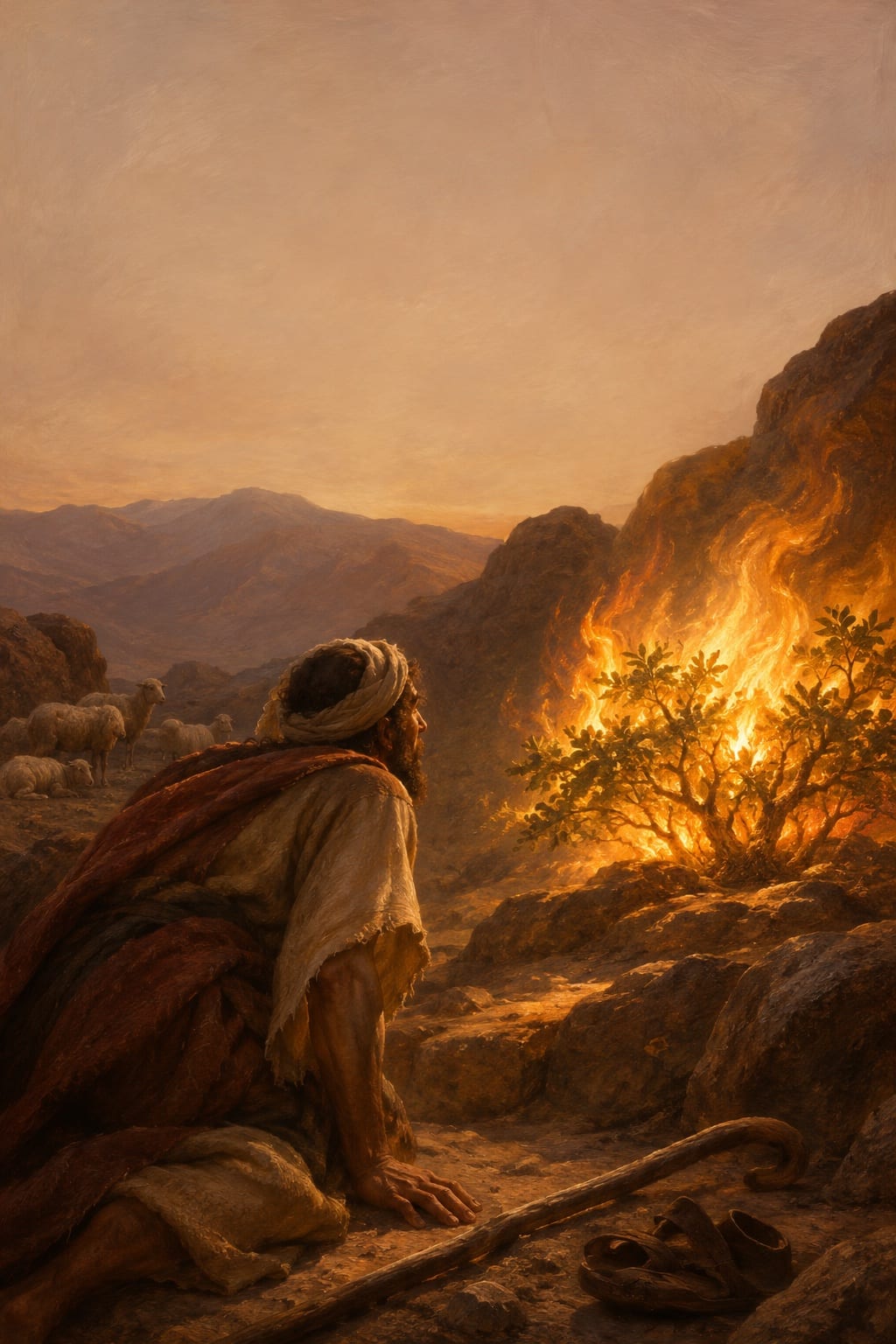
Now Moses was keeping the flock of his father-in-law Jethro, the priest of Midian, and he led his flock to the west side of the wilderness and came to Horeb, the mountain of God.
-- Exodus 3:1
It is an ordinary Tuesday. He is doing what he has done a thousand times before: leading the sheep to a fresh pasture. There is nothing in this morning to suggest it is the morning. And then he sees a bush, and the bush is on fire and not consumed, and he turns aside.
When the Lord saw that he turned aside to see, God called to him out of the bush, Moses, Moses!
-- Exodus 3:4
The bush had been waiting. We do not know how long. Maybe it ignited that morning. Maybe it had been burning, in some sense, for years, and Moses had to walk past it for forty years before his interior was finally quiet enough to turn aside and see it. Either way, the calling is unchanged. The mission is the same one Moses had assumed at forty. I have surely seen the affliction of my people who are in Egypt... I have come down to deliver them... Come, I will send you to Pharaoh that you may bring my people, the children of Israel, out of Egypt.
The difference is the man.
The Moses who replies to the bush is not the Moses who killed the Egyptian. That man tried to drive Pharaoh out of him by force. The man at the bush stutters. Who am I that I should go to Pharaoh? The fluency, the certainty, the swagger of forty has been buried in the sand of Midian. What stands in front of the bush is a slow, hesitant, eighty-year-old shepherd, and that is the man God can finally use.
The burial was the curriculum. The forty years were not God forgetting his man. They were God forming a man the deliverance required. Egypt would never come out of Israel until Egypt first came out of Moses. And Egypt could only come out of Moses in a place far enough from Egypt to forget how to talk like it.
By the time Moses returns to confront Pharaoh, he is barely the same person. He carries no court swagger. He carries a staff. He carries the patience of someone who has learned the rhythms of sheep and the slow shape of an ordinary day. He carries the long shadow of a buried first attempt. And, most importantly, he carries the I AM of a God who was willing to wait forty years for a leader.
Today
You may be the one whose first attempt at the calling failed loudly.
There was a moment, years ago, when you were sure you were the one. The strength was in you. The conviction was in you. The vision had a clarity that felt like vocation. You went after it with everything. You spoke up. You moved. You acted. And it failed. Not in some dignified, mature way. It failed loudly, in front of people, with consequences. Maybe you hurt someone. Maybe you ruined something. Maybe you simply discovered, in a single brutal moment, that the version of you who tried to do that thing was not equal to it. The Egyptian is buried in the sand somewhere, and you have been living with the fact of him ever since.
You have spent the years since tending other people's flocks. A different city than you planned. A different role than you imagined. A different family, a different career, a different anonymity. The dream is so far away now you have stopped waiting for it. You have named your sons Gershom. I am a sojourner here. You have made peace with the idea that the call was either real and irreversibly squandered, or imagined and embarrassing in retrospect.
Moses would tell you to keep an eye out for shrubbery.
The God who wrote your story did not stop writing it the day your first attempt fell apart. He took the long view. He watched you pick up the staff and learn the rhythms of someone else's sheep. He watched the swagger come out of you, slowly, like dye out of a fabric. He watched you become humble, hesitant, gentle, slow. The very things that look to you like the loss of your calling are, in his ledger, the prerequisites for it. Egypt had to come out of you before he could send you back to Pharaoh.
If the bush has not yet burned, that does not mean it never will. The God of Midian is a God of staggering patience. He is willing to wait forty years for a leader because what he is forming is worth waiting for. The version of you that needed to die has been dying. The version of you he can send is being made. When the bush finally burns — if it burns — you will not approach it as the proud forty-year-old who buried an Egyptian in the sand. You will approach it as the slow shepherd of a thousand quiet Tuesdays, hesitant and ready in a way only the burial could have produced.
For today, lead the flock to fresh pasture. Be gentle with the sheep that are not yours. Love the family that grew up around you in the years you thought you were forgotten. Keep your eyes open. The God of the bush is the God of your unburied call, and he has not lost the address.
Pause
Take a slow breath.
Sit with what you've read.
Ponder
Where in your life is the buried Egyptian — the loud failure of your first attempt at the calling — still shaping how you read your present obscurity?
What might God be slowly removing from you in these forty years that could only be removed in Midian, away from the centre of the dream?
If the bush has not burned yet, what would it look like to keep your eyes open today, leading the flock with the kind of attentiveness that turns aside when something strange begins to glow?
Pray
A prayer
Lord God of the burning bush, you are the I AM who waited forty years for a shepherd, the One who buries proud men in the sand of Midian and raises slow shepherds in their place. Let your kingdom come in the desert I did not choose, and let your will be done in the long, quiet undoing of the version of me that needed to die. Forgive me for the loud first attempt. Forgive me for the Egyptian buried in my own sand, and for the years I have spent assuming that the failure was the end of the call. Form in me the gentleness of the man at the bush. Take the swagger of my younger years and replace it with the staff of a hesitant, willing servant. Let Egypt come out of me before you ever send me back to it. And when the day comes that a strange fire begins to burn in front of me, give me eyes to turn aside, and ears to hear my name spoken twice. The staff is in my hand. The flock is in front of me. I am here.
Amen.
Lead the flock today.The bush has not forgotten where you are.