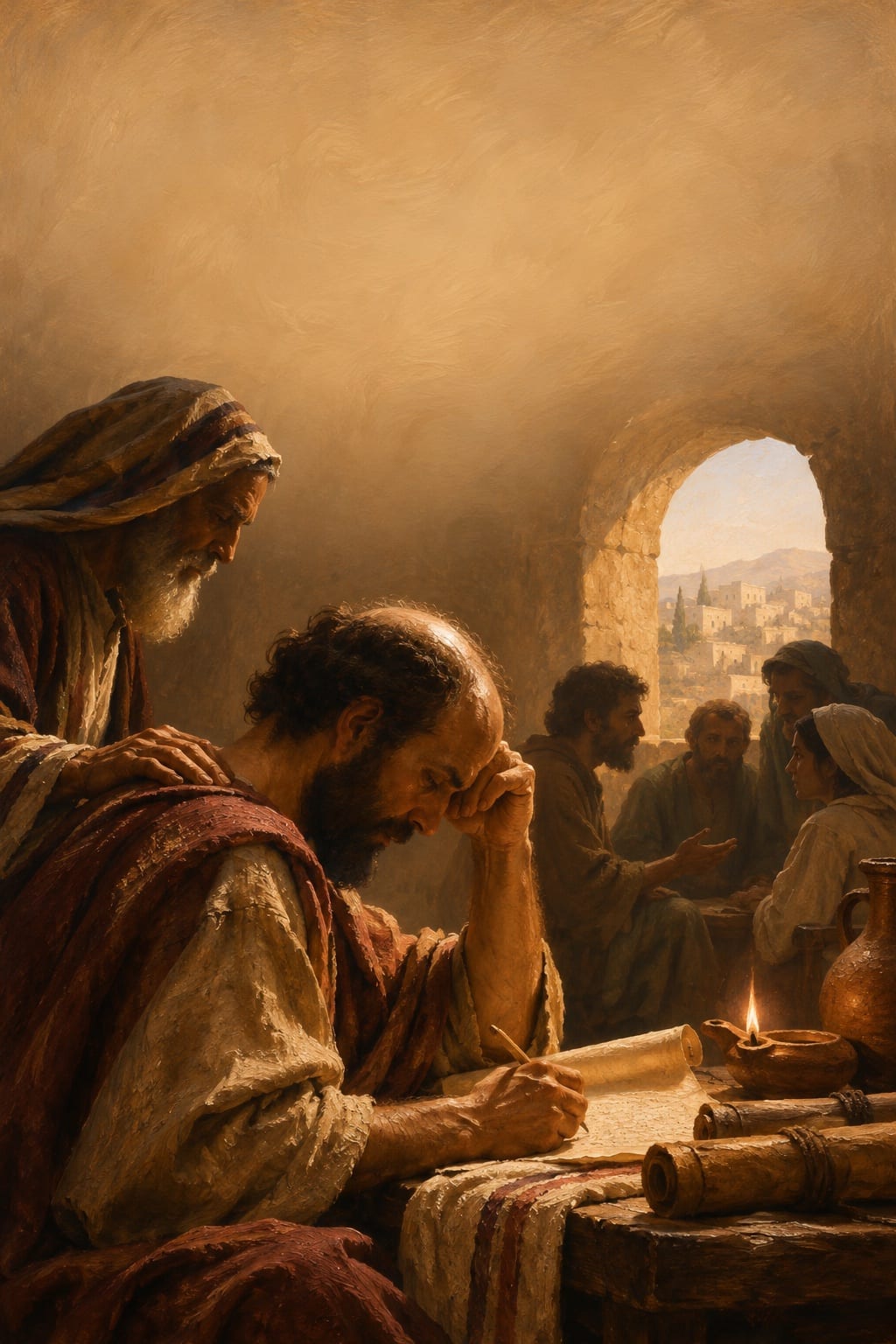
The Decade Paul Spent Where No One Was Looking
Galatians 1:11-2:17 min
After Damascus, Paul disappears for nearly a decade — because the apostle to the Gentiles is being made in a long obscurity the risen Christ chose for him on purpose.
Scripture
Galatians 1:11-2:1
Key moment Galatians 1:15-18
Read
He has the most dramatic conversion story in the New Testament, and then he disappears.
Luke gives us the road to Damascus in three retellings. The light. The voice. Saul, Saul, why are you persecuting me? The blindness. The street called Straight. Ananias laying his hands on a man the church is afraid of. The scales falling. The baptism. We expect the camera to follow him into the great mission. We expect a clean cut to him standing in front of the Sanhedrin, then to the Areopagus, then to the imperial court.
Instead, in Galatians, Paul tells us what actually happened. He is at pains to be precise about it, because false teachers in Galatia have been claiming his gospel is second-hand, learned from the apostles in Jerusalem. So Paul lays out the timeline.
When he who had set me apart before I was born, and who called me by his grace, was pleased to reveal his Son to me... I did not immediately consult with anyone; nor did I go up to Jerusalem to those who were apostles before me, but I went away into Arabia, and returned again to Damascus.
-- Galatians 1:15-17
I went away into Arabia. Not to a seminary. Not to Peter and James for a credentialing course. Not to the church planters' summit. Into Arabia. The Nabatean wilderness, most likely — the same general territory where Moses was formed for forty years, where Elijah ran when he wanted to die, where John the Baptist was tuned in silence. Paul does not tell us what he did there. He gives us no transcript. Just the geographical fact that the man with the most violent testimony in the early church spent his first season after Damascus in the desert, alone with the Christ who had just stopped him on the road.
Then he comes back to Damascus. Then, after three years, he finally goes up to Jerusalem to meet Peter — a fifteen-day visit. James the Lord's brother is the only other apostle he sees. He is not yet Paul the apostle. He is a man with a story the church is still nervous about.
Then he disappears again.
Then I went into the regions of Syria and Cilicia. And I was still unknown in person to the churches of Judea that are in Christ.
-- Galatians 1:21-22
Unknown in person. He goes home. Tarsus, in Cilicia. The town of his upbringing. We know almost nothing about these years. Some scholars estimate as long as seven to ten years pass between his return to Tarsus and the moment Barnabas finally comes looking for him — because the church at Antioch is exploding and they need a teacher who can speak to Gentile hearts. Barnabas went to Tarsus to look for Saul, and when he had found him, he brought him to Antioch.
When he had found him. The verb implies effort. Paul is not advertising. He is not waiting at the gates of the city with a résumé. He is somewhere in Tarsus, doing whatever he is doing, when the church remembers him and Barnabas has to go searching.
So Paul gives us, total, fourteen years between his conversion and his second trip to Jerusalem. Fourteen years between the road to Damascus and the moment the apostles formally recognize his Gentile mission. Almost half of those years pass in places no one was watching.
What happened in those years?
We do not exactly know. We can guess. He was likely making tents — the trade he never abandoned. He was likely arguing in synagogues, getting into trouble, getting beaten with rods, fleeing cities at night through windows in baskets. He was working out, in solitude and in obscurity, the gospel he would later write down with such force in Romans and Galatians and Ephesians. He was being forged into a man who could write, I have learned in whatever situation I am to be content. He was learning, slowly, the difference between a real commissioning and a felt platform.
By the time the great years finally arrive — the missionary journeys, the letters, the Areopagus, the chains — he carries them as a man whose interior was built in a desert and a hometown, not in a podium.
Today
You may have had a real encounter.
A moment with God you cannot explain away. A clear call you can still feel in your bones. Maybe years ago. Maybe more recently. Whatever it was, it was real enough to reorganize the way you saw your life. You came up out of it expecting the trajectory to follow. The platform. The role. The people who would call you up into the new thing. The community that would recognize the call and put you to work.
Instead, you went home.
No door opened. No one came looking. The encounter is still real, but the calendar has gone quiet. Years pass. You watch other people get pulled into rooms, given titles, handed assignments. You are still in Tarsus, doing whatever you are doing, wondering if you imagined the whole thing on the road.
Paul would tell you: probably not.
The risen Christ, who could have launched him into apostleship the day after Damascus, chose for him a near-decade in places no one was watching. Arabia. Damascus. Tarsus. Solitude, then home. Quiet years to forge in him an apostle the early church would not even know how to use yet. The famous letters, the famous trials, the famous courage — none of it happened in the early years after the encounter. Christ was happy to wait. He was building someone the building required.
If you are in a similar season — commissioned in private, unannounced in public, wondering if Barnabas is ever going to come and find you — do not fast-forward this. The temptation is to manufacture your own platform, to pull yourself out of obscurity by force, to interpret the silence as either rejection or proof you misheard. Resist that. The same Christ who appeared on the road has chosen this hometown for you, this trade, this quiet, this stretch of unknownness. He is not idle in it. He is making a vessel that will, when finally pulled out into the wide assignment, hold what he has for you to hold.
The knock on the door comes for everyone the Lord has called. It just rarely comes when we expect it. Stay faithful in Tarsus. Make the tents. Argue the gospel in the small synagogues. Read deeply. Suffer well. Pray more than you publish. When Barnabas finally comes, he will find you the kind of person whose obscurity has prepared him for an Antioch he could not have entered any other way.
Pause
Take a slow breath.
Sit with what you've read.
Ponder
Where in your life has a real encounter with God been followed by a longer silence than you expected, and how has that silence tempted you to doubt the encounter itself?
What might Christ be forging in your years of unknownness that could not be forged in a public season?
If Barnabas has not come yet, what does faithfulness in your version of Tarsus look like this week — in the trade, the prayers, the small rooms, the daily obscurity?
Pray
A prayer
Lord Jesus, Christ of the road and Christ of the desert, you are the One who knocked Saul off his horse and then sent him into Arabia, the One who chooses our long obscurities with the same authority you choose our public years. Let your kingdom come in the silence between my encounter and my assignment, and let your will be done in the years I cannot account for on a résumé. Forgive me for the days I have suspected you of forgetting me. Forgive me for trying to manufacture a platform you did not promise, for measuring my call by how many people are calling me up. Make me faithful in Tarsus. Build in me, in the unseen years, the kind of soul that can carry whatever you finally hand me without breaking under it. And when Barnabas comes for me — if Barnabas comes for me — let him find a man whose interior was forged where no one was looking, and let me walk into Antioch carrying what only the silent decade could give me.
Amen.
Stay faithful where no one is looking.The silent decade is the apprenticeship.