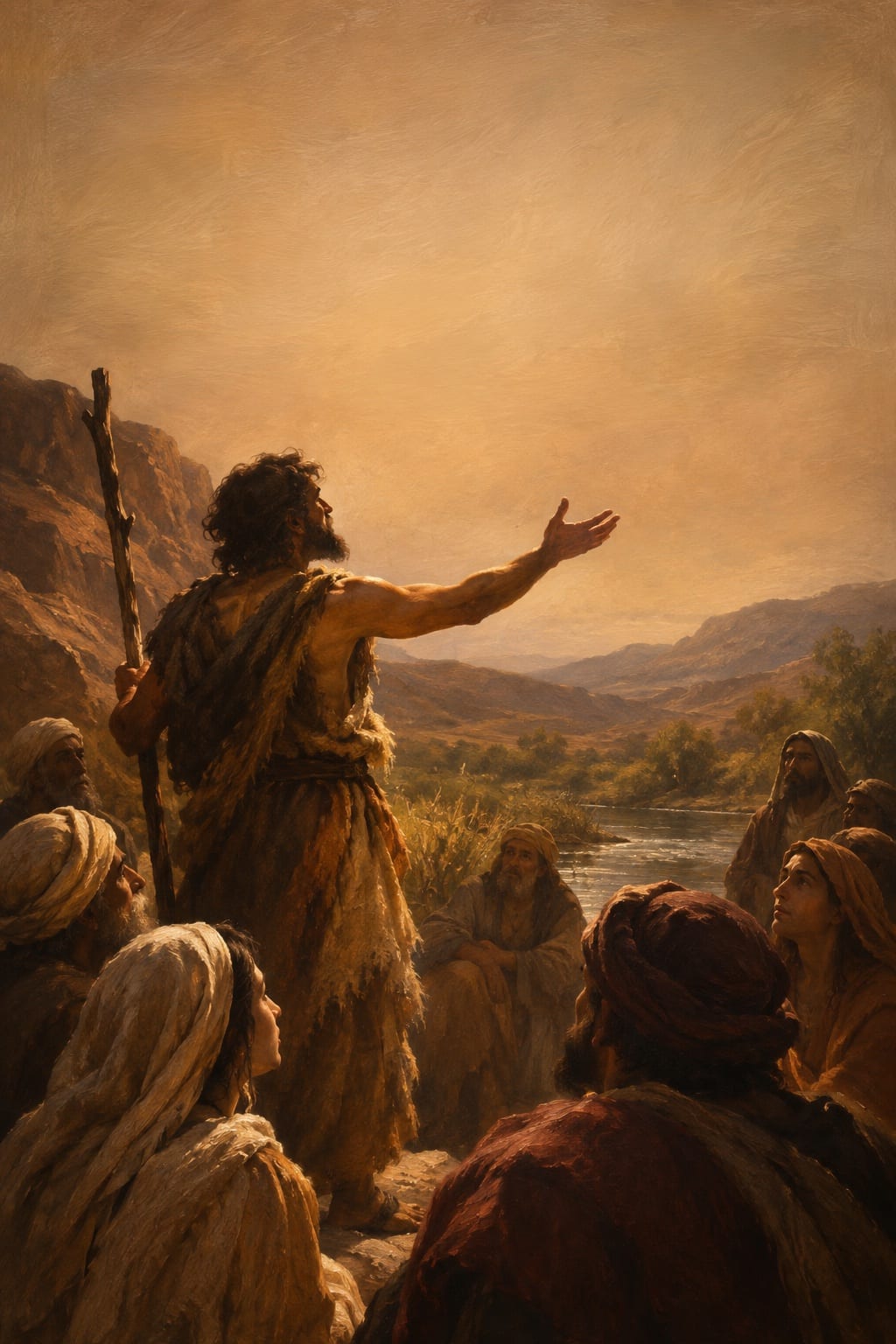
The Word Came to John in the Wilderness
Luke 1:80; 3:1-37 min
The son of a temple priest is formed not in the temple but in the desert, where God tunes the voice of a prophet outside every institution that expected to shape him.
Scripture
Luke 1:80; 3:1-3
Key moment Luke 3:2
Read
His father is a priest. His mother is a daughter of Aaron. By every reasonable expectation, this child should grow up inside the temple.
Zechariah serves in the priestly division of Abijah. He has spent his life in the courts, swinging incense, reading Torah, ordering the sacrifices. When the angel finds him, it is at the altar of incense, in the holy place. His son, by the laws of inheritance, will follow him there. The boy will grow up smelling burnt offerings. He will learn the Aaronic blessing the way other children learn lullabies. He is, by every birthright, a temple insider.
Luke gives us his birth in glorious detail. The angel. The mute father. The leaping in the womb. The hill country song. The neighbors whispering, what then will this child be?
Then Luke tells us almost nothing. Just one sentence to cover decades.
And the child grew and became strong in spirit, and he was in the wilderness till the day of his public appearance to Israel.
-- Luke 1:80
In the wilderness. En tais erēmois. The plural deserts. The text does not say he visited. It says he was in them. He grew up in them. The boy whose blood entitled him to a robe and an altar grows up instead among locusts and dry stones, with a leather belt around his waist and his head full of silence.
We do not know exactly when he left, or who took him. Some traditions say his parents died early; others, that he was sent to one of the desert communities. Luke does not care to explain. He cares to tell us only this: when the prophet finally appears, he does not appear out of the temple. He appears out of the wilderness. And the line that opens his ministry is one of the most beautiful in the Gospels.
...the word of God came to John the son of Zechariah in the wilderness.
-- Luke 3:2
Luke surrounds this line with imperial scaffolding. In the fifteenth year of the reign of Tiberius Caesar, Pontius Pilate being governor of Judea, Herod being tetrarch of Galilee... during the high priesthood of Annas and Caiaphas... He lists every official platform of the day. Caesar in Rome. Procurator in Caesarea. High priest in Jerusalem. Every chair from which one might expect God to speak.
And then he tells us where the word actually went.
Not to Tiberius. Not to Pilate. Not to Annas or Caiaphas. The word of God came to John the son of Zechariah in the wilderness. The address is wrong, by every institutional metric. The word skips the centres. It walks past the temple. It travels out to the desert, to a strange man in camel's hair who has been listening to God in silence for years, and it comes to him.
Why?
Because the wilderness has done something the temple could not have done. It has stripped John. It has emptied him of the inherited religion he was entitled to perform, and replaced it with a tuned ear. He has not had a congregation to please. He has not had a priestly career to protect. There is no political base, no donor list, no liturgical reputation. There is only the long silence and the slow shaping of a voice that, when it finally speaks, will sound like nothing the centres of power have ever heard.
When John emerges, his message is one Israel could not have produced from the inside. Repent. Bear fruit. Do not say to yourselves, we have Abraham as our father. He goes after the very institutional confidence the temple existed to maintain. He prepares the way for a Messiah who will be born in a manger, raised in Nazareth, killed outside the gate. The whole arc of God's Son will mirror the arc of his forerunner. Both formed on the outskirts. Both crowned by the centre's rejection. Both speaking with an authority no chair in Jerusalem could grant.
The word came to John in the wilderness because the wilderness was the only place a voice like his could be made.
Today
You may be in a season where everything you expected to shape you has not.
The institution. The mentor. The family system. The denomination. The job. The city. The role. There was a story you had about how your formation was supposed to happen, and you assumed the centres of that story were where God would meet you. Instead, God has steadily walked you out to the outskirts. You have been quietly relocated to a wilderness. A different city than you planned. A church on the edge of things, or no church at all for a while. A career that detoured. A calling that started forming in a season of no platform, no audience, no scaffolding to legitimize it. You feel forgotten by the very places that were supposed to send you.
John would tell you that the address is correct. The word of the Lord, when it finally comes for you to speak, will not need the credentials you thought it would. It will need the tuned ear that only the wilderness could give you. The years in the locusts and silence are not a detour from the prophetic life; they are the prophetic life. Voices formed in the centres tend to sound like the centres. Voices formed on the outskirts tend to sound like God.
God has a long, strange preference for the outskirts. Moses was found at the back of the desert. David came in from the sheep. Amos was a farmer from Tekoa, not a son of the prophets. Mary lived in Nazareth, not Jerusalem. Paul went to Arabia before he ever stood in front of the apostles. The pattern is consistent enough that it should comfort you. If the place you are being formed feels like exile or forgetting, you may simply be in the kind of address God prefers to write to.
What is being made in you out here cannot be made in the temple. Stop apologizing for the strangeness of your training ground. Stop trying to migrate back to the centre before God has finished tuning you. The fifteenth year of Tiberius is coming for someone, and the word of the Lord is going to find a man in the wilderness, not a man in a robe at the altar. Be the kind of soul whose ear is open enough that, when it does, you will hear it.
Pause
Take a slow breath.
Sit with what you've read.
Ponder
Where in your life have you felt forgotten by the institution or community you expected to form you, and how might God be using that distance to tune your voice?
What would it mean to stop apologizing for the strangeness of your current training ground and let the wilderness do its work?
If God has a long preference for the outskirts, what is he forming in you out here that could not be formed at the centre?
Pray
A prayer
Lord God of John in the wilderness, you are the One who skips capitals and walks past temples, who sends your word to a son of a priest standing alone in the locust country. Let your kingdom come in the outskirts of my life, and let your will be done in the long silence I did not choose and cannot understand. Forgive me for the days I have measured my formation by the institutions I am inside or outside of, and for assuming that proximity to the centre was the same as proximity to you. Tune my ear in this wilderness. Strip me of the inherited religion I was entitled to perform. Build a voice in me that, when it finally speaks, will sound like you and not like the systems I came from. When the fifteenth year of some Tiberius arrives, and the word of the Lord is looking for a man in the desert, let me be standing where you can find me, with my heart open and my hands free.
Amen.
Stay in the wilderness a while.The word knows where to find you.