The Forgotten Prisoner Who Fed the World
Genesis 39–414 min
Joseph's years of quiet faithfulness in slavery and prison were not wasted time — they were the formation God used to shape a man capable of stewarding the salvation of nations.
Scripture
Genesis 39–41
Key moment Genesis 39:21-23
Read
The story opens with a young man sold by his own brothers, hauled to Egypt in a trader's caravan, and deposited into the household of Potiphar, an officer of Pharaoh. No angelic chorus accompanied him. No divine voice explained the plan. Joseph simply arrived — owned, displaced, and alone.
What happens next is striking for its ordinariness. Joseph worked. He managed grain inventories and household logistics. Genesis 39 tells us the Lord was with Joseph and gave him success, but that success looked like competent administration in someone else's house. He didn't build a monument; he kept good records. He earned trust by showing up reliably in a role no one would envy.
Then came the test that would define him more than any promotion could. Potiphar's wife pressed him, day after day, and Joseph refused — not with a grand speech about destiny, but with a plain moral clarity: "How then could I do this great wickedness and sin against God?" (Genesis 39:9). His reward for integrity was a prison cell. The narrator doesn't soften this. Faithfulness cost him everything he'd built.
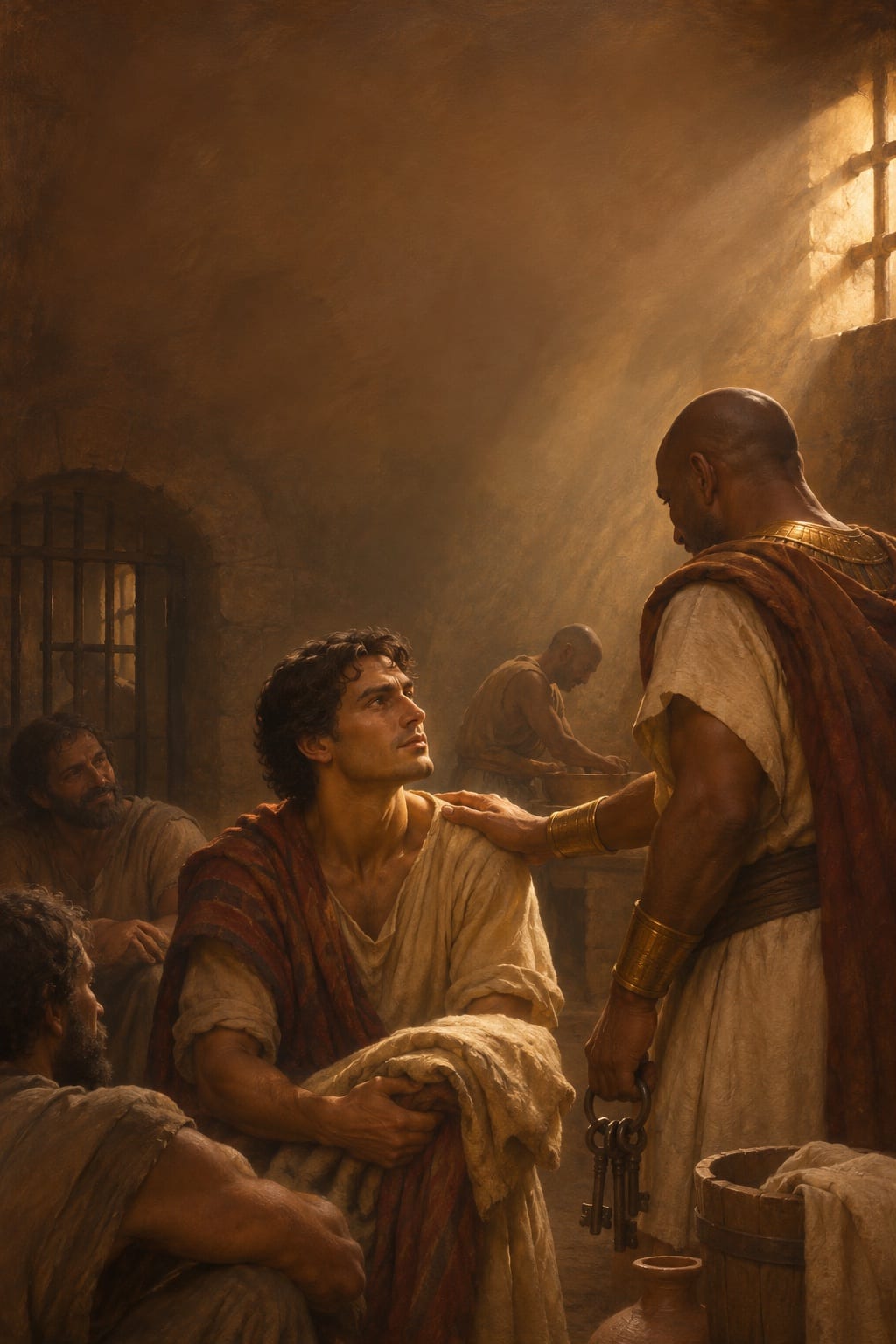
In prison, the pattern repeated. Joseph didn't sulk or scheme. He served. He noticed the downcast faces of Pharaoh's cupbearer and baker and asked a disarmingly human question: "Why do you look so sad today?" (Genesis 40:7). He interpreted their dreams accurately, then asked the cupbearer to remember him. The cupbearer forgot. Two full years passed — 730 days of silence after a promise of advocacy. Joseph kept managing the prison.
When Pharaoh finally dreamed his troubling dreams and the cupbearer's memory finally stirred, Joseph stood before the throne not as a polished courtier but as a man whose character had been refined by years no one witnessed. He gave God the credit — "It is not in me; God will give Pharaoh a favorable answer" (Genesis 41:16) — and proposed a plan so wise that Pharaoh recognized something the world had overlooked: "Can we find anyone like this man, one in whom is the spirit of God?" (Genesis 41:38). The forgotten prisoner became Egypt's second-in-command, and his administrative skill — honed in a house and a dungeon — saved entire nations from famine.
Today
Most of us will never stand before a king. But all of us know what it feels like to labor in roles that seem too small for the ache inside us, to do good work that goes unnoticed, to wait for a promise that someone else forgot they made.
Joseph's story confronts a quiet lie many of us carry: that hidden seasons are wasted seasons. We imagine God's real work begins when the spotlight turns on, when the calling becomes visible, when someone finally notices. But Genesis tells a different story. Every skill Joseph used to save Egypt — logistical thinking, emotional perceptiveness, steady leadership under pressure, the habit of crediting God rather than himself — was forged in obscurity. The prison and the palace required the same man.
Your faithfulness in the unseen place is not a waiting room for your real life. It is your real life, and God is using it. The integrity you practice when no one is watching, the kindness you extend when you have every reason to grow bitter, the competence you bring to work that feels beneath your potential — these are not preludes to the story. They are the story. God does not waste formation. What feels like delay may be the very curriculum that makes you ready for what you cannot yet imagine.
This doesn't erase the grief of waiting or the loneliness of being overlooked. Joseph wept when his brothers finally stood before him. Those years left marks. But they also left him capable of mercy, wisdom, and the kind of authority that feeds people instead of exploiting them. Ordinary faithfulness, sustained across time, became the instrument through which God preserved life.
Pause
Take a slow breath.
Sit with what you've read.
Ponder
What hidden or overlooked area of your life might God be using to form something in you that you can't yet see?
When faithfulness has cost you rather than rewarded you, how have you responded — and what did that season quietly teach you?
Is there a place where you've stopped bringing your full self because the work feels too small or the recognition too sparse?
Pray
A prayer
Father of Joseph, God who sees what is hidden and remembers what others forget — I bring you the parts of my life that feel small and unseen. Forgive me for the times I have despised the ordinary, believing that only visible things carry weight in your kingdom. Teach me to serve faithfully where I am, not as a strategy for promotion, but because you are worth my integrity whether anyone notices or not. Give me eyes to see your presence in the long middle of my story. Let your will be done in the hidden years as surely as in the harvest. Shape me into someone who can be trusted with what is coming, even before I understand it.
Amen.
Your hidden faithfulness is never hidden from God.He who began a good work in you is faithful to complete it — even in the unseen years.