Thirteen Years Between the Promise and the Palace
Genesis 41:1-574 min
Joseph's journey from a pit to Pharaoh's court reveals that God uses hidden, painful seasons not as punishments but as preparation—shaping us into vessels capable of carrying the weight of the purpose He always intended.
Scripture
Genesis 41:1-57
Key moment Genesis 41:15-16
Read
Thirteen years. That's the gap between a seventeen-year-old dreaming of sheaves bowing and a thirty-year-old standing before the most powerful man on earth. Scripture covers those years in a handful of chapters, but Joseph lived every single day of them — the stench of the pit, the humiliation of the auction block, the slow grind of Potiphar's household, the cold dark of an Egyptian dungeon. No timeline. No progress report from heaven.
What's striking is what Joseph didn't do during those years. He didn't grow bitter enough to stop working. In Potiphar's house, everything he touched prospered. In prison, he managed the other inmates so well the warden stopped checking his work. These weren't glamorous assignments. Nobody was watching. There was no audience, no applause, no prophetic word saying "hang on, eighteen more months." Joseph simply kept being faithful in rooms that didn't matter to anyone but God.
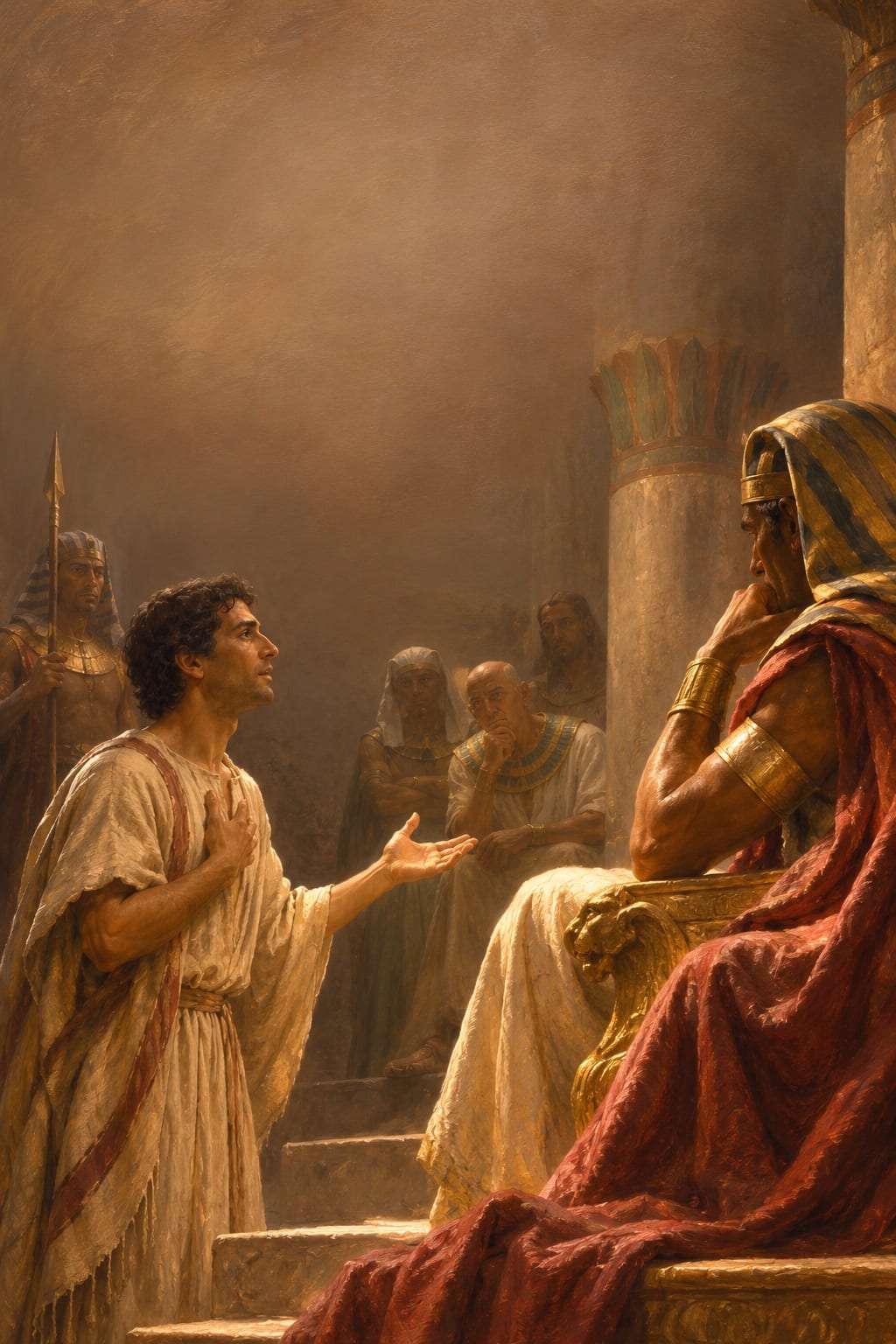
Then Pharaoh dreamed — seven fat cows swallowed by seven gaunt ones, seven plump heads of grain consumed by seven thin and scorched ones — and the entire machinery of Egypt's wisdom failed to interpret them. The cupbearer, two full years after Joseph had asked him for help, finally remembered the Hebrew prisoner. When Joseph stood before Pharaoh, he didn't posture or perform. His first words were a redirection: "It is not in me; God will give Pharaoh a favorable answer" (Genesis 41:16). The years of obscurity had hollowed out self-reliance and filled the space with something sturdier.
Pharaoh didn't just get an interpretation — he got a strategy. Joseph outlined a fourteen-year economic plan with the clarity of someone who understood scarcity intimately, who had lived without control over his own life and learned to steward whatever small thing was placed in his hands. God hadn't been idle during those thirteen years. He had been building an administrator in a prison, a national leader in a slave's quarters, a provider of nations inside a man who had nothing.
Today
If you're in a season that feels like it has no purpose — where the work is invisible, the waiting feels pointless, and the distance between where you are and where you hoped to be stretches out with no end in sight — Joseph's story presses a different question than "when will this end?" It asks: what is being built in me right here?
We tend to treat difficult seasons as obstacles between us and our real life, as though God's plan is on pause until circumstances improve. But Joseph's prison wasn't a detour from God's plan; it was the plan. Every act of quiet faithfulness — managing a household he didn't own, caring for prisoners who couldn't repay him, interpreting dreams for a cupbearer who forgot him — was shaping capacity. Joseph arrived in Pharaoh's court not just with a God-given interpretation but with years of practiced competence, humility tested by injustice, and a reflex to credit God rather than himself.
Your hidden season is doing something similar. The skills you're developing in obscurity, the character being refined when no one notices, the patience being forged in waiting rooms you didn't choose — none of it is wasted. God doesn't just position us for a moment of promotion; He prepares us to carry its weight. Joseph could steward the provision of entire nations because he had already proven faithful with a prison warden's trust. Whatever small, unglamorous thing is in your hands today, tend it well. You may not see the architecture yet, but the Builder does.
Pause
Take a slow breath.
Sit with what you've read.
Ponder
What 'small' responsibility in your current season might God be using to develop something you'll need later?
Where have you been treating a difficult season as a detour rather than preparation — and how might that shift change how you move through it?
When Joseph stood before Pharaoh, his instinct was to redirect credit to God. What does your instinct reveal about what obscurity has or hasn't yet built in you?
Pray
A prayer
Father, Sovereign over every season — the ones that shine and the ones that feel forgotten — I confess that I have resented the waiting. I have looked at closed doors and empty timelines and concluded that You were absent or indifferent. Forgive my impatience and my small view of Your work. Your kingdom does not run on my schedule. Let Your will be done in this hidden place, even when I cannot trace its shape. Give me the grace to be faithful with what is in front of me today — not because I can see the outcome, but because You are worth my trust. Prepare me, as You prepared Joseph, not just for a moment but for a weight of purpose I cannot yet imagine. And when the day comes, let my first words point to You.
Amen.
Tend what's in your hands. The Builder sees.Your hidden season is not hidden to God. He is working.