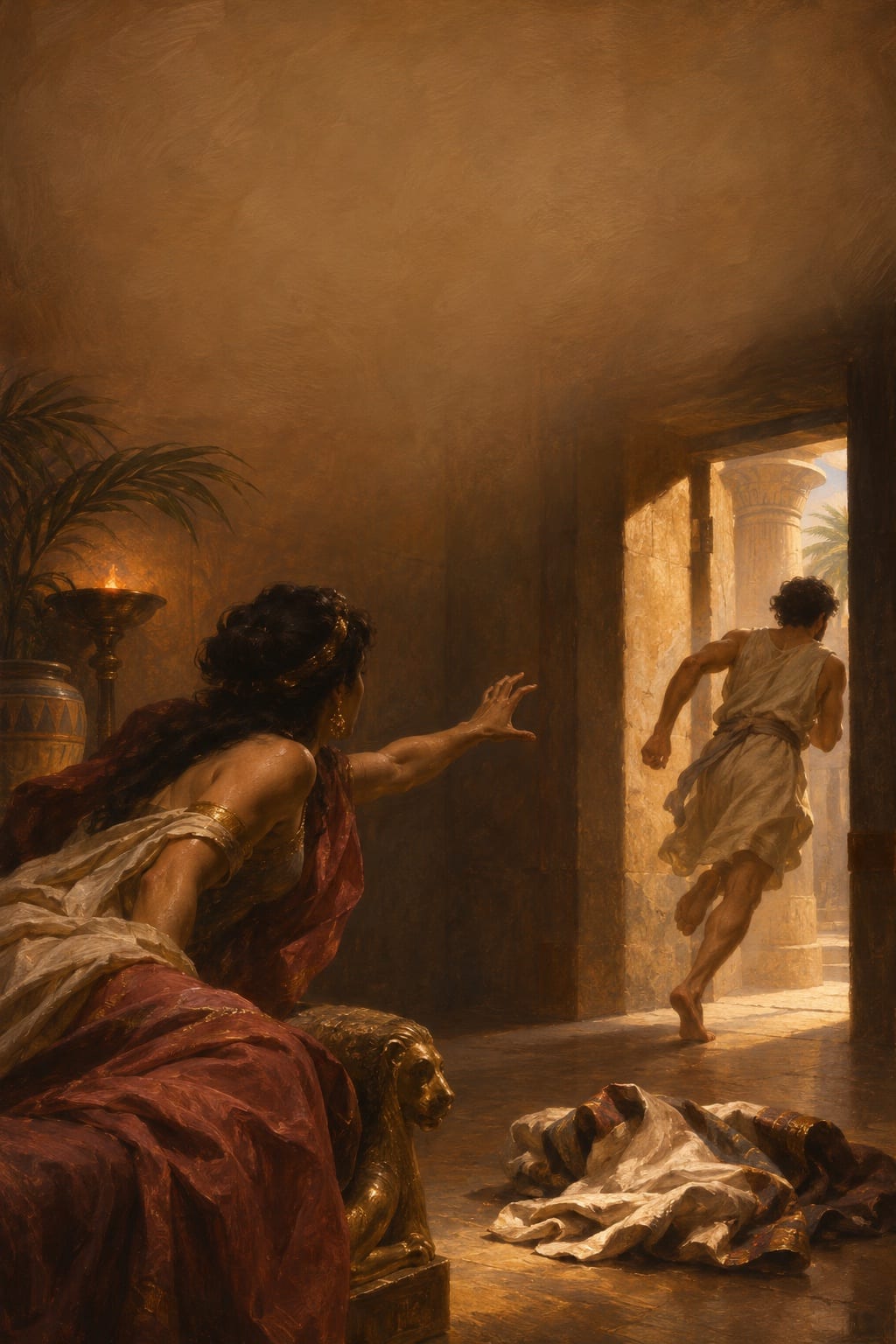
The Man Who Left His Coat Behind
Genesis 39:1-234 min
When Potiphar's wife grabbed Joseph's garment, he didn't pause to reason with her. He ran — and in doing so revealed that true strength sometimes looks like an empty doorway and a coat on the floor.
Scripture
Genesis 39:1-23
Key moment Genesis 39:9-12
Read
Joseph had every reason to give in. He was young, far from home, enslaved in a foreign country where nobody from his old life would ever know. Potiphar's wife pursued him not once but day after day, and the text is honest about that — this wasn't a single dramatic moment but a slow, grinding campaign of pressure. The ground had been softened long before the day she grabbed his cloak.
What stands out is what Joseph said before that final confrontation: "How then could I do such a wicked thing and sin against God?" Notice he didn't say "sin against Potiphar" or "ruin my career" or even "violate my conscience." He located the act in relation to God's presence. His reasoning wasn't built on self-discipline or moral calculation; it was anchored in something deeper — an awareness that he lived before the face of someone who mattered more than his comfort, his loneliness, or his desire.
Then came the day she cornered him when no one else was in the house. And Joseph didn't negotiate, didn't explain one more time, didn't try to let her down gently. He left his garment in her hand and ran. The Hebrew word is vivid — he fled outside, into the open. He chose exposure and loss over staying in that room one second longer. His coat became evidence used against him, and he ended up in prison for doing the right thing.
Here is the uncomfortable truth the story preserves: obedience cost Joseph everything in the short term. He lost his position, his reputation, his freedom. But the narrator frames the prison scene with the same phrase used earlier — "The LORD was with Joseph." God's presence didn't prevent the suffering, but it traveled with him into it. The same God who watched Joseph flee was the God who met him in the cell.
Today
Most of us have been taught that resisting temptation is about standing firm, gritting your teeth, willing yourself to be stronger than the pull. Joseph's story offers a different picture. He didn't stand firm — he ran. And Scripture honors the running.
There's a reason Paul later told Timothy to "flee youthful lusts" rather than fight them head-on. Some battles aren't won by engagement but by distance. This means the practical, unglamorous work of identifying your triggers before they escalate matters enormously. Knowing which situations thin your resolve, which hours of the day leave you most vulnerable, which habits open doors you don't want opened — that knowledge is not paranoia. It's wisdom.
Building an escape plan might look mundane: a phone call to a friend, a change in routine, an accountability relationship where honesty replaces performance. It might mean closing a browser, leaving a room, or restructuring your evening. None of that feels heroic. But Joseph's heroism looked like bare feet on a dusty road and an empty hallway — hardly the stuff of legend in the moment.
If shame has been the loudest voice in your story, hear this: Joseph's identity wasn't defined by Potiphar's wife or by the false accusation that followed. It was defined by whose presence he chose to live in. The same is true for you. Purity isn't a streak you maintain until you break it; it's a direction you face. Every time you turn back toward God — even from the floor, even after failure — you are doing exactly what grace makes possible. God's strength arrives precisely where yours runs out.
Pause
Take a slow breath.
Sit with what you've read.
Ponder
What situation or pattern in your life are you trying to manage through willpower that might actually require you to flee — to physically remove yourself or change the circumstance entirely?
When you think about sexual integrity, is your inner voice shaped more by shame or by an awareness of God's presence? How might Joseph's reframing — 'How could I sin against God?' — change the conversation in your own mind?
Who in your life could you trust with honest accountability, not as a monitor but as a companion?
Pray
A prayer
Father, you see the places where I am tired of fighting alone, the patterns I keep circling back to, the shame that tells me I am too far gone. I confess that I have tried to negotiate with what I should have fled. Forgive me — not to condemn me, but to free me. Give me Joseph's clarity: the deep, settled knowledge that I live before your face and that your presence is worth more than anything temptation offers. Where I lack strength, be my strength. Where I lack a plan, give me wisdom and honest companions. Lead me not into temptation, but deliver me from evil. Let your kingdom come in my habits, my evenings, my secret places. I trust that your grace meets me here — not after I've cleaned up, but right now, as I am.
Amen.
You are not defined by your worst moment.You are defined by the One whose presence never left — even in the prison, even now.