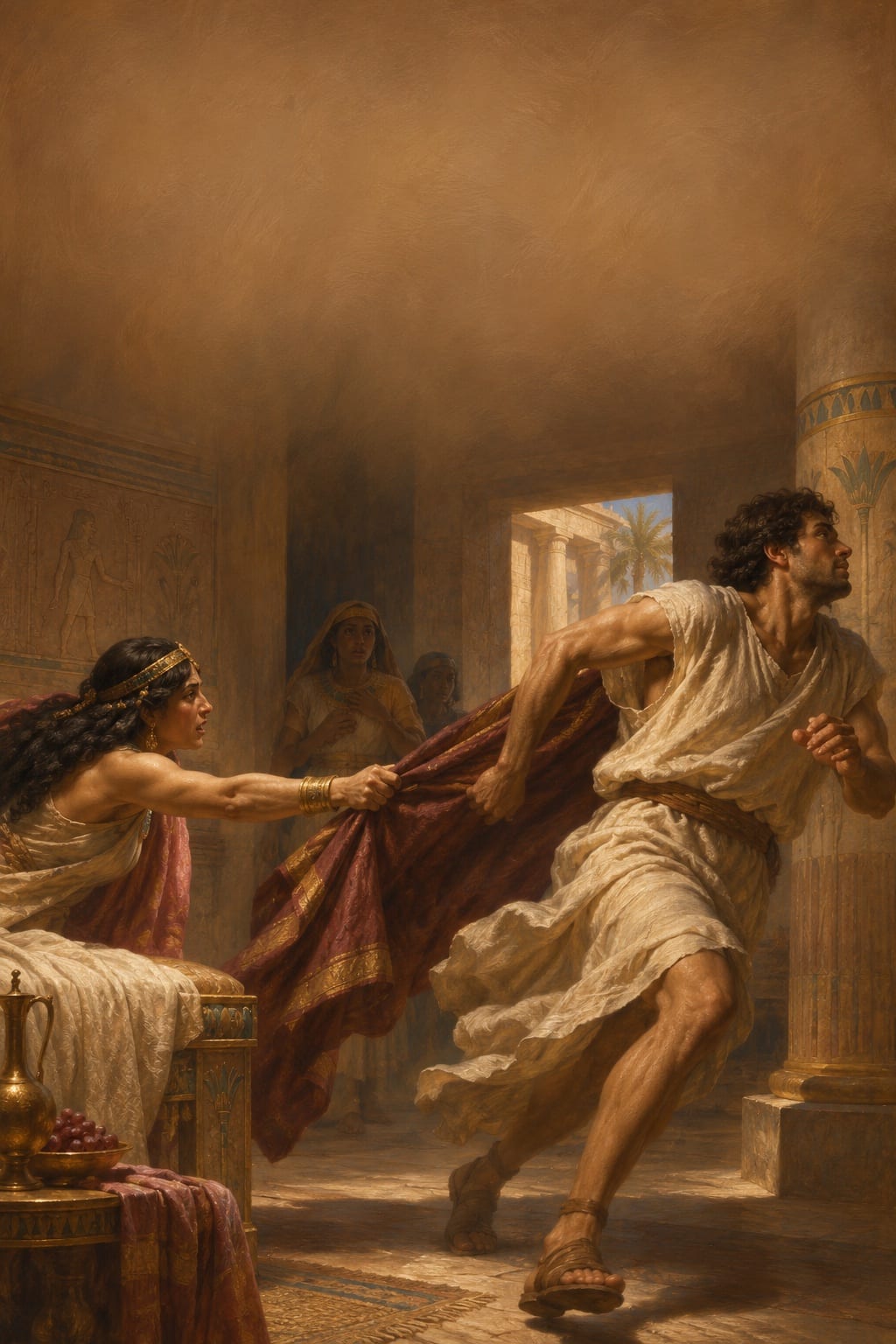
The Man Who Ran and the Garment He Left Behind
Genesis 39:1-234 min
When Potiphar's wife seized Joseph's garment, he didn't stay to argue or negotiate. He ran — and his flight reveals that awareness of God's presence is a more reliable defense than willpower alone.
Scripture
Genesis 39:1-23
Key moment Genesis 39:11-12
Read
Joseph had every reason to feel abandoned. Sold by his brothers, trafficked to Egypt, stripped of his family and his father's coat — he was a young man carrying enormous pain in a foreign land. And yet Genesis 39 opens with a strange, quiet declaration: "The LORD was with Joseph." Whatever Joseph had lost, he had not lost that.
His competence drew Potiphar's attention, and soon Joseph managed the entire household. He was trusted, capable, and alone. No family watching. No accountability. No elders. Just a young man far from home with real authority and real stress. It was precisely in this season — isolation layered with responsibility — that temptation arrived. Not once, but day after day (v. 10). Potiphar's wife was persistent, and the text doesn't sanitize the pressure. This was sustained, deliberate pursuit.
Notice what Joseph didn't do. He didn't silently entertain the offer while telling himself he was strong enough to resist. He didn't linger in the doorway weighing his options. When the moment came and she grabbed his garment, he left the garment in her hand and ran out of the house. The Hebrew word is vivid — he fled, as from danger. He chose to lose his clothing rather than lose his integrity.
But the foundation of his flight wasn't fear of consequences. Listen to his words in verse 9: "How then can I do this great wickedness and sin against God?" Joseph's refusal was rooted in relationship. He didn't say "Potiphar might find out" or "this could ruin my career." He named the act for what it was — sin against a God who was near enough to sin against. His awareness of God's presence was the thing that gave his legs permission to run.
Today
Sexual temptation rarely announces itself in neon. More often it arrives quietly, in seasons when you're overworked, lonely, or carrying grief you haven't spoken aloud. The patterns are predictable: late nights, emotional exhaustion, isolation from community, a screen that no one else can see. Temptation reads the room and waits for the moment your defenses are thinnest.
This is why Joseph's story matters practically, not just theologically. He didn't defeat temptation through gritted-teeth resolve. He had already decided, long before that afternoon, who he belonged to. When the moment came, his body followed what his spirit already knew. The decision to run was made before the crisis arrived.
Paul echoes this principle centuries later in 1 Corinthians 6:18 — "Flee from sexual immorality." The Greek word is pheugo, the same instinct as Joseph's: get out, physically remove yourself. Paul doesn't say "stand your ground" or "reason with it." He says run. There is no shame in flight. Sometimes the most courageous thing you can do is close the laptop, leave the room, pick up the phone and call someone, or simply drive somewhere else. These aren't signs of weakness. They're the discipline of someone who knows their own limits and trusts God more than their own willpower.
So build your exits before you need them. Know your triggers — the time of day, the emotional state, the circumstance that makes you vulnerable. Tell one trusted person the truth. And when the moment comes, remember Joseph's words. The question isn't "Can I get away with this?" The question is: "How can I do this and sin against the God who has been with me?" His presence is your shield. Run toward it.
Pause
Take a slow breath.
Sit with what you've read.
Ponder
When you examine the seasons where you've been most vulnerable to temptation, what conditions were present — isolation, stress, grief, boredom? What does that pattern reveal about where you need protection?
Joseph's resistance was grounded in his relationship with God, not in fear of punishment. What currently anchors your own resistance — consequence avoidance or genuine awareness of God's nearness?
Is there a situation right now where you're negotiating with temptation instead of fleeing it? What would it look like to physically remove yourself?
Pray
A prayer
Father, You who were with Joseph in the pit and in the palace and in the prison, Be with me in the quiet moments when no one is watching. I confess that I have trusted my own strength more than Your presence. I have lingered where I should have fled and negotiated where I should have run. Give me the wisdom to know my limits and the humility to act on them. Let Your nearness be more real to me than any momentary promise of pleasure. Build in me the kind of awareness Joseph carried — that I belong to You, and that belonging changes everything. Lead me not into temptation, but deliver me from evil. When the moment comes, let my legs obey what my heart already knows
Amen.
Run toward Him. He meets you mid-stride.The God who was with Joseph in every season is with you now — even in the running.