The Slow Erosion: What Samson Lost Before He Lost His Hair
Judges 16:1-314 min
Samson's downfall didn't happen in a single dramatic moment. Judges 16 reveals a man who had drifted so far from his identity and community that he couldn't recognize the pattern destroying him — and his story illuminates how we can.
Scripture
Judges 16:1-31
Key moment Judges 16:16-20
Read
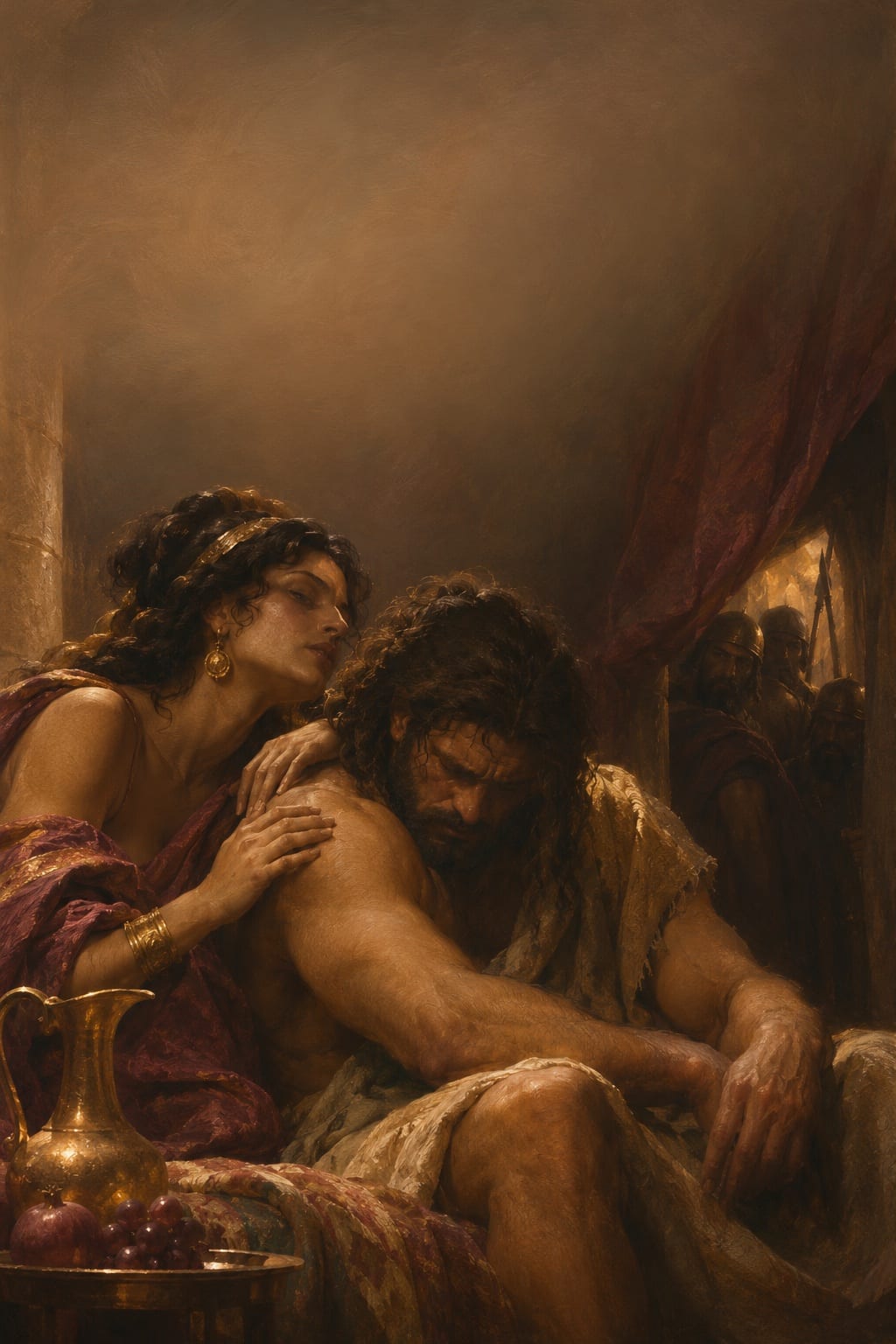
By the time Delilah asks her famous question, Samson is already a man undone. The text doesn't frame his fall as a sudden catastrophe. It reads like an autopsy of slow erosion — a pattern so rehearsed that Samson walks through it almost mechanically.
Look at what precedes Delilah. Judges 14-15 catalogs a man increasingly isolated from his own people, operating on impulse, leveraging his gift for personal vendettas. His Nazirite vow — the external sign of consecration that marked his life from the womb — had become a relic he carried rather than a covenant he inhabited. He still had the hair. He'd long since lost the heart beneath it.
Then comes the repeated cycle in Judges 16:6-20. Delilah asks; Samson lies; the Philistines come; Samson escapes. Three times. Each round, he edges closer to the truth, almost flirting with his own destruction. Verse 16 says she pressed him daily until "his soul was vexed to death." The Hebrew word for vexed — qātsar — means shortened, cut off, exhausted. His resistance wasn't overcome by a single overwhelming force. It was worn thin by repetition, fatigue, and the ache of unmet loneliness that had brought him to her valley in the first place.
Verse 20 delivers the most haunting line in the passage: "He did not know that the Lord had departed from him." Samson had confused the residue of past encounters with God for present connection. He shook himself as before, expecting power to be there. But somewhere in the fog of repeated compromise, he had stopped noticing God's absence — because he had stopped seeking God's presence.
The Philistines didn't defeat Samson. His unexamined patterns did. They gouged out his eyes, but he had been blind long before Gaza.
Today
Samson's story maps onto something many of us know but rarely name aloud: the cycle of habitual sin, particularly sexual sin, and the trigger patterns that drive it. Masturbation, pornography, compulsive sexual behavior — these rarely arrive as isolated events. They follow a path: loneliness builds, stress compounds, exhaustion lowers every guard, boredom opens a door, and before you're conscious of choosing, you're already deep into the sequence. Afterward, shame floods in and whispers that you're disqualified, which creates the very isolation that starts the cycle again.
Paul writes in 1 Corinthians 10:13 that God "will not let you be tempted beyond what you can bear" and that with every temptation he provides "the way of escape." We often imagine that escape as a lightning bolt of divine intervention. But the Greek word — ekbasis — literally means "a way out," like an exit in a building. It's architectural, not miraculous. It was there before the fire started. You just need to know where it is.
The practical shape of that escape is honest self-awareness. It means identifying the trigger moment — not the moment of acting out, but the earlier moment: the 11 PM scroll when you can't sleep, the shame spiral after a hard conversation, the loneliness of a quiet apartment on a Friday. Name it before God without performance or self-hatred. Then choose a concrete, pre-decided alternative: a phone call, a walk, a prayer you've written down, moving to a different room.
Galatians 5:22-23 tells us self-control is fruit of the Spirit. Fruit grows in connection; it doesn't come from clenching your jaw harder. And 1 John 1:9 dismantles the shame spiral at its root: "If we confess our sins, he is faithful and just to forgive us." The word is confess — not perform penance, not prove you're sorry enough. Confession means stepping out of hiding immediately, the same night, the same hour. Hiding after falling is what keeps the cycle alive. Confession breaks it.
Samson never had someone to help him see his pattern. You do. This week, identify one recurring trigger — be specific, be honest — and write down one Spirit-led escape route beside it. Not a vow to never fail again. A plan for the next time the pressure builds.
Pause
Take a slow breath.
Sit with what you've read.
Ponder
When you trace your pattern backward from the moment of acting out, what earlier trigger — emotional, situational, relational — consistently appears?
What would it look like to confess to God immediately after falling, without first trying to clean yourself up or promise to do better?
Where in your life has isolation replaced community, and how might that gap be feeding the cycle?
Pray
A prayer
Father, Searcher of hearts, you knew Samson's drift before he did, and you know mine. I confess that I have patterns I've tried to manage through willpower and shame, and they have not set me free. Forgive me for hiding from you after I fall — as though your grace has a threshold I've exceeded. Teach me to see the trigger before the moment arrives. Give me the humility to name it honestly and the wisdom to walk toward your exit rather than past it. Produce in me, by your Spirit's patient work, the self-control I cannot manufacture. I am not disqualified. I am yours.
Amen.
You are not your worst pattern.The God who grew Samson's hair back is the God who restores what repetition has stolen.