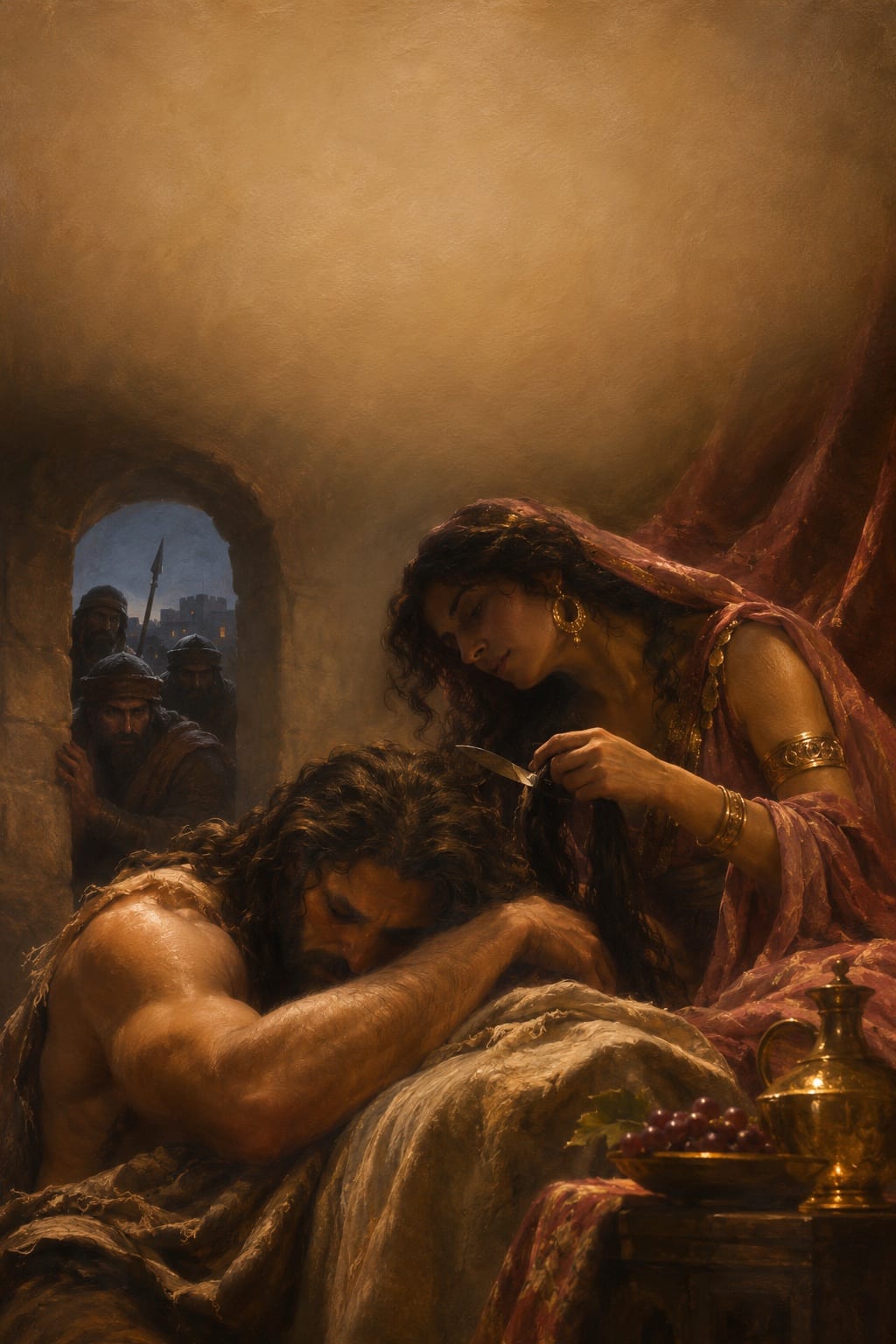
The Slow Unraveling: Samson and the Pattern Before the Fall
Judges 16:4-314 min
Samson's downfall wasn't a single dramatic betrayal — it was a pattern of returning to what he knew was dangerous, each visit eroding what God had given him. His story reveals how strength fades gradually, and how God still hears us after the unraveling.
Scripture
Judges 16:4-31
Key moment Judges 16:15-20
Read
Samson had already been here before. Different woman, same geography of the heart. By the time we reach Judges 16, this is a man whose pattern is well-worn: intensity, isolation, desire, compromise, escape. Repeat. What makes the Delilah episode so devastating is that Samson clearly knew what was happening. She asked him outright, three separate times, where his strength came from — and each time, enemies appeared from the next room to test his answer. There was no ambiguity. The trap was visible.
And yet he kept going back.
This is the detail the story refuses to let us skip over. Verse 16 says she pressed him daily with her words and urged him until his soul was vexed to death. The Hebrew word for "vexed" — qatsar — carries the sense of being shortened, cut down, exhausted at the deepest level. Samson didn't hand over his secret in a moment of passion. He handed it over because he was worn down. Depleted. The resistance he once had simply wasn't there anymore, because each previous visit had taken a little more from him than he realized.
The most haunting verse in the chapter is verse 20: "He did not know that the LORD had departed from him." This is what incremental compromise does. It doesn't announce itself. There's no alarm, no sudden darkness. Samson woke up and shook himself "as at other times" — he expected to operate on yesterday's strength. The erosion had been so gradual that the absence of God's power was invisible to him until it was tested.
But the story doesn't end in the dark. Judges 16:28 records Samson's prayer from captivity — blinded, humiliated, grinding grain in a Philistine prison. He calls out: "O Lord GOD, please remember me and please strengthen me only this once." And God heard him. The strength returned. Not because Samson had earned it back, but because God's mercy outlasts our patterns. The hair that had begun to grow back was never the real source — it was the sign of a relationship that God refused to permanently sever.
Today
The pattern Samson lived is recognizable to anyone who has struggled with habitual sin, especially the kind tied to the body. You know the cycle: a hard week at work drains you. You isolate, telling yourself you need space. The loneliness settles in alongside the fatigue, and suddenly the thing you'd resolved to leave behind feels close and available in a way that willpower, at that hour, can't match. You give in. You feel emptied afterward. You resolve again. And the cycle resets.
What Samson's story exposes is that the critical moment isn't the moment of compromise — it's everything before it. The unprocessed exhaustion. The isolation that masquerades as rest. The slow buildup of stress that never gets named aloud to anyone. By the time temptation arrives, you're already depleted, already "vexed to death," and the battle is mostly decided. This is why sheer willpower fails: it tries to fight at the last possible moment, when the real war was lost hours or days earlier.
Practical freedom starts upstream. It looks like learning your own pattern well enough to intervene early — noticing that after an intense season of work, you're especially vulnerable; that fatigue and isolation are not neutral states but active setup conditions. It means having at least one person who knows your actual struggle, not a cleaned-up version of it. And most importantly, it means understanding that dependence on the Spirit isn't a technique. It's a posture of honesty that says, I cannot white-knuckle my way through this, and I'm done pretending otherwise.
God heard Samson in the prison. He hears you in the aftermath. Every stumble is an invitation back to dependence — not evidence that you've been disqualified. The hair grows back. The relationship holds.
Pause
Take a slow breath.
Sit with what you've read.
Ponder
What are the specific conditions — emotional, physical, relational — that tend to precede your moments of compromise? Can you trace the pattern upstream?
Where in your life are you relying on yesterday's strength, assuming you can handle what has already proven dangerous?
What would it look like to let one trusted person into the real version of this struggle, not the version you've managed to make presentable?
Pray
A prayer
Father, God of patient mercy, You see the pattern I keep circling. You know the exhaustion that opens the door, the isolation I mistake for safety, the moments I shake myself expecting yesterday's strength. I confess that I have returned to places I knew were dangerous, believing I could manage what only You can hold. Let Your kingdom come in the hidden rooms of my life — the late hours, the depleted places, the silences where temptation speaks loudest. Give me today the honesty to name my triggers and the humility to let others in. I am done pretending willpower is enough. I need Your Spirit, not as a last resort but as my first breath. Strengthen me, Lord — not because I've earned it, but because Your mercy outlasts my patterns
Amen.
The hair grows back. The mercy holds.You are not disqualified. You are being drawn back to dependence — and that is grace.