The Tree You Were Never Meant to Understand
Genesis 2:8-176 min
In a garden full of yes, God speaks one no. The first test of human faithfulness is whether we will trust a command we do not fully understand.
Scripture
Genesis 2:8-17
Key moment Genesis 2:15-17
Read
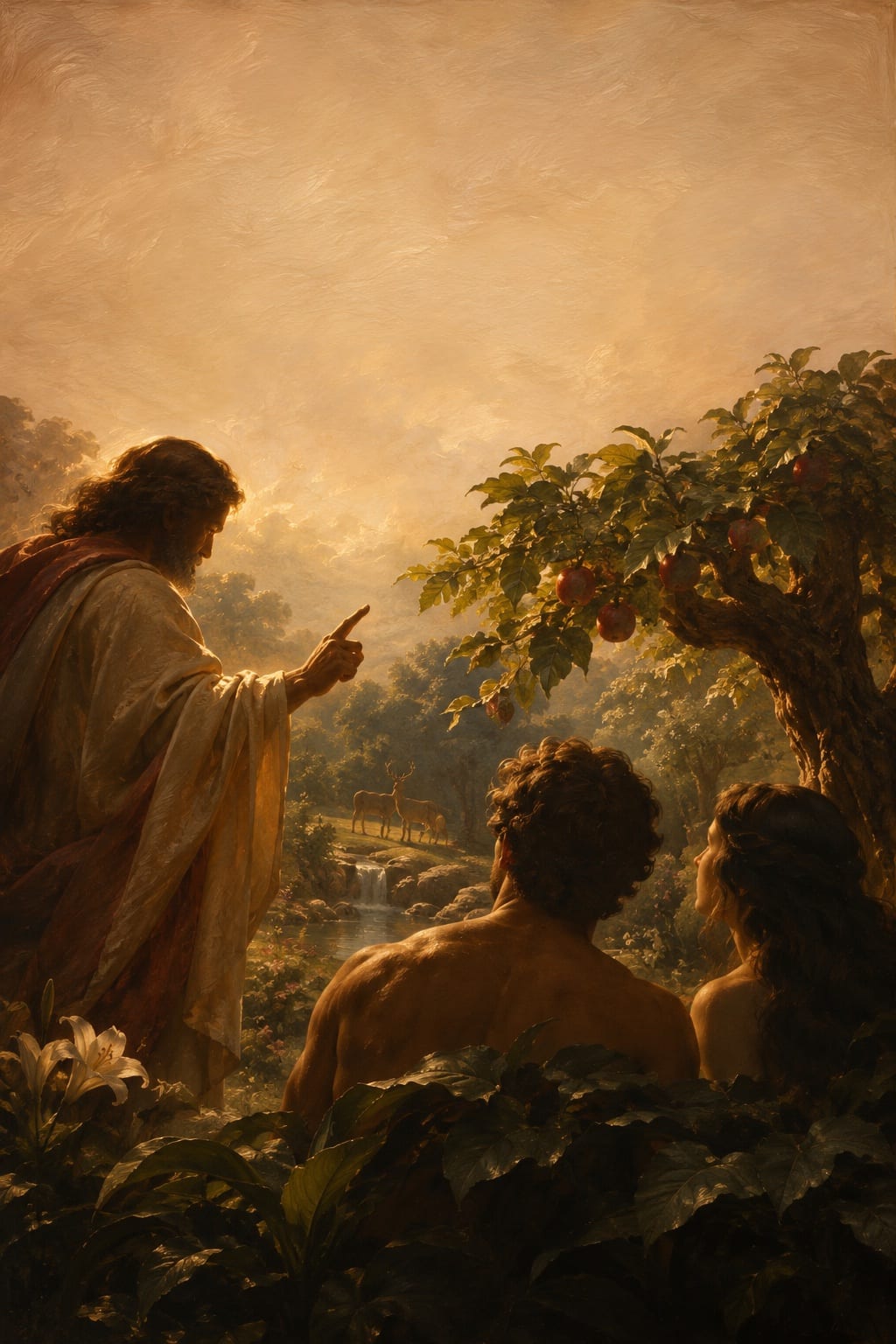
Imagine a garden so full of life that the ground itself seems to breathe. Rivers run through it in four directions. Fruit hangs heavy on every branch. The man God has formed from the dust stands in the middle of it, still learning what his own hands can do.
Into this abundance, God speaks. Not a rebuke. Not a warning about enemies. A vocation and a boundary.
The Lord God took the man and put him in the Garden of Eden to work it and take care of it. And the Lord God commanded the man, "You are free to eat from any tree in the garden; but you must not eat from the tree of the knowledge of good and evil, for when you eat from it you will certainly die."
-- Genesis 2:15-17
Notice the proportion. The freedom is vast, almost dizzying. Any tree. Every color, every flavor, every texture the Creator has dreamed into being. The prohibition is narrow, a single tree in a forest of yes.
And notice what God does not do. He does not explain. He does not lay out a philosophical argument about the nature of moral knowledge. He does not tell Adam why this particular tree, of all trees, carries death in its fruit. The command arrives bare, without scaffolding.
The Hebrew verb here, tsavah, means to charge, to commission, to entrust with an instruction. It is the same word used later when God charges Moses, when a father charges a son. It assumes relationship. A command like this is not the cold decree of a distant ruler; it is the careful word of someone who has already proven himself trustworthy by giving everything else.
Adam has known God only as provider. The breath in his lungs came from God's mouth. The garden beneath his feet was planted by God's hand. The animals he names were shaped by God's imagination. Every data point Adam has about God is gift, gift, gift. And then comes the single limit.
The tree is not evil. Scripture never calls it that. It is called the tree of the knowledge of good and evil, a tree that will teach something, but at a cost. God is not hiding something shameful behind a fence. He is asking Adam to believe that some knowledge is not yet his to carry, that a good Father sometimes says not this, not yet, trust me.
The test in the garden was never primarily about fruit. It was about whether the creature would trust the Creator when the Creator did not explain himself. Whether love and limit could coexist in Adam's mind. Whether a no from God could be received as part of his goodness, not a contradiction to it.
We know how the story turns. A voice will come and whisper that the limit is a lie, that God is withholding, that understanding must be seized rather than received. The tragedy of Eden is not that humanity wanted knowledge. It is that humanity stopped trusting the One who had given them everything else.
Today
Most of us will never stand in front of a literal tree. Our versions are quieter.
A conviction that will not lift, even though we cannot defend it logically to our friends. A door that closes when we were sure it should open. A scripture that sits uncomfortably against the shape of our lives. A season of waiting with no explanation attached. A calling that makes no sense on a spreadsheet.
In each of these, the old question returns. Will you trust a God who has not fully explained himself?
Our instinct, shaped by a culture that treats understanding as the price of obedience, is to demand the reasons first. We want the footnotes before we sign. We want to audit God's logic, weigh the evidence, and then decide whether his instruction deserves our yes. It feels responsible. It feels adult.
But the garden suggests something else. Trust was always meant to come before comprehension, because trust is built on character, not information. Adam did not need to understand the tree. He needed to remember who planted the garden.
Think about the people you actually trust in your own life. You do not require them to justify every request. You have watched them long enough to know their heart, and that knowing becomes a kind of shorthand. When they say don't go that way, you listen, even without the map.
God is inviting you into that kind of knowing. Not blind obedience, which is the caricature the enemy sells. Relational obedience, the kind that says, I have tasted your goodness in a thousand other places, so I can trust your no in this one. I have seen you provide, so I can trust you to withhold. I have watched you keep your word, so I can hold this instruction even when my understanding runs out.
There is a freedom on the other side of that trust that understanding alone cannot produce. The garden was never meant to be a place of full comprehension. It was meant to be a place of full communion. And communion, it turns out, does not require that you know everything. It only requires that you know Him.
Pause
Take a slow breath.
Sit with what you've read.
Ponder
Where in your life right now is God asking you to trust an instruction you do not fully understand?
What experiences of God's goodness could you lean on when his current word feels unexplained?
Is there a place where you have been demanding understanding as the price of your obedience, and what would it look like to loosen that grip?
Pray
A prayer
Father in the garden, Maker of every good tree, holy is your name, and holy is your wisdom, which reaches further than mine can follow. Let your kingdom come in the quiet places where I have been withholding my yes until you explain yourself. Let your will be done in me, especially where your will is a word I did not expect. I confess that I have often treated understanding as the currency of my trust. I have wanted the reasons before the surrender. Forgive me for forgetting how many trees in my life are gift, and how few are limit. Give me today the bread of trust, enough for this one step. Teach me to remember your character when I cannot trace your logic. Lead me away from the whisper that says your boundaries are cruelty, and deliver me into the freedom of a child who rests in a Father's word. I choose, in this moment, to believe that your no is as loving as your yes, and that communion with you is worth more than comprehension of you.
Amen.
Go gently into your garden.He has not forgotten to be good.