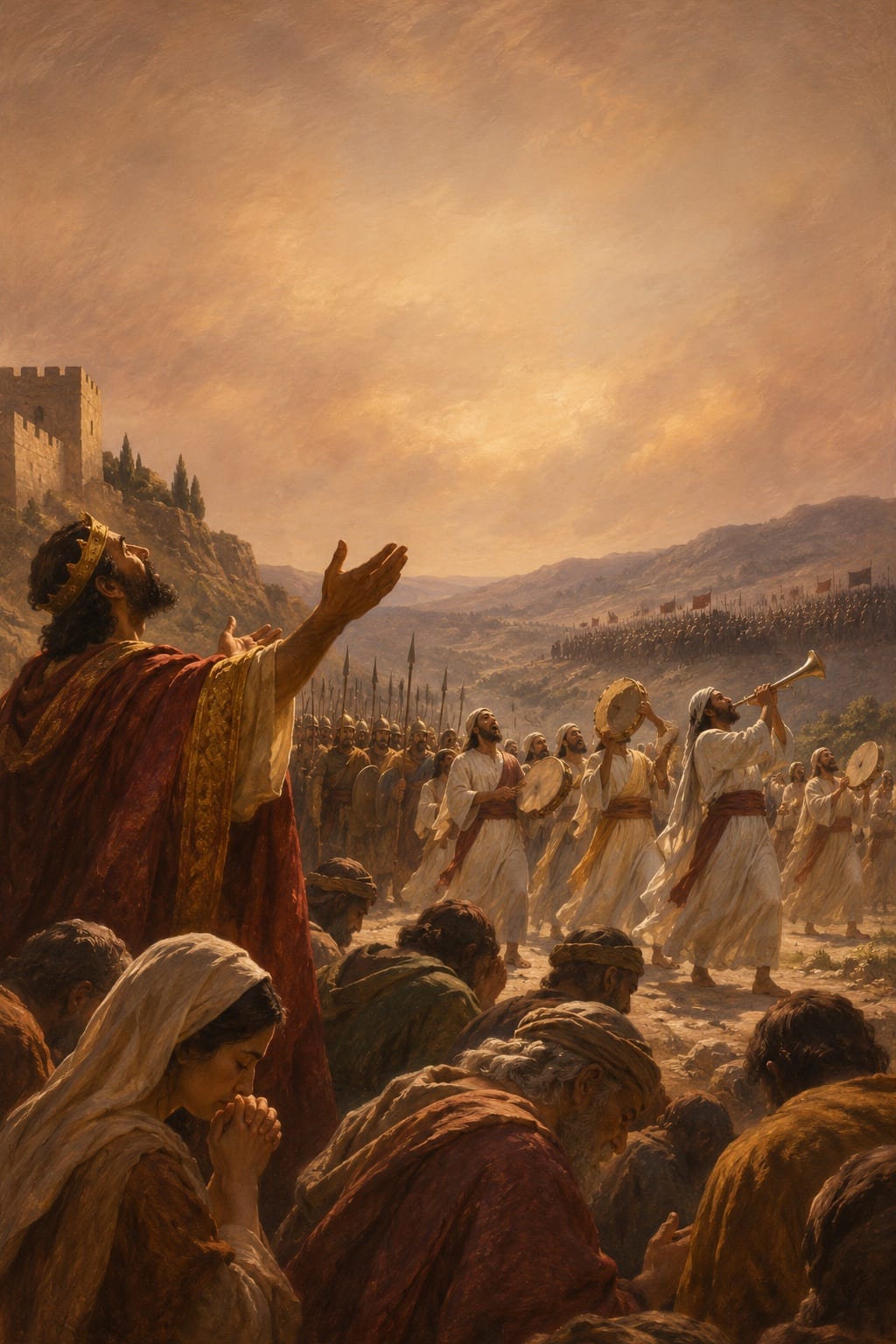
When the Choir Marched Before the Army
2 Chronicles 20:1-303 min
When King Jehoshaphat faced an overwhelming alliance of enemy armies, he didn't draft a military strategy — he called a fast, stood before his people in honest desperation, and watched God turn praise into a weapon more effective than any sword.
Scripture
2 Chronicles 20:1-30
Key moment 2 Chronicles 20:15-17
Read
Messengers arrived with the kind of news that collapses a room: a vast army — Moabites, Ammonites, Meunites — was already on the march, already close. The Hebrew word used for this coalition is hāmôn, a "multitude," a roaring mass. Jehoshaphat was afraid. The text doesn't soften that. It says he was alarmed. And then it says what he did with his alarm: he set his face to seek the Lord (v. 3).
His prayer in verses 6–12 is one of the rawest in all of Scripture. He rehearsed God's faithfulness, named his own powerlessness plainly — "We do not know what to do, but our eyes are on you" — and then he stopped talking. The whole nation stood there: men, women, children, infants. Waiting. Silence before God with no guaranteed answer.
Then the Spirit of the Lord fell on Jahaziel, a Levite buried deep in the genealogies, hardly a celebrity prophet. His message cut through the dread:
"Do not be afraid or discouraged because of this vast army. For the battle is not yours, but God's… You will not need to fight in this battle. Stand firm, hold your position, and see the salvation of the Lord on your behalf."
-- 2 Chronicles 20:15, 17
The next morning Jehoshaphat did something military advisors would have called insane. He appointed singers — not scouts, not archers — to walk ahead of the army, singing: "Give thanks to the Lord, for his steadfast love endures forever." As the praise began, the Lord set ambushes among the enemy forces, and they turned on each other until none remained. Israel never drew a sword. They spent three days gathering the plunder and named the place the Valley of Berakah — the Valley of Blessing.
Today
Most of us will never face a literal army, but we know the feeling of being surrounded. A diagnosis, a financial collapse, a relationship fracturing beyond what we can repair. The instinct is to strategize our way out — to stay up late running scenarios, to tighten our grip on every variable we can reach. Control feels like responsibility. Letting go feels like negligence.
Jehoshaphat's prayer offers a different posture. He didn't pretend confidence he didn't have. He told God the truth: I don't know what to do. That sentence, spoken honestly, is one of the most powerful prayers available to us. It's not resignation; it's redirection. It moves our eyes from the size of the problem to the presence of God.
The choir marching ahead of the army wasn't theater. It was theology in action — a declaration that God's character was more reliable than any defensive formation. Worship, in that moment, wasn't the absence of strategy. It was the strategy, because it placed the outcome back where it belonged: in God's hands.
When you feel outnumbered, you don't have to manufacture courage or engineer a solution from nothing. Sometimes the bravest thing you can do is stop moving, open your mouth in praise instead of panic, and let God handle what you cannot. The Valley of Blessing wasn't named for a battle Israel won. It was named for a battle God wouldn't let them fight.
Pause
Take a slow breath.
Sit with what you've read.
Ponder
What situation in your life right now feels like a vast army — something too large for your resources or wisdom to handle?
Where have you been gripping tightly for control when God may be asking you to stand still and watch Him work?
What would it look like, practically, to let worship replace strategy in the middle of your fear this week?
Pray
A prayer
Father, Lord of armies and Lord of the still, quiet valley — I come to You the way Jehoshaphat came: afraid and unsure what to do. My eyes are on You. Forgive me for the times I have trusted my own plans more than Your presence, for the nights I chose anxiety over surrender. Your kingdom does not depend on my striving. Fight for me where I cannot fight for myself, and give me the courage to sing before I see the victory. Let Your steadfast love be the ground I stand on today
Amen.
Stand still. He is already moving.The battle belongs to the Lord, and so do you.