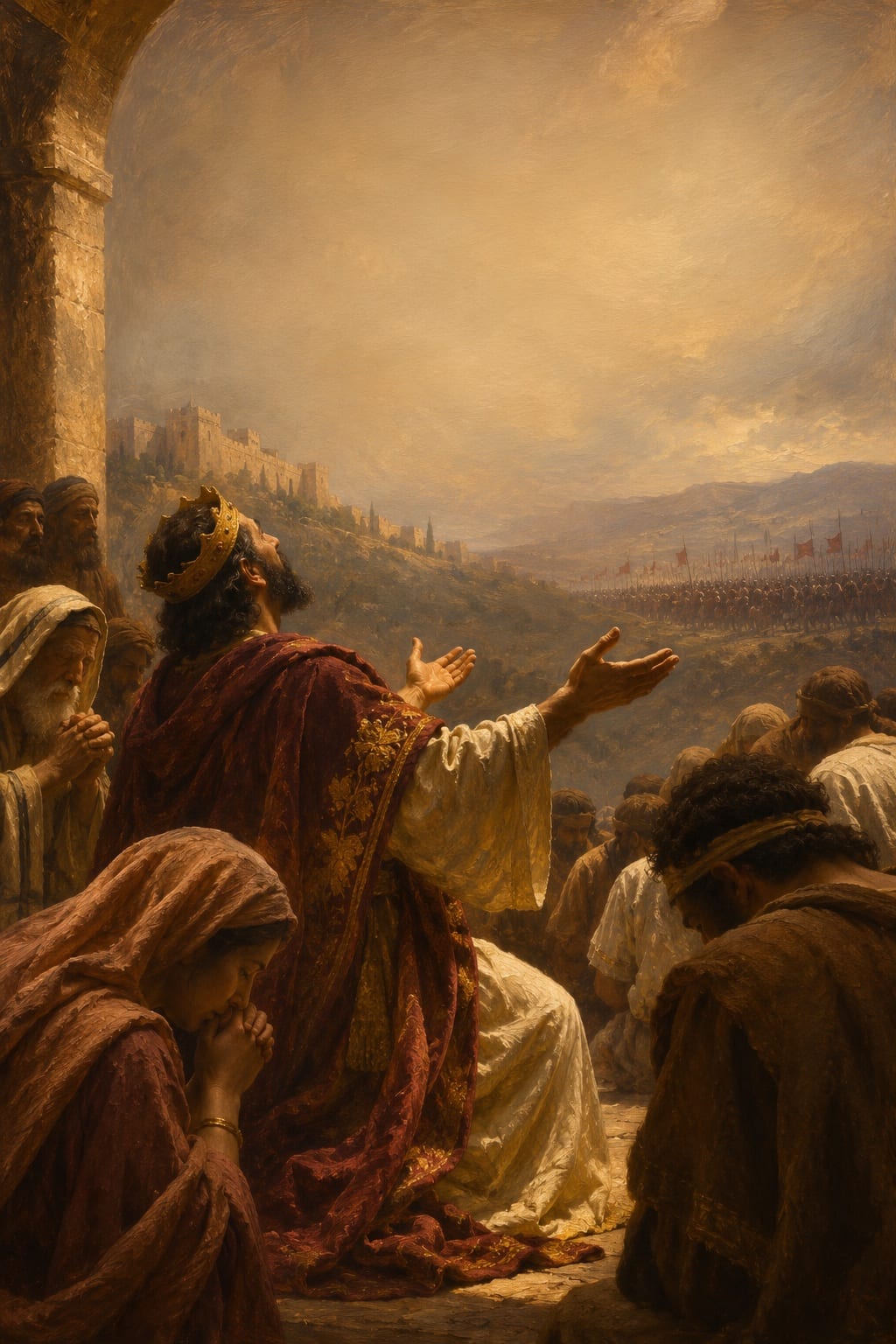
When the King Said He Didn't Know What to Do
2 Chronicles 20:1-224 min
When Jehoshaphat faced an army too large to fight, he did the one thing left to him: he told God the truth about his helplessness. What followed was a deliverance no battle plan could have produced.
Scripture
2 Chronicles 20:1-22
Key moment 2 Chronicles 20:12-17
Read
The messengers arrive with the kind of news that buckles knees. Three armies — Moab, Ammon, and a contingent from Mount Seir — are converging on Judah from the southeast. The numbers are staggering. Jehoshaphat is not a weak king or a faithless one, but the text says plainly that he was afraid. Fear is where this story begins, and the narrative does not flinch from it.
What Jehoshaphat does next is remarkable not for its eloquence but for its raw honesty. He calls a national fast. He gathers the people — men, women, children, infants — in the temple court. And he prays a prayer that every person who has ever reached the end of their competence will recognize. He begins by recounting who God is and what God has done. Then he arrives at the sentence that cracks everything open: "We do not know what to do, but our eyes are on you" (2 Chronicles 20:12). No strategy. No backup plan dressed in spiritual language. Just the admission that he is out of options and the decision about where to point his gaze.
God answers through Jahaziel, a Levite standing somewhere in the crowd, and the word he delivers is strange and specific: "Do not be afraid or discouraged because of this vast army. For the battle is not yours, but God's… You will not have to fight this battle. Take up your positions; stand firm and see the deliverance the Lord will give you" (20:15-17). The next morning Jehoshaphat does something no military commander would endorse. He appoints singers — not soldiers — to lead the march. Worship goes out ahead of the army. And as they begin to sing, God sets ambushes among the invading forces. The three armies turn on each other. By the time Judah arrives at the overlook, the valley is full of bodies and plunder, and not a single sword in Judah has been drawn.
Today
Most of us are not facing literal armies, but the feeling Jehoshaphat had is familiar enough: the convergence of pressures that outmatch our resources. Financial strain compounding with relational fracture compounding with a health scare, all arriving in the same terrible week. Our instinct is to strategize harder, to work the problem, to stay up late scrolling for solutions. And sometimes that instinct serves us. But there are seasons when the gap between what we face and what we can do about it becomes unbridgeable, and the most courageous thing available is Jehoshaphat's prayer: I don't know what to do, but I'm looking at you.
Notice what Jehoshaphat did not do. He did not pretend the threat was smaller than it was. He did not manufacture false confidence. He also did not collapse into passivity. He gathered the people, he fasted, he prayed, and then he showed up the next morning ready to walk toward the valley. Surrender was not resignation; it was redirection. He moved his trust from his own capacity to God's character.
The singers going ahead of the army is the detail that lingers. Worship preceded deliverance. Before there was any evidence that the situation would change, the people opened their mouths and praised. That is not denial — it is the posture of a people who have decided that who God is matters more than what they can see. And God moved in the space their honesty and worship created. The striving stopped, and something far larger took its place.
Pause
Take a slow breath.
Sit with what you've read.
Ponder
Where in your life right now are you carrying a problem that has outgrown your ability to solve it — and what would it look like to say so out loud to God?
What would it mean for you to 'appoint singers' before seeing any change — to let worship or trust lead ahead of your strategy?
Is there a difference between the helplessness you feel and the helplessness you're willing to admit? What keeps the gap open?
Pray
A prayer
Father, Lord of armies and Lord of the quiet valley where You fight on our behalf — we come like Jehoshaphat, afraid and honest about what we face. We confess that we have tried to outwork, outthink, and outlast things that were never ours to defeat alone. Forgive us for believing that admitting weakness is the same as losing. Teach us to stand firm, to look at You instead of the odds, and to let praise leave our mouths before proof reaches our eyes. Your kingdom come in the very places where our strategies have run out. We trust You with the battle we cannot win.
Amen.
The battle belongs to Him.Your honesty is not weakness — it is the door God walks through.