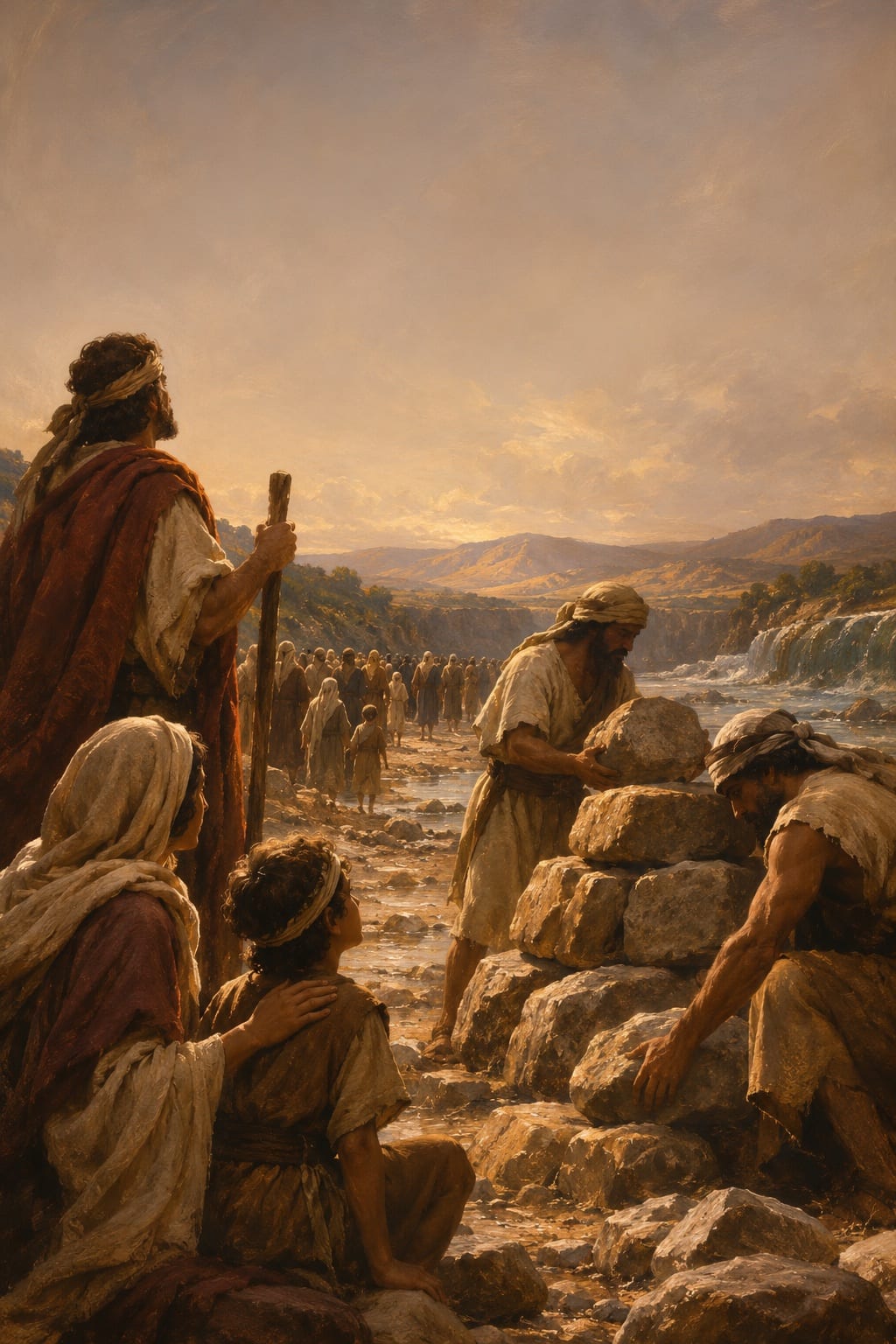
Twelve Stones from the River That Stopped
Joshua 4:1-94 min
When God parted the Jordan River, He told the Israelites to carry stones from its bed and stack them on the far side — a monument built not for Him, but for the forgetful hearts of His people and the curious questions of their children.
Scripture
Joshua 4:1-9
Key moment Joshua 4:6-7
Read
The river was at flood stage. That detail matters more than we sometimes let it. Joshua 3:15 tells us the Jordan was overflowing its banks — harvest season swelling it wide and fast. This was not a gentle stream the Israelites could wade through with their robes hitched up. It was a barrier, the kind that makes a nation stand at the edge and wonder if the promise on the other side was real.
Then the priests stepped in carrying the ark, and the waters heaped up in a wall upstream. The entire nation walked across on dry ground — men, women, children, livestock, everything they owned passing over the riverbed while the current waited. But before anyone climbed the western bank, God gave a strange instruction. One man from each tribe was to go back to the middle of the channel, find a stone, hoist it onto his shoulder, and carry it out.
Twelve men. Twelve stones. Heavy, river-smoothed, ordinary rocks pulled from the place where their feet had stood on what should have been a flooded riverbed. Joshua stacked them at Gilgal, and he told the people why: "When your children ask in time to come, 'What do those stones mean to you?' then you shall tell them that the waters of the Jordan were cut off before the ark of the covenant of the LORD" (Joshua 4:6-7). The stones were not for God's memory. They were for ours.
There is something tender in a God who knows His people will forget. He does not scold them for it in advance; He simply provides a remedy. A pile of river rocks, unremarkable to any traveler who didn't know the story, became an altar of remembrance. Each stone carried the weight of one tribe's testimony. Together they formed a single witness: the God who parted the sea for your parents has parted the river for you. He is still the same.
Today
We rarely build physical monuments, but we still need them. The human heart drifts. Seasons of deliverance that once brought us to our knees can fade into background noise within a few years, replaced by newer anxieties that feel more urgent than yesterday's miracles. God knows this about us, and rather than being offended, He invites us to mark the ground.
A memorial of gratitude can be as simple as writing down a date and what happened — the diagnosis that reversed, the relationship that healed, the provision that arrived on the last possible day. It can be a prayer journal entry or a conversation repeated at the dinner table until your children groan because they've heard it before. The point is not elegance. The point is that when the next flood-stage river appears on your horizon, you have stones to look back at.
Notice that Joshua's stones came from the middle of the impossible place. They weren't gathered from safe ground. The men had to walk back into the riverbed to retrieve them. Sometimes remembering requires us to revisit the place that frightened us most and recognize that we stood there, dry-footed, because God held the waters back. That revisiting is not reliving trauma; it is testifying to deliverance.
If you are standing at the edge of something that looks impassable today, take a breath. Look behind you. Count the crossings you've already made. The God who stopped the Jordan did not stop being faithful when you stopped noticing.
Pause
Take a slow breath.
Sit with what you've read.
Ponder
What is one crossing in your life — a season where the way forward seemed impossible — that you've allowed to fade from active memory?
If your children or someone younger asked you, 'What do those stones mean?' what story of God's faithfulness would you want to be ready to tell?
What would it look like for you to build a tangible memorial this week — something you can return to when the next river rises?
Pray
A prayer
Father of faithfulness, the One who holds back waters and holds together the fragile memories of Your people — I confess that I forget. Good gifts settle into routine, and deliverance hardens into distant history. Forgive me for the crossings I've stopped celebrating. Help me carry stones from the middle of my impossible places and set them where I can see them. Let my remembering become worship, and let my worship become testimony for anyone who asks what those stones mean. Your kingdom come in my memory as it does in my future.
Amen.
Go, and carry your stones.The river remembers what it did for you. Let yourself remember too.