Twelve Wet Stones on Dry Ground
Joshua 4:1-94 min
After God parts the Jordan River, He commands Israel to stack twelve dripping stones on the bank — not as decoration, but as a prompt for every future child who would ask, 'What do these stones mean?'
Scripture
Joshua 4:1-9
Key moment Joshua 4:6-7
Read
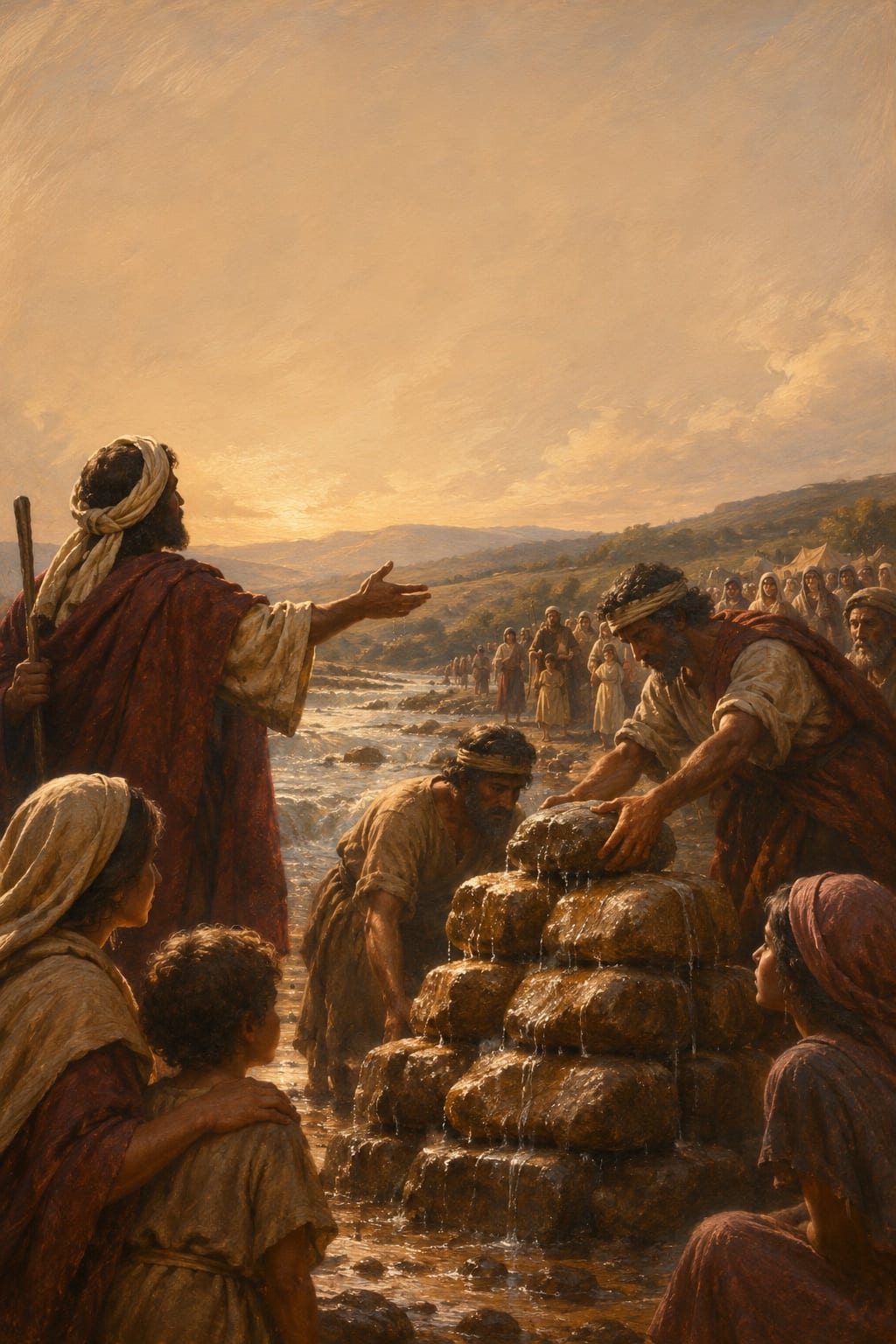
The priests' feet were still wet when God interrupted the celebration. The nation had just walked through the Jordan on dry ground — the riverbed cracked and dusty beneath a million sandals, walls of water held back by nothing visible. You'd think the next order would be to march, to strategize, to scout the land they'd waited forty years to enter. Instead, God said: go back. Twelve men, one from each tribe, wading into the place where the river had stopped. Pick up a stone. Carry it on your shoulder.
This wasn't ceremonial pageantry. These were heavy, river-slick rocks hauled from the middle of a miracle. God was specific — from the middle of the Jordan, from the very place where the priests' feet stood firm (Joshua 4:3). The stones had to come from the impossible spot, the place that should have been underwater. Each one was evidence. Each one had been submerged that morning.
What's striking is the reason God gives. He doesn't say "so you will remember." He says, "When your children ask in time to come, 'What do those stones mean to you?' then you shall tell them" (Joshua 4:6-7). The memorial was built for a conversation that hadn't happened yet — for children not yet born, for questions not yet asked. God designed the monument to provoke curiosity. He wanted future generations to point and wonder, and He wanted parents to have something concrete to gesture toward when they said, "Let me tell you what God did here."
Joshua stacked the stones at Gilgal, and he placed another set in the middle of the Jordan itself — a hidden monument no one would see once the waters returned. Some memorials are public; some are between you and God alone. Both matter. The visible pile said, God brought us through. The hidden one said, I was standing right here when He did it.
Today
Most of us don't forget God in a single dramatic moment of rebellion. We forget slowly. The months accumulate, the crisis passes, health returns, the job stabilizes, and the memory of how desperate we were — and how faithful God proved — fades into background noise. We stop telling the story because it no longer feels urgent.
That's exactly why God told Israel to pick up rocks. He knew the human heart drifts. He built a physical interruption into the landscape, something a child could trip over and ask about. The stones didn't do anything. They just sat there, heavy and obvious, refusing to let the story disappear.
You have a crossing. Maybe it was a diagnosis that didn't end the way the doctors predicted. A marriage that should have collapsed. A night you cried out and something shifted — inside you, around you, or both. The question isn't whether God showed up; it's whether you've marked the spot. A journal entry. A date you return to each year. A conversation you keep having with your kids or your friends, not because you enjoy the spotlight but because the story doesn't belong to you alone. Someone in your life needs to hear that the river stopped.
The stones at Gilgal weren't polished or engraved. They were rough, ordinary rocks made extraordinary by where they'd been. Your memorial doesn't need to be eloquent. It just needs to be honest, and it needs to stay where you can find it.
Pause
Take a slow breath.
Sit with what you've read.
Ponder
What is one moment where God's faithfulness became undeniable to you — and when was the last time you told someone about it?
What 'stone' could you set up this week as a tangible reminder of something God has done?
If a child or someone younger in faith asked you, 'What does that mean to you?' — what story would you tell?
Pray
A prayer
Father of faithfulness, You who parted the waters and held back the river — forgive me for the crossings I've let fade from memory. Your works deserve more than a passing thought. Teach me to mark the places where You met me. Give me the courage to tell the story out loud, even when my voice shakes, even when it's been years. Let my remembering become someone else's reason to trust You. May the stones I set down outlast my own forgetting.
Amen.
Go and set your stone.The river remembers. Make sure you do, too.