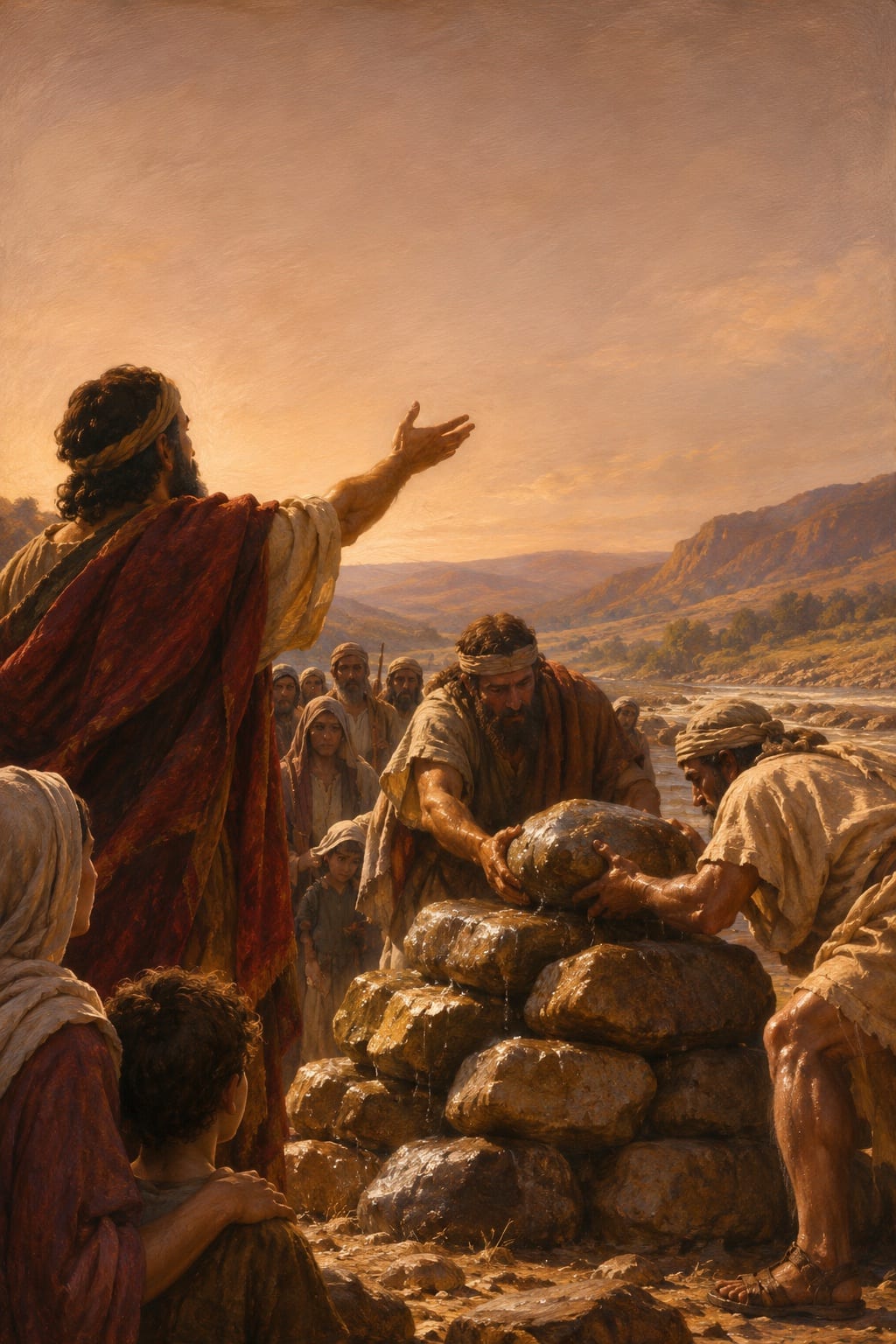
Twelve Wet Stones on Dry Ground
Joshua 4:1-94 min
After Israel crosses the Jordan on dry ground, God commands them to stack twelve stones from the riverbed—not as decoration, but as a deliberate act of remembrance, because human memory is fragile and God's faithfulness deserves a monument.
Scripture
Joshua 4:1-9
Key moment Joshua 4:6-7
Read
The crossing is finished. The riverbed is still damp under their sandals, the walls of water have barely collapsed back into place, and already God is giving a new instruction. Not "march forward." Not "prepare for battle." Instead: go back. Walk into the place you just came through, pick up a stone, and carry it on your shoulder.
This is a strange errand for a nation standing on the edge of conquest. Twelve men, one from each tribe, wading back into the Jordan to retrieve rocks—ordinary, river-smooth, heavy with water. Joshua tells them plainly why: "When your children ask in time to come, 'What do those stones mean to you?' then you shall tell them that the waters of the Jordan were cut off" (Joshua 4:6-7). The Hebrew word for "memorial" here is zikkaron, something placed deliberately in the path of forgetting. God doesn't need the monument. He was the one who parted the river. The stones are for Israel, whose memory would prove far less reliable than the current they'd just walked through.
Notice the physicality of the command. God didn't say "write this down" or "remember in your hearts." He said carry something heavy on your shoulder. Let it strain your muscles. Stack it where people will trip over it and ask questions. The weight was the point; it pressed the moment into their bodies before their minds could smooth it into abstraction.
Joshua set the stones up at Gilgal, and he also placed twelve in the middle of the Jordan itself—stones no one would see once the water returned. A hidden altar under the current, known only to God and those who were there. Some memorials are public testimony; others are private markers between you and the God who made a way.
Today
We don't forget God's faithfulness all at once. It erodes gradually, the way a riverbank loses inches to a slow current. A hard diagnosis comes, a relationship fractures, a season stretches longer than expected, and the certainty we felt six months ago feels like something that happened to a different person. We don't mean to forget. We just do.
This is why the command in Joshua 4 is so practical. God wasn't asking for poetry or theology. He was asking for stones—blunt, heavy, impossible to ignore. The question for us isn't whether God has been faithful; if we're honest, we can name at least one crossing, one moment the ground held when it shouldn't have. The question is whether we've built anything to mark it. A journal entry. A date circled on a calendar. A prayer we return to. A conversation we revisit with someone who was there.
The stones weren't only for the generation that crossed. They were for the children who would grow up seeing a strange pile of rocks near Gilgal and asking, "What do those mean?" Remembrance has a forward face. When you mark what God has done, you give the next hard season something concrete to stand on. You give the people around you a reason to ask. And when the next wilderness appears—because it will—you won't have to manufacture faith from nothing. You'll walk back to the pile and put your hand on something solid.
Pause
Take a slow breath.
Sit with what you've read.
Ponder
What is one moment of God's faithfulness that you've never deliberately marked or memorialized—and what would it look like to do so?
When uncertainty last crept in, did you have a 'stone pile' to return to, or were you trying to remember from scratch?
Who in your life needs to hear about a crossing God brought you through?
Pray
A prayer
Father of every deliverance, the God who dried the Jordan and held the ground firm beneath uncertain feet—I confess that my memory is shorter than Your faithfulness. You have carried me through passages I could not navigate alone, and too often I have walked on without marking the place. Teach me to build altars where You have met me. Give me the honesty to return to those stones when fear tells me the next river is too wide. Let my remembering become testimony, and let my testimony steady the ones who come after me. I trust that the same hand that parted the waters behind me goes ahead of me into whatever is next.
Amen.
Stack the stones.You have more crossings behind you than you remember. Let them speak.