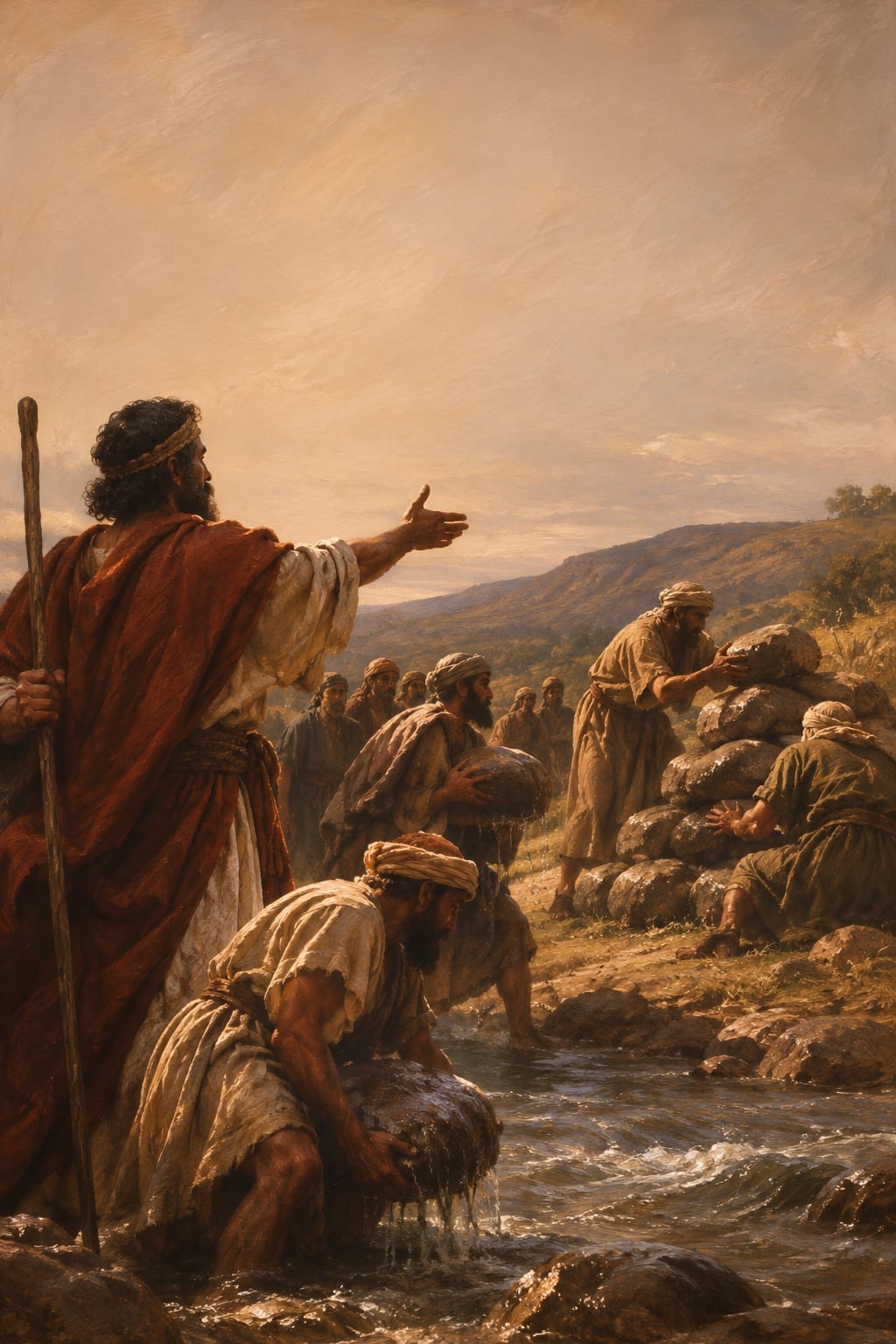
Twelve Wet Stones on Dry Ground
Joshua 4:1-243 min
After Israel crosses the Jordan on dry ground, God commands twelve men to haul ordinary river stones onto the bank and stack them at Gilgal — a rough-hewn monument whose only power is the story it carries.
Scripture
Joshua 4:1-24
Key moment Joshua 4:6-7
Read
The priests' feet were still wet when the command came. Not "celebrate," not "press on toward Jericho" — but go back into the riverbed and pick up stones. Twelve men, one from each tribe, bending down where the Jordan had been rolling minutes before, hoisting dripping rocks onto their shoulders. It must have looked strange: a nation delivered by miracle, and the first order of business is manual labor with river stones.
God's instructions were oddly specific. Not carved pillars. Not gold. Stones from the middle of the crossing itself, from the place where the priests' feet held the water at bay. The Hebrew word for memorial here is zikkaron — a physical trigger for communal memory. God knew something about His people: they would forget. Not out of malice, but because the human heart metabolizes wonder faster than it should. The stones were a hedge against amnesia.
Joshua 4:6 gives us the purpose in a single line: "When your children ask in time to come, 'What do those stones mean to you?'" The monument was built for a conversation that hadn't happened yet, for children not yet born, for a question God was already anticipating. The stones themselves were unremarkable — smoothed by current, grey-brown, ordinary. What made them sacred was placement and story. Picked up from impossible dry ground, carried on human shoulders, stacked where families would pass for generations.
The chapter closes with a sweeping declaration: "so that all the peoples of the earth may know that the hand of the LORD is mighty, that you may fear the LORD your God forever." A pile of rocks beside the road, doing the work of a cathedral. Ordinary material, extraordinary assignment.
Today
We rarely stack stones, but we carry memorials whether we name them or not. A journal entry from a dark season's turning point. The phone call that came on the day the money ran out. A friendship that arrived precisely when isolation had almost won. These moments sit in our memory like river stones — easy to walk past, easy to forget, unless we deliberately set them upright and let them mean something.
The discipline God asked of Israel wasn't poetic; it was physical and inconvenient. Go back into the riverbed. Lift something heavy. Carry it to where people will see it. Remembrance costs effort because forgetting is the default. When we pause to name a specific moment of God's faithfulness — not a vague "God is good" but a dated, placed, particular mercy — we're stacking our own Gilgal.
What shifts when we do this is not the past but our posture toward the future. The Jordan crossing came right before Jericho, right before the long, uncertain campaign for a promised land. The stones weren't a retirement gift; they were a forward-facing act. Israel needed to remember what God had already done because the hardest work was still ahead. Naming God's faithfulness in our past doesn't guarantee ease, but it recalibrates our expectation: the God who parted water is the God who walks with us into whatever Jericho comes next.
Pause
Take a slow breath.
Sit with what you've read.
Ponder
What is one specific moment of God's provision or deliverance you can point to — something dated and placed, not just a general feeling?
Where in your life right now do you need the confidence that comes from remembering what God has already done?
Who in your life needs to hear the story behind one of your 'stones'?
Pray
A prayer
Father of Israel, God who dries riverbeds and remembers every promise You have spoken — I confess that I forget too quickly. The wonders of last year grow dim under the pressure of this week. Teach me the discipline of remembrance. Help me go back into the riverbed of my own story and name the places where You met me. Stack those memories into something sturdy enough to steady my children and my own wavering heart. Let me carry what You have done into whatever I face next, trusting that Your hand is as mighty today as it was then. Your kingdom come, Your will be done — in the land ahead of me as surely as in the land behind
Amen.
Stack the stones. Tell the story.He who parted the waters walks with you still.